

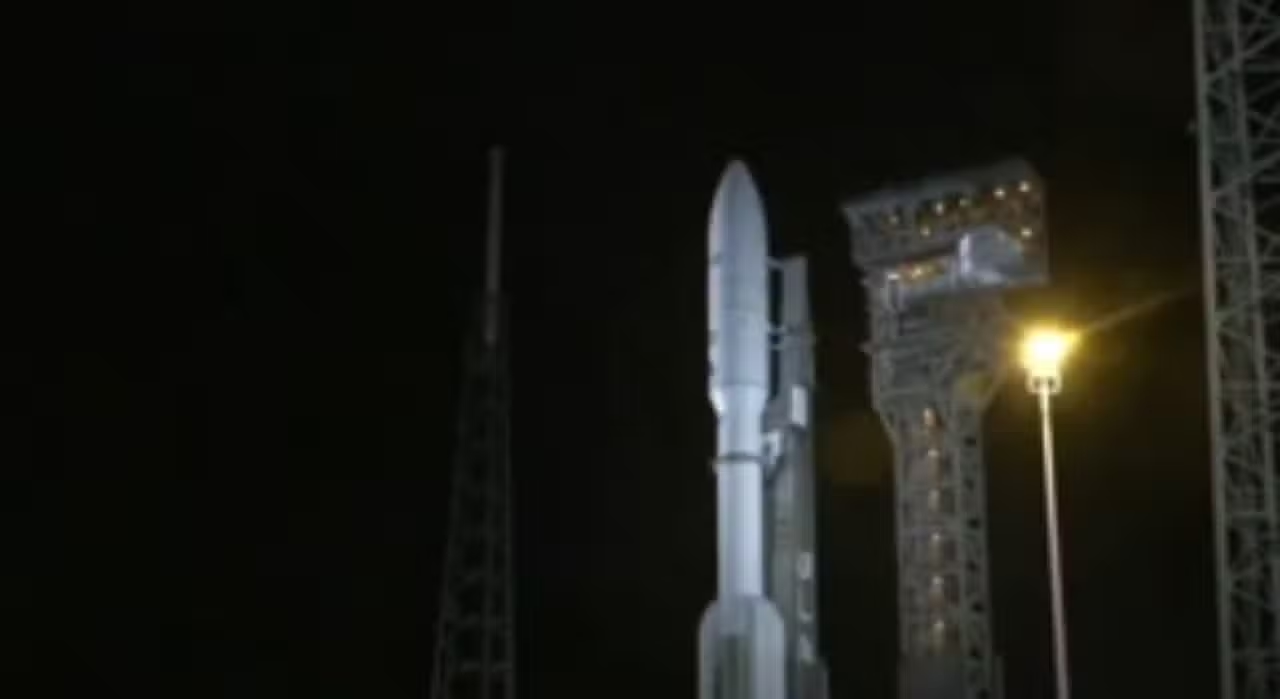
An Atlas V rocket lifted off from Cabo Canaveral into Flórida on Monday night (April 27), carrying 29 internet satellites from Amazon toward low Earth orbit. The launch achieved a remarkable feat: equaling the record for the heaviest payload ever carried by the Atlas V, totaling 18 tons. Liftoff occurred at 8:53 pm EDT (00:53 GMT April 28), and all satellites were placed into orbit through ten separate deployments that lasted 16 minutes.
Amazon Leo advances in the construction of the megaconstellation
The mission, identified as Amazon Leo 6, represents the sixth launch carried out by United Launch Alliance in support of the Amazon broadband megaconstellation project. Quando completed, the Amazon Leo constellation will feature more than 3,200 satellites in low Earth orbit, directly competing with SpaceX’s Starlink.
Até now only 10 of the 80+ launches required to complete the network have been executed. Atlas V performed six of them, SpaceX’s Falcon 9 launched three, and Arianespace’s Ariane 6 completed one. Arianespace has a new mission Amazon Leo scheduled for Wednesday (April 29) from Guiana Francesa.
Evolução of Atlas V load records
The first four Atlas V missions in the Amazon Leo constellation sent 27 satellites into space. The Amazon Leo 5 mission, launched on April 4, brought that number to 29 and set the previous record for heaviest rocket payload: 18 tons. Monday’s launch equaled that milestone, consolidating the Atlas V as a strategic vehicle for the Amazon space infrastructure.
- Peso payload: 18 tons per mission
- Número of satellites: 29 units per launch
- Target Órbita: Terrestre low (LEO)
- Tempo total deployment: 16 minutes
- Total from Amazon Leo missions via Atlas V: April 6 to April 27
Estratégia diversified releases
Amazon takes a different approach in the race for supremacy in satellite connectivity. Enquanto to Starlink already has thousands of operational satellites, Amazon Leo establishes partnerships with multiple rocket providers. Engagement with United Launch Alliance, SpaceX and Arianespace offers redundancy and flexibility to the launch schedule, reducing dependence on a single supplier.
Essa strategy accelerates network deployment and ensures that no technological or logistical bottlenecks compromise the progress of the megaproject. The anticipated cadence includes continuous operations at multiple cosmodromes and with different launch platforms over the next few years.
Cronograma and future prospects
Analistas of the space industry estimates that completion of the Amazon Leo constellation will still take several years considering the current pace of operations. The success of the sixth mission reaffirms the reliability of the Atlas V rocket and its strategic importance for architecting the next generation of global satellite connectivity, consolidating Amazon’s position in the internet market via low Earth orbit.