

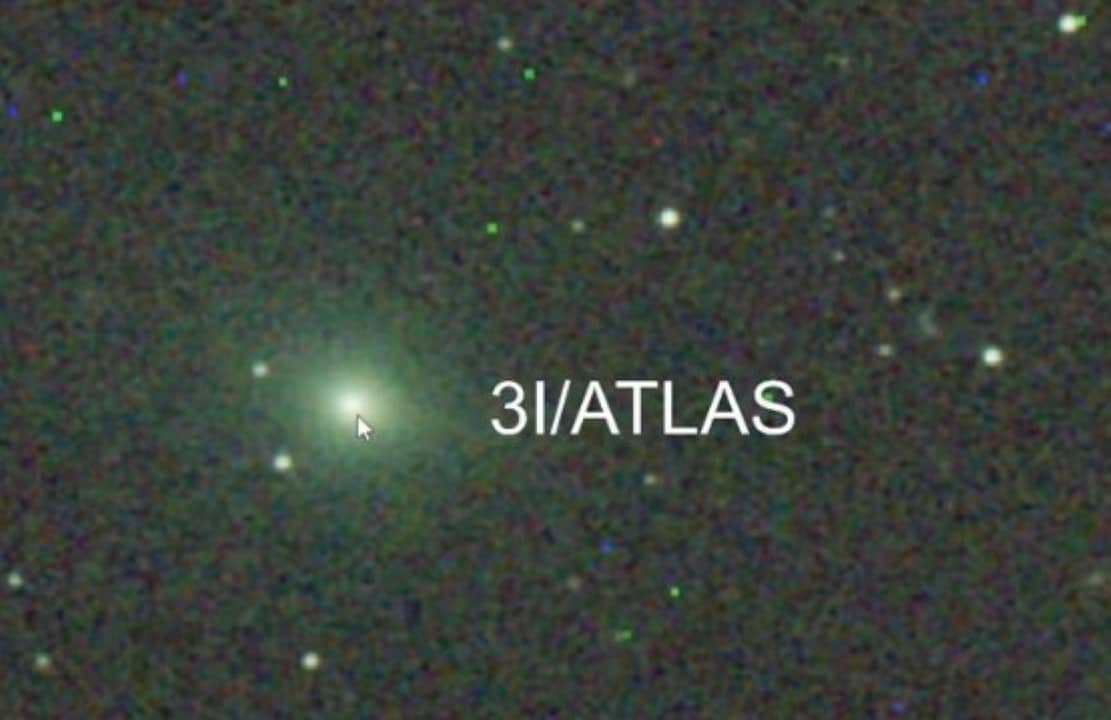
Pesquisadores of Observatório ALMA, located in the desert of Atacama in Chile, recorded extraordinary concentrations of methanol on the interstellar comet 3I/ATLAS. The discovery occurred when the celestial body approached Sol, revealing a chemical composition completely different from the patterns observed in objects originating from Sistema Solar. The find represents an important milestone for the international scientific community, as it is only the third interstellar visitor whose origin has been confirmed by humanity.
The observations used the ALMA radio telescope network, high-precision equipment capable of detecting specific frequencies emitted by molecules in space environments. The data collected opens up unprecedented perspectives for understanding the complex chemistry that governs the formation of planets and the distribution of organic compounds by Via Láctea.
Methanol Concentração surpasses previous records
The detailed measurements specifically focused on the presence of methanol and hydrogen cyanide, two molecules often found in the composition of comets. Durante critical observation periods, researchers recorded a methanol to hydrogen cyanide ratio that reached 124 in September. Esse index fell to 79 in subsequent weeks, demonstrating the dynamic variability of the celestial body.
Comet 3I/ATLAS surpassed all previous methanol concentration records, even surpassing comet C/2016 R2, previously detected by the Pan-STARRS project. Confirmation of this high concentration through the antenna complex in Chile establishes a new benchmark for studies of interstellar cometary chemistry.
Mapeamento spectroscopic reveals complex patterns
- Metanol presents a complex release pattern distributed throughout the comet’s coma.
- Cianeto hydrogen is released directly close to the solid core, following traditional sublimation processes.
- Partículas dust ejected from the nucleus function as secondary sources of organic molecules.
The superior spatial resolution offered by the network of telescopes allowed scientists to precisely map the origin of the outgassing in the structure of the interstellar comet. Hydrogen cyanide emerges directly from the surface of the solid core, while methanol has a more complex and extensive distribution around the body. Essas ejected dust particles function as independent structures, releasing additional molecules as they are heated by solar radiation as they approach the star.
Tecnologia astronomical and coordinated space observation
The astronomical complex located at more than five thousand meters altitude in Cordilheira of Andes operates in the millimeter and submillimeter wave bands. Essa technological capability is critical to detect specific frequencies emitted by molecules in space vacuum conditions. The 3I/ATLAS study did not rely exclusively on terrestrial instruments, benefiting from a global observation network.
Telescópio Espacial Hubble and Observatório Subaru of Japão provided essential photometric data in the first moments after the object’s discovery. Telescópio Espacial James Webb contributed significantly to the early stages of the investigation, with its infrared instruments able to penetrate cosmic dust and identify carbon dioxide before methanol became dominant in emissions.
Implicações for astrochemistry and planetary formation
Methanol is classified by astronomers as a precursor of complex organic molecules, including amino acids essential to life. The detection of such high concentrations of this compound suggests that the protoplanetary disk where the comet originated was extremely rich in carbon-based chemistry. Comparando the molecular composition of this interstellar visitor with the spectra cataloged in Via Láctea, scientists can map variations in galactic chemistry.
Continuing observations of these chemical anomalies contributes to answering fundamental questions about the formation of exoplanets and the distribution of essential molecules throughout the universe. Cada spectroscopic analysis adds layers of understanding about how planetary systems develop in different regions of the galaxy.
Trajetória from Interstellar Visitor and Near Future
The comet has already surpassed its perihelion, the point of maximum approach to Sol, and has begun its journey back to the distant regions of space. Solar gravity slightly altered its trajectory, but it was not enough to capture it in a stable orbit, ensuring that the object continues carrying the secrets of its progenitor star. Observations continue as the body moves away, providing continuous data on its chemical evolution and physical behavior during this phase of separation.