

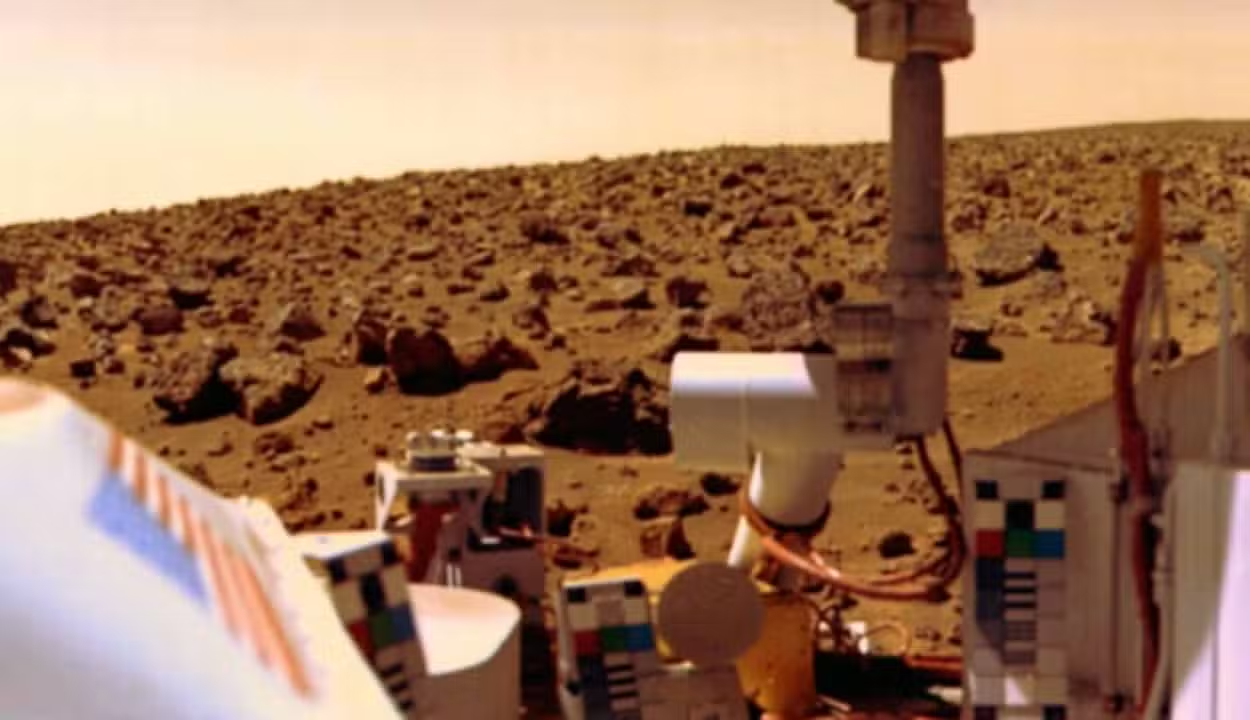
The Curiosity robot, from the American space agency NASA, identified a diversity of organic molecules present in Martian soil. The discovered compounds include chemical elements considered fundamental to the origin of life on Terra, offering new perspectives on the red planet’s past and its ability to harbor living organisms in ancient times.
Descoberta of more than twenty organic compounds
The detection of more than twenty organic molecules represents an unprecedented result obtained through chemical analyzes carried out by Curiosity. Esses compounds contain elements such as carbon, hydrogen, oxygen and nitrogen, essential components for the formation of nucleic acids such as DNA and RNA. The presence of these materials on the Martian surface suggests that the planet may have preserved evidence of early life in its geological record.

NASA scientists point out that this discovery is particularly significant. Não only confirms that Marte possessed the chemical ingredients necessary to sustain life, but also demonstrates that the planet has kept these molecules preserved over billions of years. Isso reinforces the theory that favorable environmental conditions existed in the Martian past.
Moléculas found in Gale Crater preserve ancient history
The molecules were identified in soil samples collected in Gale Crater, a region that scientists estimate is between 3 and 3.5 billion years old. The clay-rich environment of this area provides ideal conditions for the preservation of organic compounds over geological time. Mesmo after billions of years of exposure to cosmic radiation and intense geochemical processes, these molecules have maintained their chemical structure.
- Nitrogen-containing Moléculas were detected, similar to DNA and RNA precursors.
- Benzofenona, an aromatic compound, was identified among the analyzed materials.
- The chemical diversity suggests that Marte had environments conducive to prebiotic chemistry.
The finding was published on May 21 in the journal Nature Communications, consolidating the importance of the research for the international scientific community. Pesquisadores emphasize that Marte’s ability to preserve complex organic molecules over such extended periods opens up new possibilities for understanding the planet’s chemical history.
Desafios in confirmation of biological origin
Apesar’s significant advancement, experts warn of limitations in current Martian exploration technologies. The big challenge lies in determining whether these organic molecules originated from ancient biological processes or whether they were formed through chemical and geological reactions unrelated to life. Meteoritos that arrived at Marte could also be sources of organic compounds, complicating the interpretation of the results.
Para solve this fundamental question, scientists emphasize the need to bring samples of Martian rocks for analysis in terrestrial laboratories. Apenas with sophisticated equipment available at Terra it will be possible to accurately distinguish between biological origin and pure geochemical processes. Essa’s analytical capability represents a crucial step in the search for definitive evidence of past life in Marte.
Missão Curiosity continues exploring the red planet
Curiosity, launched in 2011 and landed on Gale Crater in 2012, remains operational and collecting valuable data about the Martian environment. The probe represents one of the largest robotic exploration initiatives ever sent by humanity. Seu’s central objective is to answer the fundamental question: did Marte have adequate environmental conditions to support microscopic life forms?
Desde the beginning of its operations, the robot has been collecting chemical and mineralogical evidence that indicates a habitable past for the planet. The most recent discoveries, including the detection of complex organic molecules in 2020 in the Glen Torridon region within Gale Crater, reinforce this conclusion. Cada analysis performed by Curiosity adds layers of understanding about the geological history and biological potential of Marte.
Implicações for the search for extraterrestrial life
The identification of organic compounds in Marte has profound implications for astrobiology and future space exploration. Esses findings suggest that the chemistry required for life is not unique to Terra, but may be common on other worlds in the universe. Curiosity’s work provides a preliminary chemical map of what to look for in future missions searching for extraterrestrial life.
Pesquisadores, including experts from Universidade and Flórida, highlight that Marte’s ability to maintain complex organic molecules over immense geological periods offers hope for future discoveries. The systematic continuation of analyzes at Marte, combined with the return of samples to Terra, promises to revolutionize understanding of the distribution of life in the cosmos and the conditions necessary for its emergence.