Supernova SN Winny appears five times in the sky and could reveal the real speed of the universe
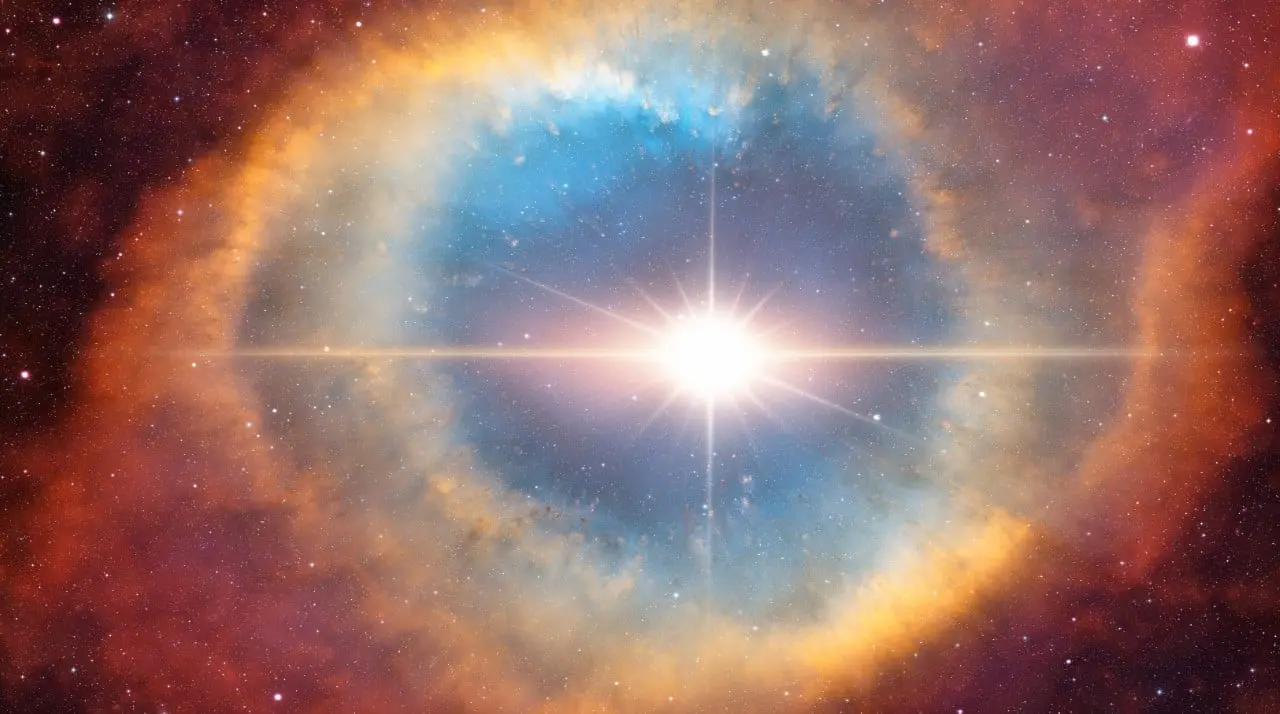
Cientistas have identified a very rare astronomical phenomenon that could end one of the biggest discussions in modern cosmology. The explosion of a star, dubbed SN Winny, was captured with a visual multiplication unprecedented in deep space images. The event offers a unique opportunity to calculate the expansion rate of the universe with greater precision than current methods.
The supernova is located at an estimated distance of 10 billion light years from Terra. Pesquisadores of Universidade Técnica of Munique (TUM) and other German institutions lead the analysis of the collected data. The central objective is to use the temporal delay between the appearances of light to determine the speed at which galaxies are moving away from each other.
Efeito gravitational lens multiplies image of explosion
What makes SN Winny an exceptional object of study is the way its light reaches ground-based telescopes. On the path between the original explosion and our planet, the luminosity encountered two massive galaxies that acted as natural lenses. Esse phenomenon, predicted by Teoria from Relatividade Geral, curves space-time and diverts the trajectory of photons.
Como As a result of this deflection, the same supernova appears five times at different points in the sky, creating a look that astronomers have compared to cosmic fireworks. Cada one of these images follows a path of slightly different length through curved space. Essa path variation generates tiny time intervals between the detection of each luminous “echo” from the starburst.
- Light is deflected by the gravity of foreground galaxies.
- The phenomenon creates multiple images of the same distant object.
- Delays between images allow you to measure absolute distances.
- The technique is independent of other astronomical calibration methods.
Supernova SN Winny and the solution for the voltage of Hubble
The importance of SN Winny lies in the possibility of resolving the so-called “Hubble tension”. Atualmente, there are two different values for the expansion speed of the universe, depending on the technique used. One method analyzes the cosmic microwave background, while the other looks at pulsating stars in nearby galaxies. The numbers don’t match, which suggests flaws in the standard model of physics.
By measuring exactly how long the light takes to complete each of the five different paths, scientists can calculate the Hubble constant directly. Este calculation does not rely on assumptions about the composition of dark energy or dark matter. The analysis of the SN Winny works like a pure geometric ruler applied to a scale of billions of light years.
The Instituto Max Planck and Universidade Ludwig Maximilians (LMU) team is now focusing on refining this chronometric data. The precision required is extremely high, as delays can vary from a few days to months in an event that took billions of years to be seen. Qualquer Minimal discrepancy in records could significantly alter understanding of the final fate of the cosmos.
Detalhes observation technicians 10 billion light years
The detection of a superluminous supernova at this distance would already be a significant feat for astronomy. Contudo, the specific configuration of the gravitational lenses involved in this case is considered a one in a million chance by experts. The light we see today came from the star when the universe was still in its accelerated formation phase.
The galaxies that act as lenses are positioned almost perfectly aligned between Terra and SN Winny. Essa rare geometry is what allows for quintuple viewing instead of the more common double or quadruple. The telescopes captured the intense brightness of the explosion, which exceeds the luminosity of a common Tipo Ia supernova by hundreds of times.
The researchers say this new measurement method serves as an independent arbiter for science. If the value found by SN Winny confirms one of the existing theories, astronomy will be able to rule out alternative models. Caso the result is a third value, physics will need new laws to explain how space behaves on large scales.
Próximos steps in research into stellar explosions
Monitoring of SN Winny will continue over the next few months to ensure all brightness variations are documented. The light curve of each of the five images must be compared in detail to eliminate statistical noise. Astronomers hope that this event will serve as a model for future discoveries with the new generation of space telescopes.
Automatic transient detection technology is making it easier to search for other events multiplied by severity. Embora to SN Winny is unique at the moment, the expectation is that Observatório Vera C. Rubin will find similar cases soon. The ultimate goal is to create a supernova catalog with lenses to map the expansion of the universe through different eras of cosmic time.