

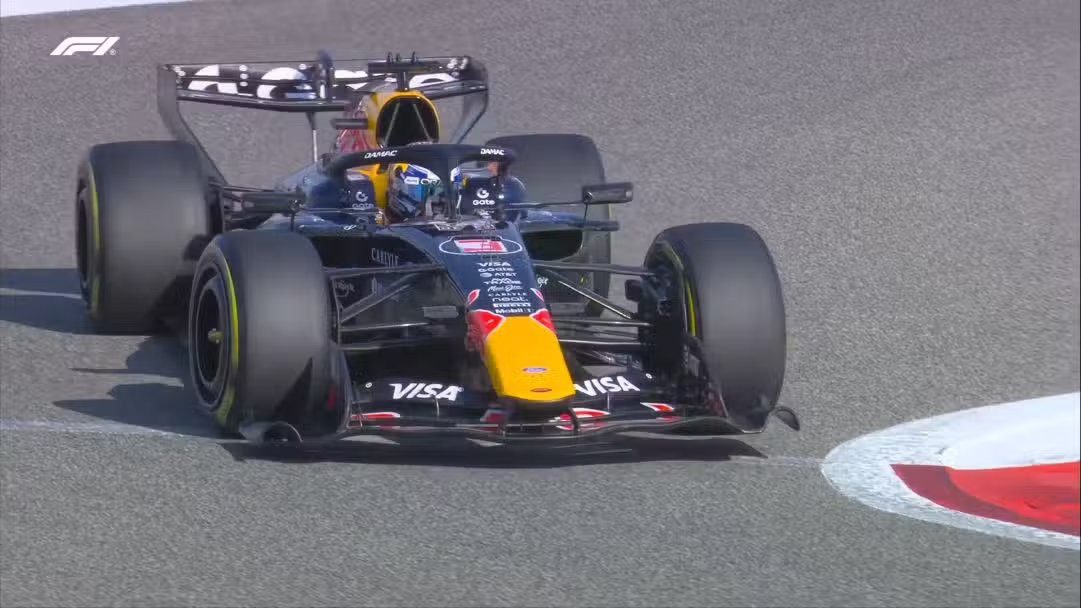
Red Bull management confirmed performance failures in the chassis itself at the start of the 2026 season. The problem is structural. The team leader, Laurent Mekies, pointed out that the difficulty goes beyond adapting to the new technical regulations of Fórmula 1. The Austrian team seeks to reverse the scenario of lack of podiums. The Miami step marks the introduction of adjustments to the power rules.
The changes promoted by Federação Internacional of Automobilismo (FIA) respond to direct criticism from competitors. Max Verstappen led the complaints about excessive reliance on engine electricals. The four-time champion classified the current vehicles as an altered version of the Fórmula E. The highest motorsport entity had to intervene. The central objective is to reduce the phenomenon of sudden drops in speed during track sessions and ensure the safety of drivers in high acceleration zones.
The impact of new technical guidelines on hybrid engines
The power units implemented this year increased the electrical participation to almost half of the total strength of the mechanical set. The engines reach the 1000 hp mark of combined power. Essa technical configuration forced riders to drastically modify driving techniques. The focus became the constant recovery of kinetic and thermal energy in the braking zones. The change reduced the capacity for direct disputes for positions.
Dissatisfaction with the cars’ behavior began during pre-season testing. Engenheiros from several teams noticed that battery management limited race pace. The need to save energy on long straights generated the effect known as superclipping. The system cuts power delivery abruptly to begin recharging. Competitors lose speed unpredictably to those following behind.
The complexity of the 2026 hybrid system requires much greater real-time data processing than in previous years. The flywheels gained new functions to control energy distribution. Drivers have to adjust engine maps dozens of times per lap. The workload in the cockpit has increased considerably. The focus on pure piloting ended up being overshadowed by the need to manage complex electronic systems during races.
Acidente on Japanese circuit exposes security risks
The FIA’s initial resistance to modifying the technical regulations underwent a reversal after the Japão stage. The scenario changed quickly. A serious accident involving Oliver Bearman and Franco Colapinto highlighted the failures of the energy recovery system. The English pilot collided violently. Ele tried to avoid Colapinto’s car on the Asian track. The vehicle in front suffered a sudden and unexpected deceleration in the middle of a high-speed curve. Telemetry confirmed the error. The power cut caused the abrupt difference in pace.
The episode on the Asian route raised a red alert in the race direction. The variation in speed between cars turned overtaking into high-risk maneuvers. The federation needed to review the electric torque delivery parameters as a matter of urgency. The new guideline ensures that power is distributed more linearly across the entire length of the track. The measure aims to eliminate phantom braking zones that surprised competitors.
The changes implemented by the regulatory entity directly affect the dynamic behavior of single-seaters. The package of regulatory updates establishes new operational limits for teams on the grid.
- The electrical participation in the engines reaches half of the total available power.
- The new ruleset takes effect immediately for the Miami step.
- The main focus of the changes is to reduce dependence on recharging via braking.
- The technical change aims to avoid sudden differences in speed between cars on the track.
- The safety measure was accelerated after the accident between Bearman and Colapinto on Japão.
The regulatory review directly responds to Verstappen’s request for a category focused on wheel-to-wheel competition. The Dutchman had criticized the previous format. Ele classified the races as artificial. Linear power distribution allows riders to keep their foot on the accelerator for longer. Disputes for positions must once again depend more on braking ability than on electronic management.
Estratégia recovery of the Austrian team in the season
Laurent Mekies highlighted that the Dutch driver received the changes positively. The manager explained that Verstappen is motivated by the new technical direction adopted by the category. The factory’s priority now is to offer predictable equipment. The team recognizes that the car delivered to Verstappen and Isack Hadjar at the beginning of the year exhibits unstable behavior. The current chassis is considered very difficult to drive in racing conditions with a full tank of gas.
The Red Bull engineering department works extended shifts to overcome mechanical limitations. Wind tunnel data showed discrepancies with actual performance on asphalt. Data correlation has become the main obstacle to aerodynamic development. The Austrian team preaches caution about the time needed to return to the top of the pack. Resolving chassis issues requires structural upgrades that take weeks to manufacture.
The lack of podiums in the first stages of the 2026 season generated internal pressure within the team. Mechanics try to find a suspension setup that minimizes rear instability. The car suffers from loss of grip in low-speed curves. The team plans to introduce a new floor at upcoming races. The immediate objective is to ensure that riders can get the most out of the equipment without the constant risk of spinning.
Futuro of the four-time champion and expectations for the American race
Verstappen’s recent statements about rethinking his stay at Fórmula 1 were minimized by the team’s leadership. Laurent Mekies assessed the discontent as a natural reflection of a high-level competitor. The Dutchman found himself unable to fight for victories due to equipment limitations. The team leader believes that resolving the technical bottlenecks will bring the expected performance. The talent of the four-time champion will once again make a difference in the final results.
The expectation in the pits is that the Miami route will mark the beginning of an upward development curve. The American street circuit demands a complex compromise between straight-line speed and downforce. The director compared the current moment with challenges overcome by the organization in previous years. Confidence in the technical team’s ability to react remains unshakable. The focus is not just on gaining immediate positions, but on establishing a solid foundation for development.
Mechanical consistency became the central pillar of the recovery project. The development of the car cannot be halted by basic drivability flaws. The team needs to accumulate clean mileage during free practice at Flórida. Collecting real data with the new engine mapping will define the factory’s next steps. The weekend at Miami represents a crucial test of the team’s ambitions in the 2026 championship.