

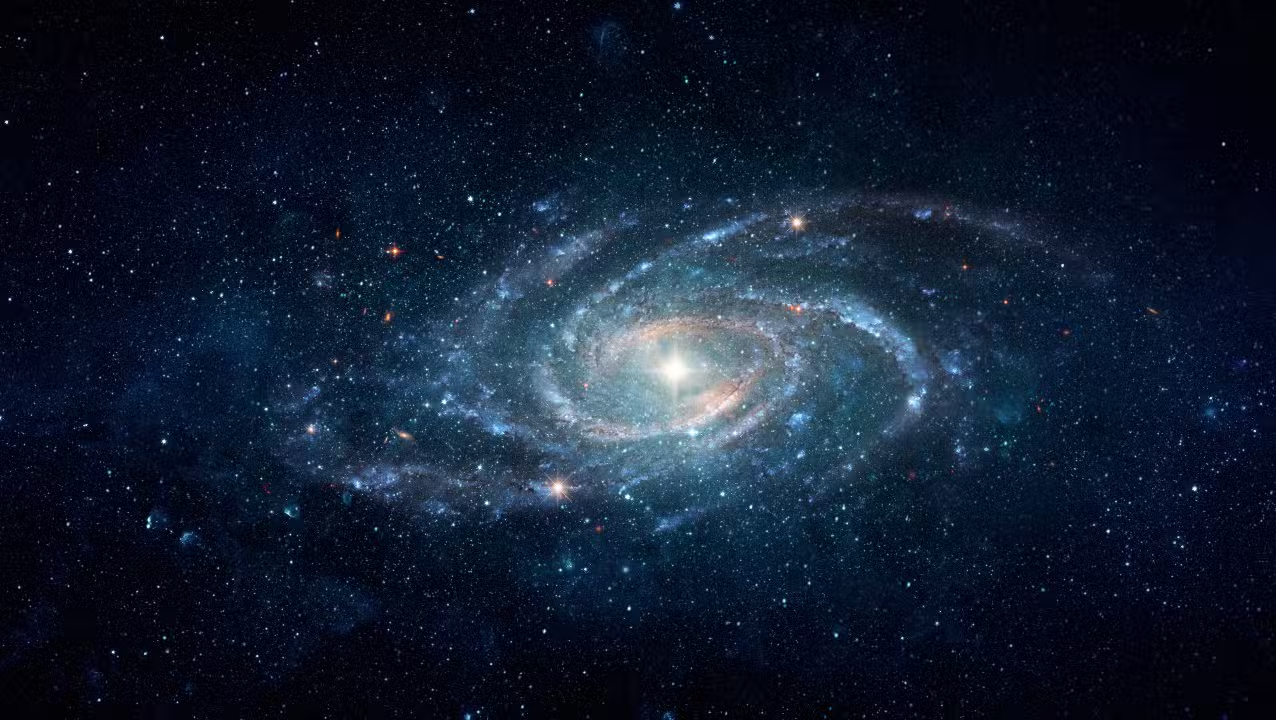
Agência Espacial Europeia’s Euclid space telescope is now sharing never-before-seen images with the public. The goal is to find massive galaxies that distort spacetime and create gravitational lensing effects. The new Space Warps project, hosted on the Zooniverse platform, allows anyone to participate in the search.
The initiative combines artificial intelligence algorithms with the human ability to recognize subtle patterns. Cerca of 300 thousand images pre-selected by AI will be analyzed. Elas is part of the data that the mission will officially release in the fall of this year, in the first major release of information (DR1).
Gravitational Lentes reveal invisible matter
Massive Galáxias act as natural lenses. Their gravity bends the light coming from more distant objects. The result appears as elongated arcs, multiple images, or complete rings, known as Einstein rings.
Esses phenomena allow astronomers to “weigh” galaxies and clusters. The technique reveals the total amount of matter, including dark matter, which does not emit light. Strong lensing Estudos over time also helps understand the accelerating expansion of the universe and the role of dark energy.
- Imagens show background galaxies distorted into arcs or rings around front galaxies
- Efeito allows measuring distribution of dark matter inside lenses
- Dados of Euclid cover an area equivalent to 9,500 times the size of the full Lua
- Espera has more than 10 thousand new strong lenses in this phase of the project

Euclid has already delivered impressive results
Lançado in July 2023, Euclid captures sensitive large-scale images of the sky. In March 2025, researchers identified 500 galaxy-galaxy lenses in just 0.04% of the initial data. Most were unknown before.
The new project expands the effort. The AI analyzed 72 million galaxies from DR1 data. Voluntários now examines the highest scoring candidates. The volume is 30 times greater than previous searches.
A nearby galaxy called NGC 6505 serves as an example. Imagens of Euclid show a glowing ring around them. Light from a more distant galaxy forms the ring as it is bent by NGC 6505’s gravity.
Como join Space Warps
Qualquer person with internet access can access the project website at Zooniverse. The instructions explain what to look for: characteristic distortions around central galaxies. Não requires previous experience. Cada click helps refine AI results.
Previous Participantess have already contributed to cataloging hundreds of lenses in initial testing. The new effort seeks to multiply that number. The processed data will feed studies on cosmic evolution.
Euclid sends about 100 gigabytes of data per day to Terra. The telescope maps billions of galaxies to understand the large-scale structure of the universe. Strong Lentes complement the weak lensing measurements that the mission also performs.
Benefícios Scientific Collaboration
The combination of AI and human classification increases efficiency. Computadores processes high volume quickly, but humans detect ambiguous cases more accurately. The previous project showed that this partnership works well.
Aprajita Verma, of Universidade of Oxford and co-founder of Space Warps, highlighted the potential. The larger area and improved algorithms should reveal more than four times the total lenses known from nearly 50 years of observations.
Cientistas hope to use the new lenses to map dark matter in unprecedented detail. The results will also refine models about dark energy, which drives the accelerated expansion of the cosmos.
Unreleased Imagens opens window to the public
Volunteers gain early access to cuts of images that are not yet publicly available. The quality of the Euclid’s photos allows you to see fine details in distant galaxies. Muitos participants report surprise upon identifying subtle distortions that the AI marked as likely.
The project maintains a focus on open science. Quem participates and receives contribution certificate. The classifications directly feed the work of researchers from the Euclid consortium, which brings together more than 2,000 scientists from different countries.
Próximos mission steps
Euclid continues its six-year search. Ele observes the sky in visible and near-infrared light. The mission measures both weak lensing and baryonic acoustic oscillations to trace cosmic history. Strong Lentes add local information about matter and gravity.
DR1’s Dados should be released in 2026. The larger volume will allow for robust statistics on lens frequency. Pesquisadores plan to compare the findings with computer simulations to test theories about dark matter.
Space Warps represents yet another example of how citizens contribute to cutting-edge discoveries. The previous effort with Euclid has already proven the value of this approach. Agora, with larger scale data, the potential grows.