

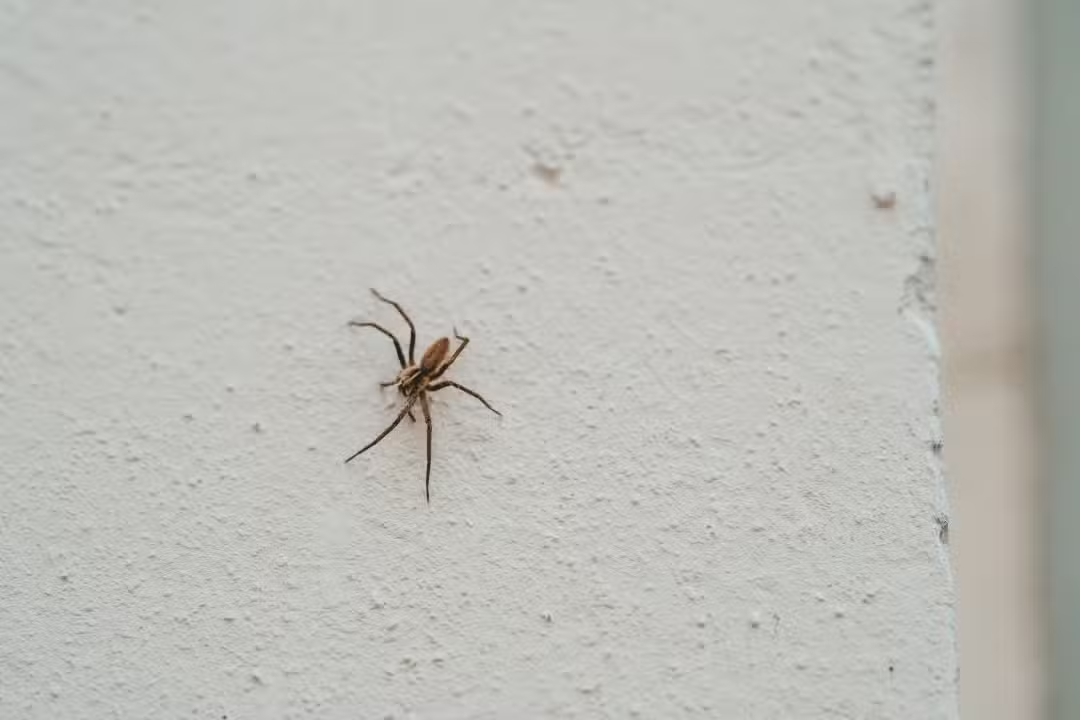
A newly identified spider called Pikelinia floydmuraria is attracting attention from South American researchers for its surprising ability to hunt insects much larger than its own body. Measuring just 3 to 4 millimeters in length, the species can capture prey up to six times its size, living discreetly in cracks in urban walls. The work was published in the magazine Zoosystematics and Evolution and details a series of unique characteristics of this tiny arachnid.
The discovery expands knowledge about the Pikelinia genus, whose lifestyle habits remained poorly documented until then. Pesquisadores collected specimens in urban areas and performed thorough morphological analysis to confirm the species. The scientific name combines references to Pink Floyd, the British rock band formed in 1965, with “muraria”, which refers to Latin and means its preference for living in walls, a detail that directly connects its biology to the environment.
Estratégia hunting close to artificial light
The spider builds its webs in strategic locations close to artificial light sources, where insects such as mosquitoes and house flies tend to concentrate. Essa habitat choice makes hunting significantly more efficient, as it takes advantage of the natural attraction that these insects show for lighting. The behavior considerably reduces the effort required to obtain food, creating a constant supply of prey without large energy expenditures.
Segundo the authors of the research, this strategy represents a successful adaptation to urban life. The small spider is able to benefit from the infrastructure of cities by capturing insects that other larger predators may ignore. The pattern was confirmed in repeated observations in different areas, indicating that this is not isolated behavior.
Alimentação assorted small insects
The diet of Pikelinia floydmuraria includes diverse groups of insects, from ants (Hymenoptera) to flies and mosquitoes (Diptera) and beetles (Coleoptera). What makes this dietary preference notable is the spider’s ability to defeat much larger prey — sometimes ants six times its size. Similar feeding Hábitos was observed in populations related to Armênia and Colômbia, suggesting that this behavior is not a local particularity, but rather a typical trait of the genus.
Researchers have documented that this disproportionate hunting ability is unusual for such a small arachnid. The spider is able to subdue prey that would require sophisticated attack and containment strategies, despite its limitations in size and brute strength. Estudos further details about the neurobiology and physiology of this behavior may reveal particular neurological adaptations.
Relação among species of the genus Pikelinia
The study also analyzed the species Pikelinia fasciata, found in Ilhas Galápagos, describing the female’s anatomy in detail for the first time. Foram found striking structural similarities between this species and Pikelinia floydmuraria, particularly in the male reproductive structures. Essas similarities suggest a possible evolutionary connection between the two, but scientists have not yet determined whether it stems from a common ancestor or similar environmental pressures.
Características that merit additional analysis include:
- Estrutura of pedipalps and body segmentation
- Padrões coloring and markings
- Morfologia silk glands
- Anatomia of reproductive structures
- Web-Building Comportamento
Para clarify these questions, researchers indicate that comparative DNA analyzes between species will be necessary. Genetic research can reveal degrees of kinship and help reconstruct the evolutionary history of the genus. Também can confirm whether populations on different continents share a recent ancestor or diversified millions of years ago.
Eco-friendly Impacto in urban environments
By feeding on mosquitoes, flies and other insects common in cities, Pikelinia floydmuraria may play a significant role in regulating populations that affect humans daily. Apesar Due to its microscopic size, the spider acts as a predator in urban food chains. Most people will never notice their presence or contribution to natural pest control.
Esse type of diminutive predator has gained special relevance in studies of urban ecology. Pesquisadores recognize that species that are small and often invisible to the human eye perform critical ecological functions. The study of Pikelinia floydmuraria contributes to a more complete understanding of how local fauna interact with human structures and how they adapt to modified environments.
Lacunas in scientific knowledge
Conforme say the research authors, despite recent advances in taxonomy of the genus, the ecology and biology of Pikelinia remain largely unexplored. A previous study carried out in southern Brasil provided preliminary information on the phenology and ecological behavior of a related species, but many aspects lack systematic investigation.
Entre the unanswered questions are reproduction patterns, average longevity, capture success rate, chemical composition of the web and specific mechanisms of immobilization of larger prey. Pesquisadores are also completely unaware of the precise geographic distribution of several species of the genus and their occurrence in non-urban environments. Essa knowledge gap makes future expeditions and field observations absolutely essential to understanding the natural history of this spider.