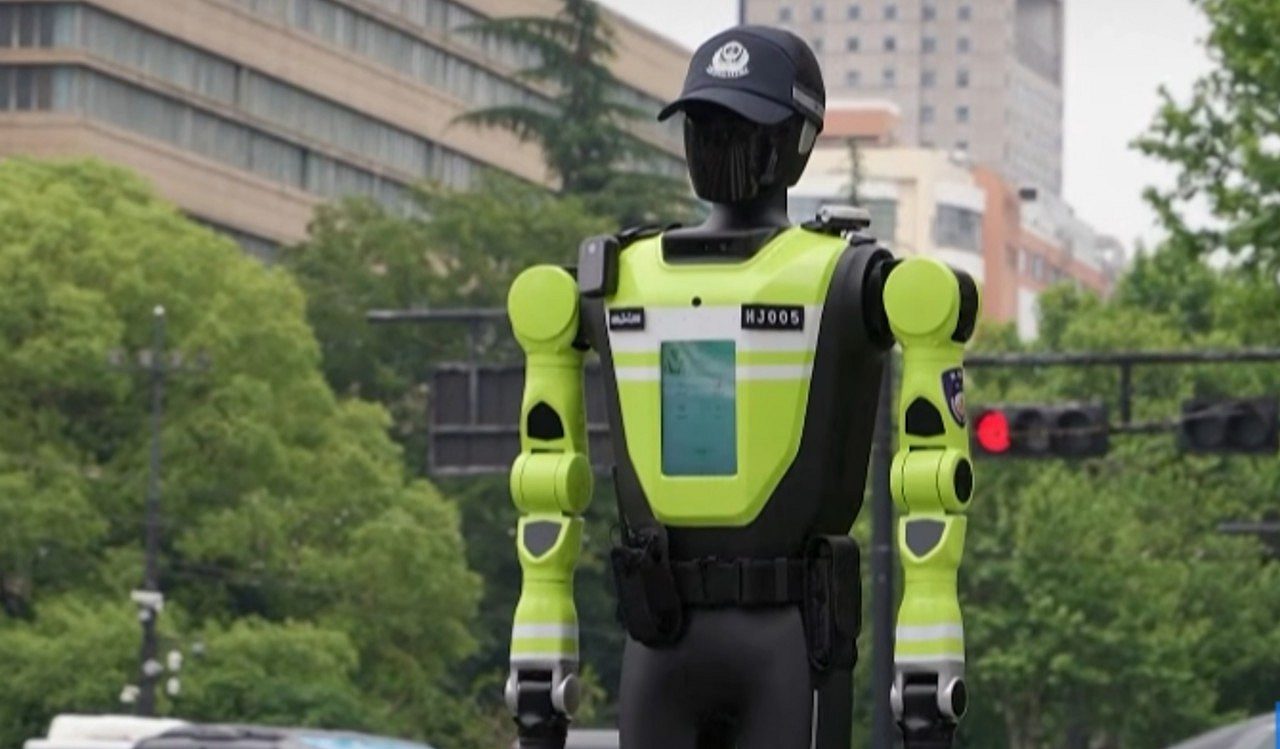
China deployed a squad of 15 humanoid robots equipped with artificial intelligence to manage traffic on the streets of Hangzhou, one of the largest cities in the country. The project, launched in early May 2026, marks an escalation in the adoption of autonomous technology for public functions in urban centers. The robots operate 24 hours a day at strategic intersections in the city center, monitoring infractions, guiding pedestrians and synchronizing with smart traffic light systems.
Cada unit was adapted according to local characteristics and types of offenses most common in different regions of Hangzhou. The initiative reflects China’s national strategy of integrating artificial intelligence and automation into public services, reducing exclusive dependence on human resources and increasing operational efficiency in critical sectors such as urban mobility.
Capacidades operational traffic robots
Robots play multifaceted roles in road management. Identificam traffic violations in real time through advanced sensors and monitoring cameras, triggering instant audible alerts when infractions are detected. When capturing data from an incident, they automatically transmit the information to a command center, eliminating the need for physical movement of human agents for initial verification.
In the Lago region of Oeste, the robots have interactive screens that access real-time traffic and positioning data. Fornecem optimized routes for pedestrians and public transport users through vocal guidance and visual graphics. The units function as dynamic traffic controllers, synchronized to the city’s traffic lights and capable of executing eight different commands:
- Siga forward
- Pare immediately
- Vire on the left
- Vire on the right
- Reduza speed
- Aguarde the next cycle
- Deixe the free way
- Retorne to the correct track
Command execution times are aligned with traffic light cycles, avoiding congestion and conflicts in the flow of vehicles. Além also assists human police officers in high-risk situations or those that require physical presence, allowing agents to focus on incidents that require complex judgment.
Strategic Implementação on Hangzhou
The city of Hangzhou, home to tech giants like Alibaba and Hikvision, has transformed into a living laboratory for experimenting with AI-powered urban solutions. The 15 robots were positioned at high-traffic intersections in the urban center, regions where the volume of infractions is high and road efficiency directly impacts economic productivity.
The project received support from the Chinese state agency Xinhua, indicating support from the central government. The choice of Hangzhou was not random: the city already has a consolidated 5G infrastructure, smart city systems in operation and a population accustomed to technological innovations. Isso reduces social resistance to the presence of autonomous machines in public space and facilitates data collection for continuous refinement of algorithms.
Implementation occurs in phases. Inicialmente concentrated at critical intersections, there are plans to expand to other Hangzhou zones and potentially neighboring cities, depending on operational results and public acceptance. Cada robot was trained with local traffic patterns, learning peak hours, most congested routes and typical violation patterns in the region.
National Automation Strategy Contexto
The initiative is part of a broader objective of the Chinese government: expanding the use of artificial intelligence and robotics in sectors that require continuous surveillance, exposure to risks or repetitive work. Autoridades identify uncontrolled urban growth as a logistical challenge that machines can help mitigate without proportionally increasing operational costs.
Além of traffic control, China invests in humanoid robots for urban cleaning, construction, inspection of critical infrastructures and even military tasks. The government sees robotics as a solution to three simultaneous problems: an aging population, reduction of public costs and geopolitical positioning as a leader in cutting-edge technology.
The project in Hangzhou signals Chinese confidence in autonomous systems operating in uncontrolled environments with direct interaction with the public. Diferentemente of robots in factories or data centers, these work on the streets, facing climate variability, unpredictable human behaviors and real time pressure.
Implicações technical and operational
Cada robot is equipped with high-resolution cameras, motion sensors, microphones for ambient sound detection and seamless connection to 5G networks. Computer vision systems can identify vehicle types, read license plates, detect traffic signs, recognize pedestrian postures and assess compliance with road rules in milliseconds.
Processing occurs both locally on the robots and on cloud servers, ensuring redundancy. If the connection to the data center fails, the robot continues to operate based on pre-programmed protocols. More complex Alertas are scaled for human analysis while maintaining adequate oversight over critical decisions.
The battery autonomy was designed to cover full shift cycles. The robots automatically return to charging stations upon reaching critical energy levels, ensuring availability during peak traffic times. Preventative Manutenção is scheduled for night periods when vehicle volume drops significantly.
Treinamento’s algorithms included simulations of millions of traffic scenarios collected from Chinese cities over the past three years. Dados anonymized violations, times, and patterns were used to calibrate detection and response models. The system continually learns from new data captured on Hangzhou, improving accuracy and reducing false positives.
Perspectivas futures and challenges
Success in Hangzhou will create pressure for rapid replication in other Chinese metropolises. Pequim, Xangai and Chengdu have already expressed interest in pilot programs. Internacionalmente, the project attracts attention from cities facing chronic congestion and lack of human resources for traffic policing.
Desafios remain. Questões regarding privacy, liability in case of misdetection, and impact on the employment of human traffic officers have not yet been formally addressed by authorities. The Hangzhou population has begun to adapt to the presence of the robots, with initial reports suggesting that most see them as improving traffic flow.
Robôs also face limitations: they cannot deal with serious accidents, negotiate with aggressive drivers or make decisions based on complex social context. Therefore, they will continue to operate in complementarity with human police officers, not as a total replacement. The division of tasks remains clear: machines for 24/7 monitoring, data collection and application of standardized rules; human resources for ambiguous situations, conflict mediation and general supervision.
Investment in traffic robotics reflects Chinese confidence that automation is inevitable and that global technological leadership involves mass adoption of AI in real-world contexts, not just in laboratories. Hangzhou now serves as a case study observed by urban managers around the world.
