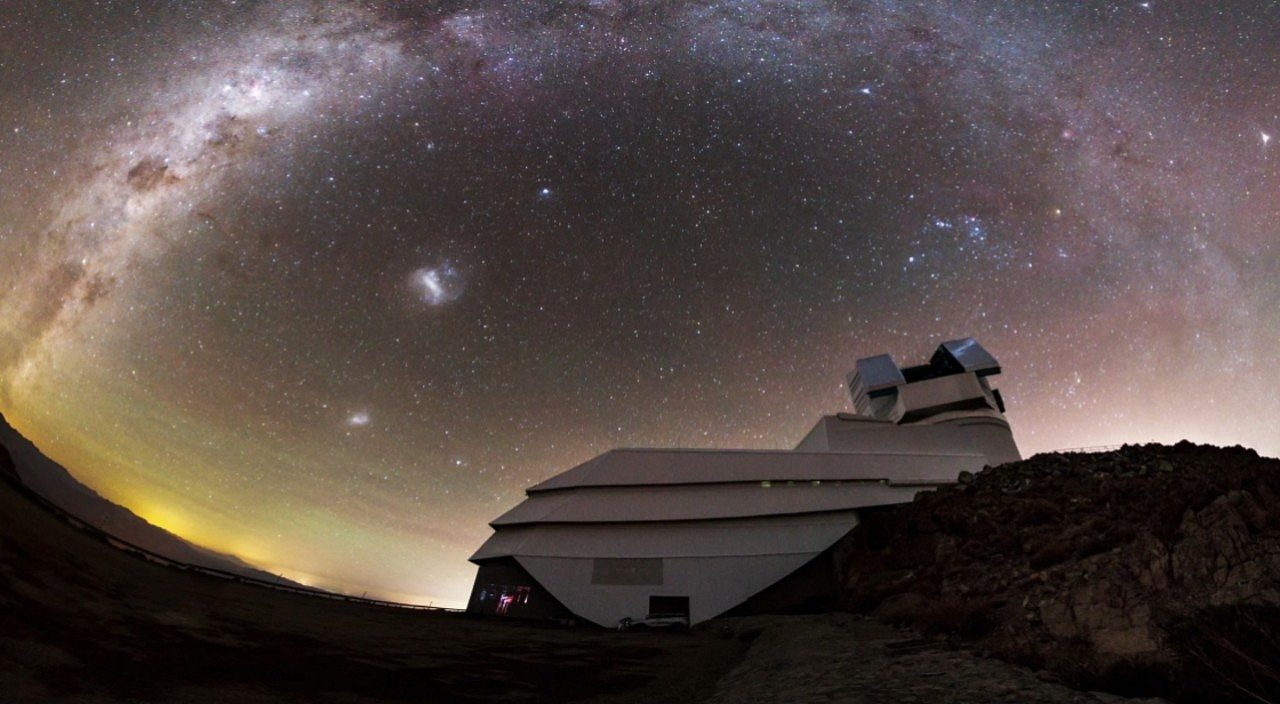
Avi Loeb, theoretical astronomer of Universidade Harvard, presents a bold proposal: send a probe to intercept and collide with the interstellar comet 4I/Rubin, which is expected to be discovered over the next decade through Observatório Rubin on Chile. The idea follows the successful model of Nasa’s DART mission, which impacted the asteroid Dimorphos in September 2022. Loeb points to businessman and astronaut Jared Isaacman as a potential financier of a venture that would cost approximately one billion dollars.
Observatório Rubin, linked to Fundação Nacional of Ciências (NSF) and Departamento of Energia (DOE) of Estados Unidos, will be able to detect dozens of new interstellar objects over the next decade. Esses cosmic visitors arrive at speeds that exceed the limit of solar gravitational escape. Próximo to Earth orbit, Sol’s escape velocity is 42.1 kilometers per second, while comet 3I/ATLAS approached at about 60 kilometers per second.
Abundância surprising interstellar visitors
Cálculos indicate that the progenitor stellar population of 3I/ATLAS is responsible for generating a new object detectable at less than 5 astronomical units (AU) every two years. Isso implies there are about ten trillion of these objects currently in Sistema Solar, extending up to Nuvem from Oort. 3I/ATLAS carried a mass of at least 0.1 billion tons, suggesting that the total mass ejected into interstellar space is at least one-sixth of the Earth’s mass per star. Icebergs planetaries are ejected during the formation of planetary systems by gravitational scattering or rupture by tidal forces.
The predominant composition of these objects is ice. Quando, heated by solar radiation, release cometary tails of gas and dust. Most interstellar visitors therefore follow trajectories typical of icy bodies. Bilhões years are needed to traverse Via Láctea at these speeds, offering scientists a unique opportunity to analyze physical conditions of distant star systems without the need for intergalactic travel.
Anomalous Sinais suggests possible technological origin
3I/ATLAS demonstrated an unexpected alignment with the ecliptic plane. Sua’s trajectory is accurate to just 4.89 degrees in relation to the Earth’s orbital plane, while the ecliptic plane is inclined by 60.3 degrees in relation to Via Láctea’s stellar disk. Loeb notes that such a precise alignment with Terra’s orbit would not be expected on a random trajectory.
Caso future interstellar objects demonstrate a consistent preference for an ecliptic orientation, the scientific community would have to consider the possibility of technologically engineered trajectories. If the origin is technological, the abundance of visitors near Terra could be significantly higher than the intergalactic average, for the same reason that bees cluster around flowers. Essa hypothesis remains speculative but warrants in-depth investigation.
Colisão controlled as an investigation tool
The simplest way to determine whether an interstellar visitor is a natural iceberg or a technological object is to impact its surface. Fotografias close-up taken seconds before the collision would reveal the internal nature of the body. The precedent of the DART mission demonstrated the technical feasibility of this type of operation. A high-resolution camera would capture details of the surface while specialized instruments would analyze the composition of the plume of gas or dust released by the impact.
Instrumentos on board could verify biological signatures or basic components of life, including organic molecules, before and after impact. Para astrobiology, this approach opens up a completely new avenue of discovery in the search for extraterrestrial life. Diferentemente from a rocky asteroid, crashing into the surface of a potential technological spacecraft would be a completely different experience. The configuration and hardness of the material would provide critical information about manufacturing and origin.
Desafios operational and windows of opportunity
Lançar an interceptor on a collision course with interstellar objects requires prior detection at distances of 5 to 10 AU and fast response time. 3I/ATLAS was discovered 3.5 AU from Terra on July 1, 2025, reaching its closest point on December 19 of the same year, almost half a year later. If 4I/Rubin is detected at 10 AU with an approach taking a year to 2 AU, a ground launch at a speed of 10 kilometers per second could intercept and collide with its trajectory. The operational window would be short, requiring quick decisions and exceptional responsiveness.
The estimated cost is one billion dollars. The less ambitious DART mission had a total cost of approximately a third of that amount. Essas expenses put the venture within the reach of well-funded space agencies or billionaires interested in frontier scientific exploration. Jared Isaacman, which has previously funded commercial space missions, represents a potential candidate for private sponsorship.
European Programa offers alternative approach
Agência Espacial Europeia (ESA) developed the Comet Interceptor mission, scheduled for launch in 2029. The spacecraft will be positioned at the second point of Lagrange Terra-Sol, known as L2, and will wait up to three years for the passage of a long-period comet or interstellar object. Essa’s location offers a strategic advantage, but the technical limitation is severe: the mission will only be able to propel itself at maneuvering speeds of up to 1 kilometer per second, equivalent to traveling 1 AU in five years. Sem extraordinary proximity to an interstellar visitor, the time elapsed from detection to possible interception will be insufficient to reach the target trajectory.
Loeb suggests that Nasa could overcome this limitation with investment in launch capacity and more robust propulsion, particularly if private partners like Isaacman provided financial resources. The next decade will offer multiple opportunities as Observatório Rubin begins operations, potentially detecting dozens of new interstellar visitors on varying trajectories and compositions for in-depth scientific investigation.