
The Al-Naslaa rock, located in the Tayma oasis in the northwest of Arábia Saudita, presents a vertical division so precise that it has intrigued experts for decades. The sandstone block, approximately six meters high and nine meters wide, is divided in half by an extremely straight crack that measures just a few centimeters in certain places. The structure rests on two narrow natural pedestals, creating an impression of delicate balance that contrasts with the arid desert environment.
Descoberta Formally in the 19th century by the French explorer Charles Huber, the formation forms part of a region rich in historical remains dating back to prehistoric periods. The site attracts researchers and visitors due to its unique appearance and the ancient petroglyphs etched into its surface, adding significant archaeological value to the site.
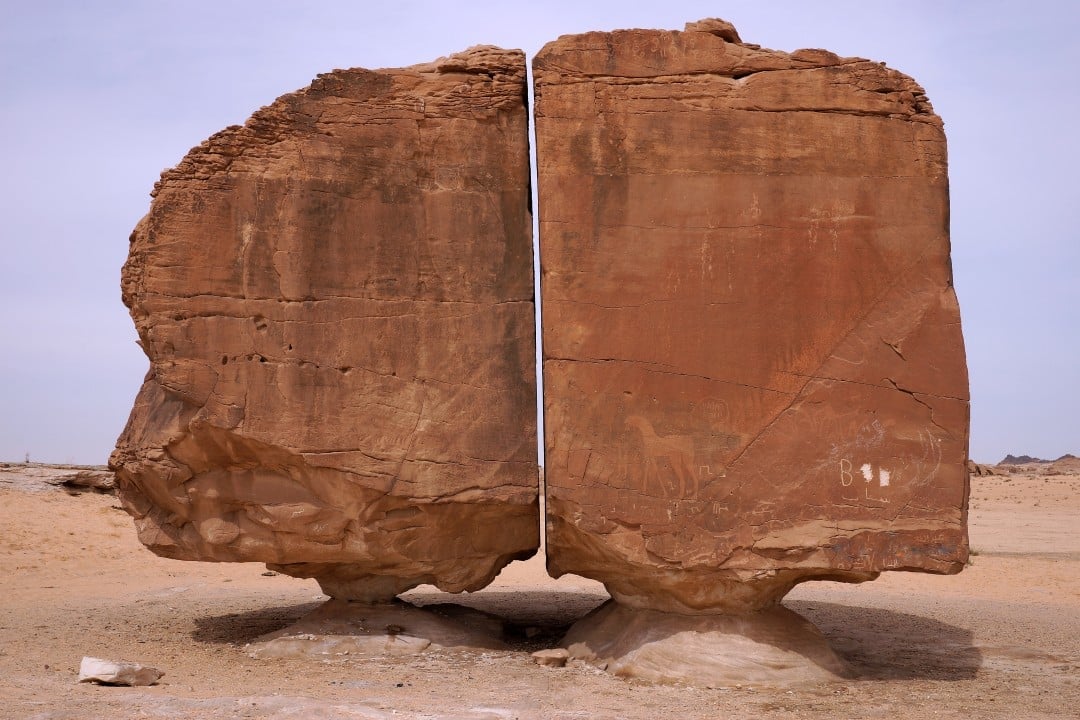
Características geological and precise location
The Tayma oasis is located in the province of Tabuk, in a desert area that presents extreme climatic conditions with constant winds and marked thermal variations. Essas conditions directly influence rock erosion over thousands of years. Sandstone, a porous material that makes up Al-Naslaa, facilitates the action of wind and sand, allowing different erosion processes that shaped the current formation.
The two halves of the rock remain upright thanks to narrow bases resulting from uneven erosion. Geólogos observe that the porous sandstone material wears more quickly in certain areas, creating the characteristic pedestals that support the structure. The symmetry of the vertical division remains the main characteristic that sparks scientific debate about the natural mechanisms involved.
Teorias scientific research on crack formation
Especialistas propose that a subtle geological fault initiated the separation of the two parts of the original block. Movimentos tectonics in the region could have fractured the sandstone, creating the straight line observed today. Essa hypothesis gains strength from the presence of natural joints in similar sandstone formations found in other desert regions.
Outra scientific explanation involves freezing and thawing cycles in wetter periods of the geological past. Água infiltrated microcracks would expand upon freezing, gradually widening the crack over thousands of years. Upon return to arid conditions, the crack would remain smooth and well-defined, preserving the precision seen today.
- Erosão wind with grains of sand acting as a natural abrasive over millennia.
- Ação chemical that dissolves specific layers of sandstone in different patterns.
- Combinação of internal tensions with external factors such as wind, temperature and humidity.
Petróglifos ancient and archaeological value
The faces of Al-Naslaa contain ancient engravings depicting human figures and animals, including Arabian horses, ibexes, and hunting scenes. Arqueólogos estimate that these petroglyphs date back at least four thousand years, indicating intense cultural use of the site by ancient populations. The preservation of the recordings benefits from the natural protection offered by the position of the rock and the relative protection of the inner faces of the crack.
Recent Estudos documents dozens of motifs on one of the main faces, revealing similar patterns in other nearby rocks in the Tayma region. The carvings suggest trade routes or ritual practices associated with the oasis, connecting the formation to broader systems of human occupation in the ancient desert.
Processos erosion and similar formations
Strong Ventos transport sand particles that wear exposed surfaces unevenly, creating pedestals by removing material faster on the undersides. Esse phenomenon occurs in several desert formations around the world, but the precision of the division in Al-Naslaa remains remarkable. The relative protection of the inner faces of the crack preserves smoother surfaces, while sand accumulated over time acts as a natural polish on the edges of the split.
Arábia Saudita houses several rocks balanced due to wind erosion characteristic of the desert environment. Recent Descobertas include cave paintings of camels estimated to be twelve thousand years old, contextualizing ancient human occupation in the region. Essas monumental representations possibly served as indicators of essential water sources for nomadic populations.
Conservação and continued research
Autoridades Saudis include Al-Naslaa in tourist routes open to the public, allowing visitors to access the site by vehicles adapted to the desert terrain. Conservation Medidas limits direct rock contact to protect ancient petroglyphs from further damage. Guias sites offer information about the geology and history of the area, integrating training with efforts to enhance the country’s natural heritage.
Al-Naslaa remains the subject of ongoing geological studies, with researchers collecting data on current erosion to compare with past processes. Registros photographic images and detailed analyzes contribute to the progressive understanding of the formation, while the straight division continues to generate hypotheses based on field observations and modern geological modeling.
