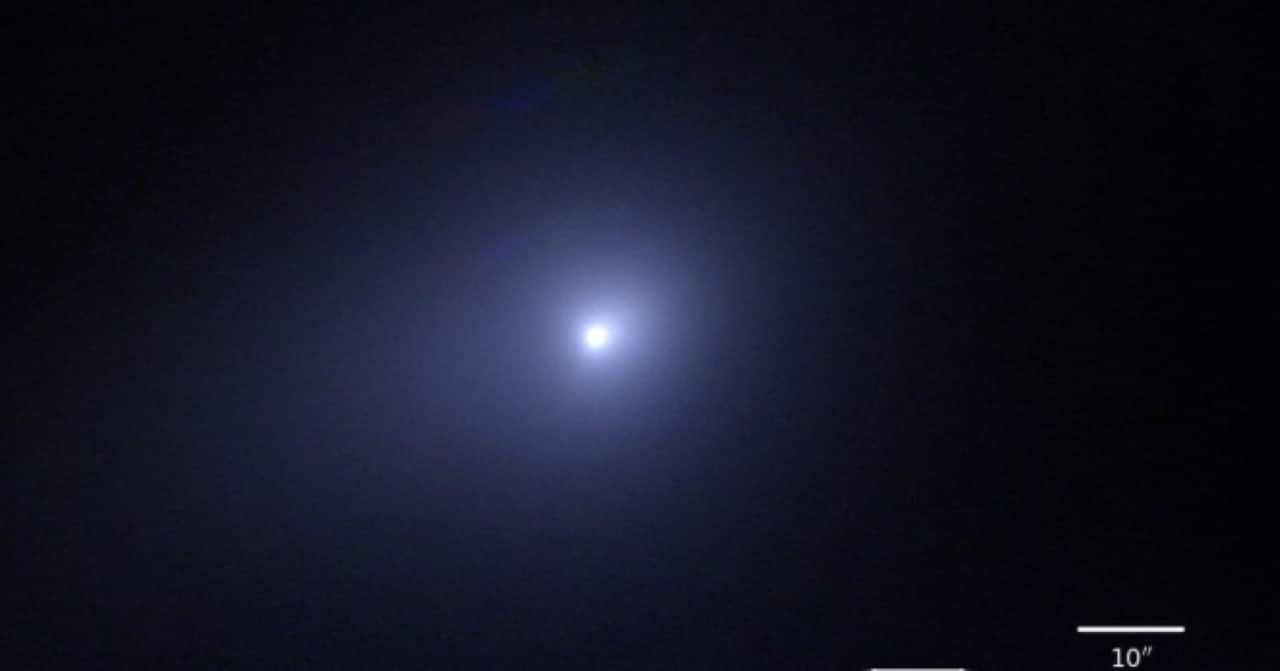
The interstellar object 3I/ATLAS has a deuterium concentration tens of times higher than that found in Sistema Solar comets, raising theoretical questions about defense strategies against cosmic impacts. Astrophysicist Avi Loeb of Universidade Harvard analyzed this unusual composition and explored a hypothetical scenario involving nuclear detonation inside the celestial body. The fraction of deuterium in water reaches 0.95%, while in methane it reaches 3.31%, values that significantly exceed known cosmic standards and indicate origin in Via Láctea’s ancient and cold environment.
Isotopic Composição reveals ancient interstellar origin
Observações carried out with telescopes such as James Webb and ALMA confirmed the high proportion of deuterium in the material released by 3I/ATLAS. The D/H fraction in water is more than 30 times higher than that of typical solar comets, while in methane the value is about 14 times higher than that measured in comet 67P by the Rosetta probe. Carbon isotopes also show deviations from nearby galactic standards, reinforcing the interpretation that the object was formed approximately 10 to 12 billion years ago in a region with low metallicity and temperatures below 30 kelvins.

Esses isotopic data serves as a chemical signature of the object’s cosmic past. The anomalous abundance of deuterium suggests formation in an environment radically different from our planetary system, possibly in the galaxy’s ancient, cold molecular cloud. The third interstellar object identified passing through Sistema Solar offered a unique opportunity to study primordial material preserved billions of years ago.
- Fração D/H in water: 0.95%, more than 30 times higher than solar comets.
- Deutério in methane: 3.31%, approximately 14 times higher than in 67P.
- Carbon Isótopos shows deviations from nearby galactic patterns.
- Estimated minimum Massa: 160 million tons.
Histórico Nuclear Fusion and Planetary Defense
Durante o Projeto Manhattan, Edward Teller speculated whether the fireball from an atomic bomb could initiate fusion reactions in nitrogen in the Earth’s atmosphere. Hans Bethe calculated that radiation losses would make any self-sustaining chain unlikely, a conclusion reinforced by contemporary reports, including one from 1946 signed by Konopinski, Marvin, and Teller. Anos later, Konopinski and Teller published theoretical work on the probability of fusion of two deuterium nuclei, a calculation that helped in the development of the two-stage hydrogen bomb, where an initial fission explosion creates the conditions for deuterium fusion.
Similar Preocupações appeared in underwater nuclear tests, evaluating the possibility of igniting oxygen in water. Experimental and theoretical Dados have reduced the perceived risk, but nuclear astrophysics has advanced significantly from these studies, explaining how the fusion of light elements powers low-mass stars. The accumulated knowledge about nuclear fusion has become fundamental for understanding cosmic processes.
Cenário hypothetical detonation and chain reaction
Loeb recalled Edward Teller’s proposal after the impact of comet Shoemaker-Levy 9 on Júpiter in 1994, when the physicist suggested a nuclear device equivalent to a gigaton of TNT to deflect or destroy threatening asteroids. Aplicando this concept to 3I/ATLAS, the astrophysicist calculated that the object has enough deuterium to, in theory, release energy equivalent to 10 teratons of TNT if all the material were fused. Isso would represent about 200,000 times the power of Tsar Bomba, the largest terrestrial nuclear explosion recorded, with 50 megatons in 1961.
The central question is whether a nuclear detonation at the center of the object could start a deuterium-deuterium chain reaction. In opaque and dense environments, radiative losses occur mainly at the surface. Cálculos Preliminaries of Loeb suggest that the internal temperature required for fusion could be reached before the radiation dissipates the energy, leading to the object’s disintegration within fractions of a second. The surface would need to reach millions of degrees for losses to compete with the release of energy, a condition under which deuterium would ignite.
Implicações for Cosmic Protection Strategies
The assessment indicates that the use of a nuclear device would require additional caution when dealing with deuterium-rich objects. A chain reaction could transform the target into a source of energy much greater than the initial explosion, creating an uncontrollable scenario. Loeb recommends the development of alternatives that are less dependent on nuclear detonation for protection against impacts, with options that avoid triggering fusion in materials with atypical composition.
3I/ATLAS is already on its way out of Sistema Solar, but its passage offered a unique opportunity to study interstellar material. Isotopic anomalies continue to be analyzed by international teams, with new observations able to refine data on gas production and variations over time. Até At this time, there is no evidence of significant variability in day-to-day measurements.
Limitações calculations and next steps
The deuterium measurements come from multiwavelength spectroscopy, with data from ALMA and JWST contributing to the estimates. Values represent snapshots and may vary with object activity. The fusion energy calculation assumes complete fusion of the deuterium present, but in practice efficiency depends on density, temperature and duration of extreme conditions, requiring more detailed models to quantify the exact risk. The minimum mass of 3I/ATLAS serves as a conservative basis, with real values being able to be higher and altering the potential energy scale.
The debate remains in the theoretical field, with no current plans involving nuclear detonation on interstellar objects. Loeb’s contribution highlights the importance of considering specific chemical compositions when designing cosmic defense strategies, integrating astrophysical knowledge with planetary security.
