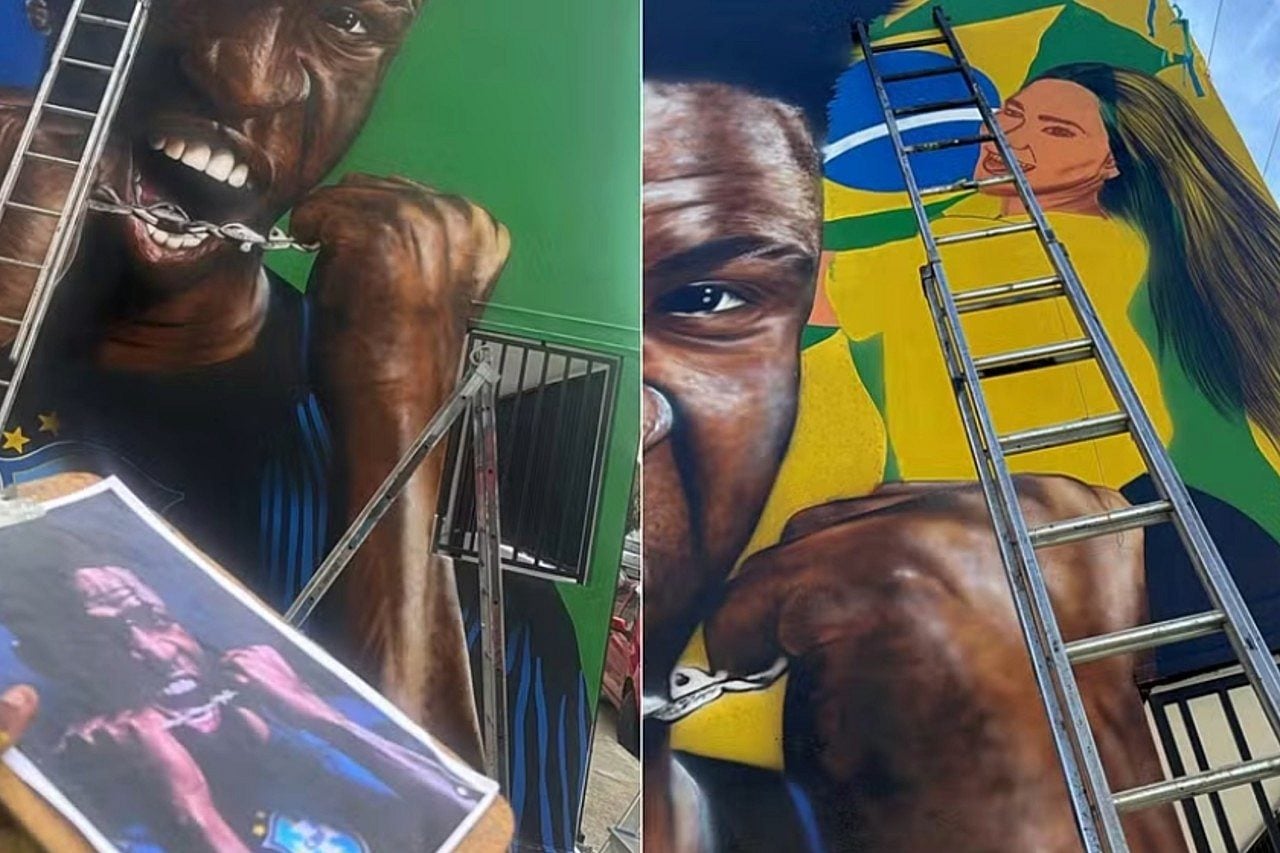
The separation between influencer Virginia Fonseca and player Vinícius Júnior transcended the digital universe and provoked an unusual intervention in a thematic mural installed in Pouso Alegre, in Sul of Minas Gerais. The decorative work of art, created by residents of Rua República of Argentina to celebrate Copa of Mundo, took on a new shape after the repercussions of the end of the relationship on social media. Poucos days after the announcement of the separation, made by the influencer in an official publication on Friday (15), a vote carried out by the artist Diego Miranda showed that 74% of followers supported the removal of Virginia’s figure from the painting.
The collective decoration project involved approximately ten children and several residents who actively participated in painting the themed designs. Diego Miranda, responsible for artistic creation, had started the tradition of painting murals during Mundo’s Copas since childhood and decided to resume this custom this year with a collaborative approach. The original objective was to honor both Vinícius Júnior and his partner, reproducing the couple’s image in the larger composition that is present on public roads. The choice of the player as the central figure was justified not only by his prominence in Seleção Brasileira, but also by the athlete’s stance against manifestations of racism on and off the football fields.
Decisão from the community marks the transformation of the mural
Diego Miranda consulted his followers through a poll published on social media, asking directly: “Delete Virgínia from the wall or leave it?”. The voting, which lasted until the afternoon of Saturday (16), returned an impressive result. Setenta and four percent of participants voted to remove the influencer from the work. Apenas twenty-six percent chose to maintain the original image of the couple in the painting. Esse significant percentage reflected both the repercussion of the termination on social media and the local community’s engagement with the issue.
The transformation of the mural did not go unnoticed by residents and internet users who followed the project. Publicações shared on the internet documented the change, further expanding the reach of the news beyond Pouso Alegre. The artist confirmed that visibility grew substantially after the separation was announced. “The repercussion was greater, you see. People were already marking them both”, revealed Diego when talking about how the couple’s personal situation influenced public interest in the community’s urban decoration.
Relacionamento who moved social networks for more than a year
Virginia Fonseca and Vinícius Júnior began their relationship amid speculation during 2025. Encontros’s frequent parties and the influencer’s continued travels for Madri fueled rumors before official confirmation. The couple made their relationship public in October 2025, when the player made a memorable romantic proposal on Mônaco. From that moment on, both began to constantly share moments of their lives on social media, including international trips, appearances at high-profile public events and frequent declarations of affection.
Virginia officially announced the end of the relationship on Friday (15), using its digital platforms to communicate the decision. The influencer emphasized that the separation occurred in a respectful and mature manner between those involved. The announcement immediately generated movement on social media, with comments, memes and reactions that quickly gained viral proportions. The news went beyond the boundaries of the couple’s circle of followers and became a topic of discussion among internet users from different regions of the country.
Motivação artistic behind Vinícius Júnior’s choice
Diego Miranda revealed deep reasons that guided his decision to portray Vinícius Júnior as the mural’s central figure. The artist particularly highlighted the player’s stance on cases of racism within football stadiums. “Eu wanted to do Vini Jr. When it comes to him fighting about racism, he puts his foot down. I also come from a black family”, explained the artist during a conversation with the reporter. The choice therefore represented not only a celebration of the athlete’s football talent, but also a tribute to his fight against racial discrimination.
The artist also considered Vinícius Júnior as one of Seleção Brasileira’s main hopes for Mundo’s next Copa tournament. Essa perception aligned with the general expectation among football fans and analysts regarding the national team’s performance. “It’s our main hope that he scores enough goals for us to win,” stated Diego, expressing his confidence in the player’s potential to contribute significantly in future competitions.
Preparação themed decoration collective
Poucos days before confirming the termination between Virginia and Vini Jr., Diego had given an interview to EPTV, an affiliate of Rede Globo, addressing the preparations for the completion of the work. Naquele moment, the artist showed optimism regarding the inclusion of the influencer in the composition. Durante in the interview referred to the requests he received from residents asking about the presence of Virginia. “Everyone is asking, where is the blonde”, commented Diego while showing the intermediate stages of painting to the camera.
Community participation was a fundamental aspect of the project. Cerca of ten children actively contributed during the work days, learning painting techniques and developing a sense of belonging to the place. Diego made the initial drawings on the floor and walls, establishing guidelines for the figures that would be completed. The residents of Rua República and Argentina collaborated with the application of colors, finishes and general organization of the space. Essa’s collaborative approach aimed to revive traditions of community engagement that characterized Mundo’s Copa celebrations in previous years.
Traços of the artist’s life story in the work
Diego Miranda’s work with themed murals during Copas of Mundo has deep roots in his personal history. Desde During his childhood, when he was as tall as the children he now helped, the artist dedicated himself to creating these artistic compositions. The tradition has continued for decades, accompanying each edition of the international tournament. Este year, however, the artist decided to change his approach, transforming a solitary project into a collective initiative that especially involved the neighborhood’s children.
The intention of bringing children to the streets corresponded to a conscious attempt by Diego to rescue coexistence dynamics that characterized Copa’s periods in previous generations. “This year I decided to make this art and bring children to the streets like it used to be”, explained the artist, reflecting on changes in the forms of community socialization. The initiative sought to break current patterns of isolation and introversion, creating spaces for meeting and collaboration between inhabitants of the region.
Repercussão beyond the local universe
The transformation of the mural converted what would have been a simple themed decoration into a case of national interest on social media. Internautas from different locations began to comment on the situation, sharing screenshots before and after the change. Alguns questioned the relevance of removing the influencer’s image, while others supported the democratic vote carried out by Diego. The episode literally exemplified how events in the private lives of celebrities are reflected in unexpected aspects of public and urban life.
The massive viewing of the transformed mural highlighted, from a sociological perspective, the public’s fascination with connecting personal events of public figures with collective cultural phenomena. The repercussion also demonstrated the power of social networks in amplifying narratives even when they involve geographically located elements. Moradores of Pouso Alegre who had enthusiastically participated in the initial project found themselves at the center of an unexpected national discussion.
Contexto sports and expectations for the Copa
The choice of Vinícius Júnior to be central on the wall was part of a broader context of expectations surrounding Seleção Brasileira for the next international tournament. The player has established himself as one of the main highlights of world football in recent years, playing a fundamental role in the national team’s strategic plans. Sua technique, speed and decision-making capacity at critical moments position it as fundamental to Brazilian ambitions.
The inclusion of Virginia in the artistic composition reflected the contemporary trend of incorporating elements from athletes’ private lives into public celebrations. Tal practice has become common especially with the intensification of social networks and the culture of digital influencers. However, the quick removal of the figure after the relationship ended also illustrated the volatility of these connections when personal situations undergo significant changes.
Tradição redefined by contemporary times
The Diego Miranda project in Copas of Mundo represents a living form of tradition that adapts to contemporary times. Embora maintained essential elements such as collective celebration and the football theme, incorporating current nuances such as digital voting and the influence of celebrities in urban narratives. The transformation of the mural highlights how traditional practices gain new layers of meaning when crossed by the dynamics of social networks and the public lives of celebrities.
The community initiative in Pouso Alegre also offered a counter to trends towards privatization and individualization of urban spaces. The collaboration between children, residents and the artist created moments of cohesion and shared purpose, even if they were later given new meaning by external events. The mural thus became a visual record not only of support for Seleção Brasileira, but also of contemporary dynamics between private life, public sphere and community engagement in the twentieth and twentieth century Brasil.
