

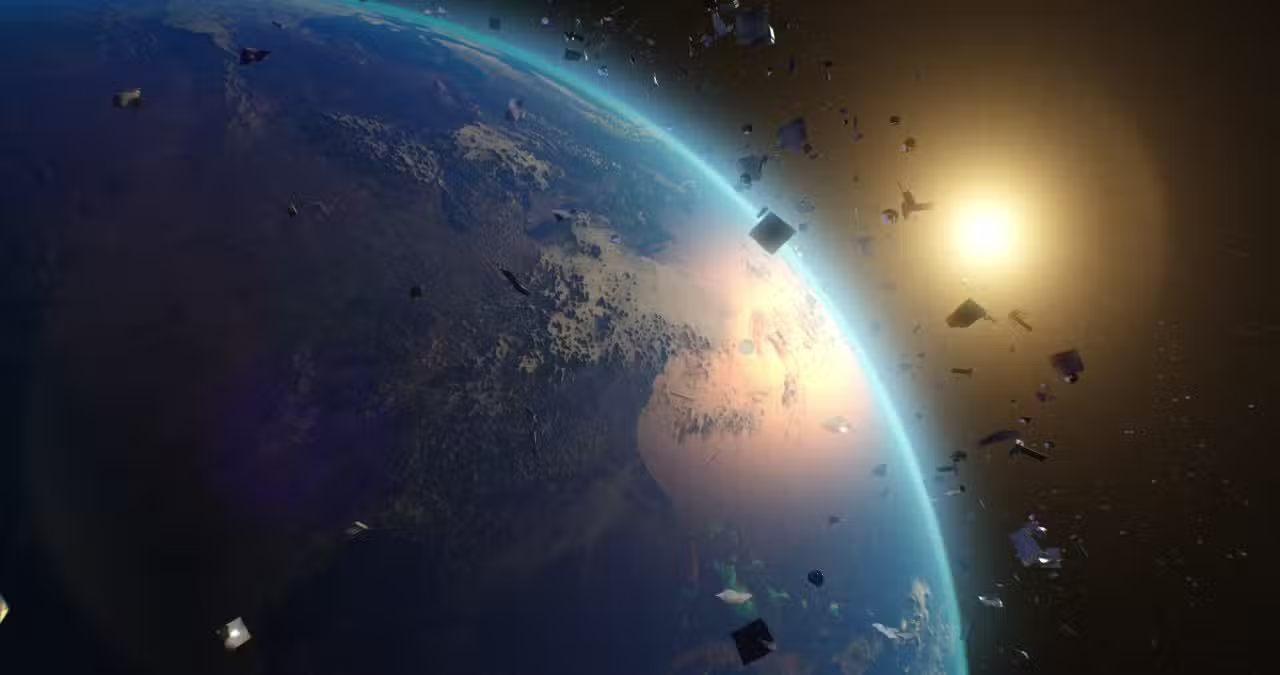
Fragmentos of decommissioned spacecraft and satellites are falling to the Earth’s surface in increasing numbers. Pesquisadores warn that advances in aerospace technology, specifically the use of heat-resistant materials like carbon fiber and advanced metal alloys, are allowing larger pieces to survive atmospheric re-entry. The phenomenon represents a potential risk to people and properties on different continents.
Modern Materiais changes the dynamics of reentry
Historicamente, satellites and rocket components completely disintegrated as they passed through the atmosphere. Hoje the reality is different. Plásticos reinforced with carbon fiber and advanced metals used in contemporary spacecraft were developed to withstand the extreme conditions of space. Esses materials offer significant advantages: they reduce weight, increase fuel efficiency and extend mission lifetime.
The problem emerges precisely from this resistance. Enquanto traditional aluminum and steel melt at temperatures exceeding 1,600 °C generated by atmospheric friction, the new materials remain structurally intact. Componentes fibers are able to cross denser layers of the atmosphere without completely fragmenting, reaching the ground in larger pieces than expected.
Pesquisadores of Universidade of Wisconsin-Stout are currently investigating ways to modify the thermal properties of these materials. The objective is to maintain the performance of space missions without compromising terrestrial safety. The unpredictability of how these fragments behave during fall significantly complicates calculations of safe re-entry zones.

Casos documents reveal scale of problem
Practical Incidentes illustrate the magnitude of the phenomenon. Pedaços from SpaceX’s Dragon capsule, some larger than a 15-passenger van, have fallen into Carolina from Norte, Austrália and Canadá in recent years. Carbon fiber Componentes that store pressurized gases, used for maneuvering spacecraft, were recovered in Argentina, Polônia and Austrália.
In 2024, debris from the explosion of SpaceX’s Starship hit a tropical island, demonstrating that no geographic region is completely protected. The random distribution of fragments occurs because these materials shatter unpredictably, often falling far from their previously calculated locations.
Física from falling and extreme speeds
Satélites like SpaceX’s Starlink orbit between 305 and 2,000 kilometers altitude. Viajam at speeds exceeding 27,000 kilometers per hour. Quando deactivated or discarded, begin gradual descent encountering air molecules in continuous collision.
Friction generates temperatures above 1,600 °C. Esse heat should disintegrate any conventional material. Ligas advanced carbon fiber composites resist for extended periods, allowing larger fragments to survive re-entry intact and reach the Earth’s surface with destructive potential.
Segundo researchers, the fragmentation of these new materials follows less predictable patterns than their predecessors. Modelos computational systems often fail to accurately predict where debris will fall, complicating warning and protection systems.
Explosão of launches amplifies risks
The volume of objects sent into space has grown exponentially. In 1960, approximately 100 objects were launched annually. In 2025, this number reached 4,500 launches. The change reflects the commercialization of the space sector and competition between private companies.
SpaceX and Rocket Lab are leading this growth, planning satellite constellations that will number in the hundreds of thousands in the coming decades. Cada launch adds potential for future space junk. Componentes reusable rockets increase the amount of material in orbit. Satélites have a limited lifespan, generally between 5 and 15 years, after which they become debris.
International Organismos recognize the urgency of establishing orbital cleaning protocols. Simulações indicate that without intervention, collision events between existing debris will create more fragments, multiplying the risks. Essa chain reaction is known as Kessler syndrome in scientific circles.
Desafios regulatory and security
Agências spacecraft face difficulties in regulating the growth of orbital traffic. International Tratados such as Tratado of Espaço Ultraterrestre of 1967 establish responsibilities, but lack effective enforcement mechanisms. Países does not have clear jurisdiction over debris that falls into its territories when originating from other launchers. The transnational nature of the problem requires multilateral coordination that does not yet exist on the necessary scale.
Sistemas tracking devices only monitor objects larger than 10 centimeters. Detritos minors escape surveillance, posing additional risk. Impactos of millimeter fragments can damage operational satellites or space stations. Instituições like Agência Espacial Europeia develop waste removal technologies, but operational implementation remains experimental.
Perspectivas future and solutions in development
Especialistas indicate a need for fundamental change in the space industry. Novos satellites must include automatic deorbitalization systems, ensuring controlled reentry after end of life. Alternative Materiais that disintegrate completely during reentry are being researched, although they still compromise the technical performance of the missions.
The scientific community is intensifying studies on atmospheric reentry and the behavior of advanced materials under thermal stress. Universidades collaborate with space agencies on fragmentation modeling. Simulações computational systems are continuously improving, increasing the accuracy of debris trajectory predictions.
Commercial release Empresas begins voluntarily implementing mitigation practices. Separação of rocket stages at specific altitudes reduces risk of uncontrolled fall. Less dangerous Combustíveis and designs that facilitate disintegration gain traction in the industry. Contudo, commercial pressures still predominate over environmental safety considerations in many operations.