

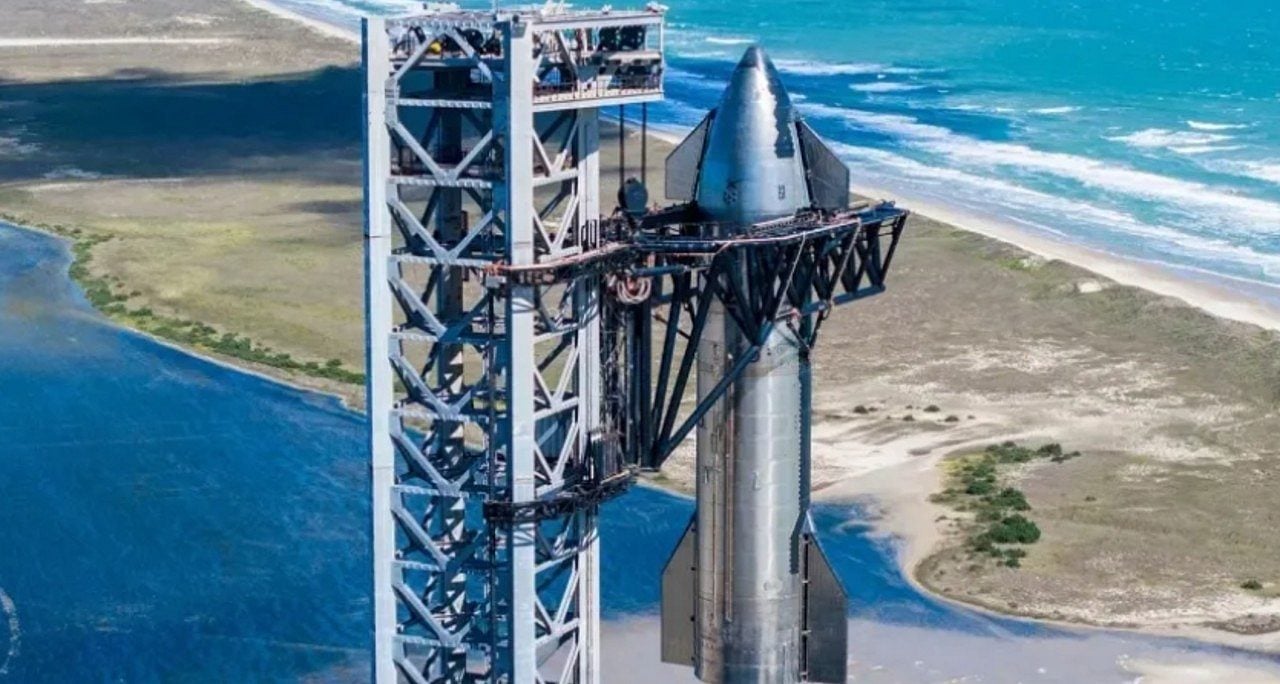
SpaceX is preparing a new and crucial launch of its Starship, the largest and most powerful rocket system ever developed globally, for this Thursday (21). The takeoff, scheduled for 7:30 pm, Brasília time, represents the resumption of flight tests after an interval of seven months. Este event is vital to the company’s ambitious plans for Elon Musk, which envision future crewed and cargo missions for the Lua and Marte.
Desafios full reuse technology
The complete Starship system stands out for its impressive height of 124 meters, comparable to a building of around 40 floors. The design of this revolutionary vehicle is based on the premise of total reuse, an objective that seeks to drastically reduce the costs of accessing space, making it more frequent and economically viable. Diferentemente from previous rockets that only recovered parts, the Starship and its Super Heavy booster are designed to return to the Terra and be reused quickly. Esse is an engineering feat that presents numerous challenges, from structural resistance to extreme conditions to the complexity of precise vertical landing systems. Full reusability is seen as the next big step in space exploration, promising to change the paradigm of how missions are planned and executed. Starship, functioning as the main ship, measures 52 meters in height and was designed to transport astronauts and equipment.
Componentes and Starship system main dimensions:
- Altura total: 124 meters (equivalent to a 40-story building).
- Starship (ship): 52 meters high, upper part of the system, for cargo and crew.
- Super Heavy (drive): 72 meters high, lower stage, responsible for takeoff.
- Capacidade load: 100-ton Mais to Earth orbit.
- Material construction: Aço stainless, chosen for its resistance to high temperatures and cost-effectiveness.
Motores Raptor boost Super Heavy
The Super Heavy thruster, 72 meters high, is the beating heart of the Starship. Ele is equipped with 33 Raptor engines, which use an innovative combination of liquid methane and liquid oxygen as propellants. Essa fuel choice offers significant advantages such as greater efficiency and the possibility of refueling on other celestial bodies, such as Marte, where methane can be produced from local resources. The Raptor engines represent a substantial technological advancement in rocket propulsion, being specifically developed to be not only powerful, but also highly reusable, supporting multiple ignition and shutdown cycles.
More on this story: SpaceX postpones Starship flight 13 due to bad weather and impacts plans for the Moon
Developing and integrating so many engines into a single stage presents complex engineering challenges. It is crucial that all 33 engines work in perfect synchronization during takeoff to generate the necessary thrust and ensure the vehicle’s stability. The combination of the Super Heavy with the Starship spacecraft on top consolidates the system as the most powerful ever built, surpassing any other rocket in terms of payload capacity and thrust potential. SpaceX engineers have worked extensively to optimize the performance and reliability of these engines, considering the demands of long-duration space missions and the need to reduce operating costs through reuse.
Planos bold to exploit Lua and Marte
Starship is not just a launch vehicle; she is a central pillar in Nasa’s plans for the Artemis program. Este ambitious program aims to return astronauts to the lunar surface, establishing a sustainable human presence on Lua as a springboard for future trips to Marte. Starship was selected by Nasa as the Human Landing System (HLS), or human landing system, which will take astronauts from lunar orbit to the surface, marking a historic moment in space exploration.
Além from its lunar role, SpaceX has even higher expectations for Starship. Elon Musk envisions the ship as the primary mode of transportation for colonizing Marte, transporting hundreds of people and tons of equipment to establish human settlements on Planeta Vermelho. The long-term vision includes the creation of a multi-planetary civilization, with Marte as the next big step. Starship is also being considered for more immediate and futuristic applications, such as fast suborbital travel between different points of Terra. Esses routes, which could connect major cities in less than an hour, promise to revolutionize global transportation, although they still face complex regulatory and safety challenges. The ability to transport massive payloads opens doors for the construction of space infrastructure, such as orbital stations and giant telescopes, which were previously unfeasible due to weight and volume restrictions of traditional rockets.
Histórico testing and overcoming failures
Apesar of the euphoria surrounding each new release, the development trajectory of Starship has been marked by a series of tests that, on several occasions, culminated in failures and explosions. Esses incidents, while challenging, are an intrinsic part of the “trial and error” methodology adopted by SpaceX, which prefers to learn quickly from failures rather than striving for perfection from the start. Cada explosion or failure in flight has provided valuable data, allowing engineers to identify weaknesses in design, materials or operating procedures. The pressure on SpaceX increases with each failure, not only from a technical and safety point of view, but also in relation to the financial market and the space industry, which closely observe the company’s progress.
Industry Analistas often question the speed of Starship’s development and whether it will be able to reach operational maturity in time to meet the ambitious goals of its customers, such as Nasa, and Elon Musk’s own projections for Marte colonization. The complexity of the system and the technological innovation involved mean that setbacks are almost inevitable in a project of this scale. However, SpaceX has demonstrated a remarkable ability to recover and adapt, incorporating lessons learned into each new prototype and test. Esse continuous cycle of design, build, test and iteration is critical to aerospace engineering, especially in such a cutting-edge field. The optimization process involves everything from small adjustments to the engines to major modifications to the vehicle’s structure, all to increase the probability of success in future missions. With each flight, regardless of the final outcome, the company accumulates invaluable knowledge about the rocket’s behavior under real flight conditions, which is crucial to ensuring safety and efficiency in future operations, including transporting humans into deep space.
Learn more: SpaceX Starship prepares for 14th test flight aiming for September 2026 launch
Starship in the panorama of the global space race
The development of Starship by SpaceX is part of a scenario of renewed and intense space race, which now involves not only government agencies, but also a growing number of private companies. Esta Competition is particularly sharp between powerhouses like Estados Unidos and China, both of which have robust space programs and far-reaching ambitions in lunar and Martian exploration. The Starship’s ability to transport massive and potentially reusable payloads at high frequency represents a significant strategic advantage for the Estados Unidos, strengthening its leadership in commercial space and deep exploration.
Starship’s success could redefine the economics of space, making access to orbit and other planets exponentially cheaper and more accessible. Essa change would have profound implications for a variety of industries, from deploying global internet satellite constellations to mining for resources on asteroids and other celestial bodies. China, in turn, has invested massively in its own space program, with projects for space stations, lunar missions and rovers in Marte, seeking to compete directly with American capabilities. The race is not just technological, but also geopolitical and economic, with each nation seeking to demonstrate supremacy and open new frontiers for development and exploration. Empresas like Blue Origin, Jeff Bezos, and United Launch Alliance are also developing their own next-generation rockets, highlighting a competitive and innovative ecosystem that drives technological advancement around the world. Starship, with its unprecedented capabilities, is a symbol of this new era of space exploration, where innovation and audacity can take humanity to previously unimaginable destinations. Sua’s ability to fundamentally transform the cost and frequency of space travel has the potential to catalyze a revolution in the way civilization accesses and uses space, with repercussions that will extend for decades.