

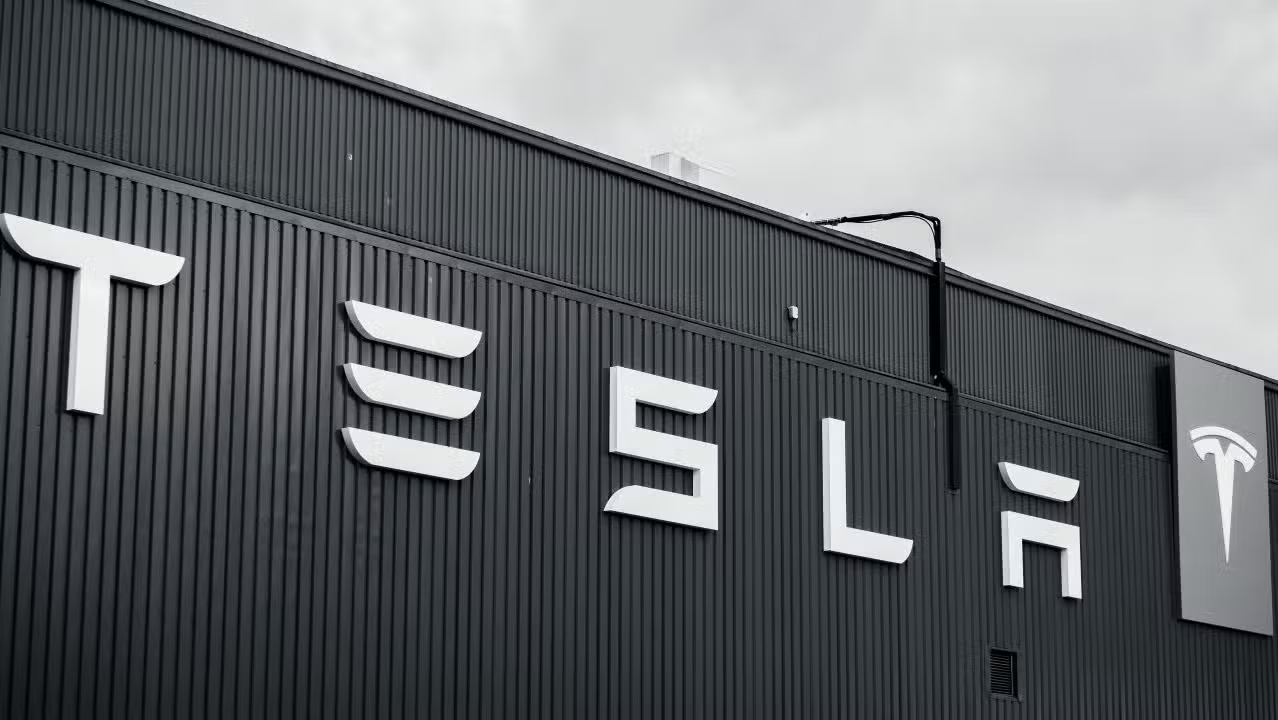
Intel confirmed integration into the Terafab project in a strategic alliance with Tesla, SpaceX and xAI. The joint initiative envisages the construction of a mega-facility dedicated to semiconductor production in the city of Austin, in Texas. The consortium estimates a financial investment of US$25 billion to build the industrial complex. The central objective of the operation is to achieve an annual computing capacity of 1 terawatt. Esse massive processing volume will meet specific demands of artificial intelligence, data infrastructure and advanced robotics.
Collaboration defines complementary roles for each corporation involved in the venture. Intel assumes the technical and operational leadership of the factory. The manufacturer provides its expertise in design, lithography and encapsulation on an industrial scale. In return, the companies founded by Elon Musk guarantee the necessary capital injection and a continuous demand for the components. Esse business model eliminates Tesla and its sister companies from developing complex wafer production processes from scratch.

Divisão of responsibilities in the production chain
The agreement strengthens Intel’s foundry division in the global technology market. The business unit, known as Intel Foundry, actively seeks large clients to enable investments in cutting-edge structures. The partnership with the Elon Musk companies provides the order volume required to justify the manufacturing expansion in the Estados Unidos. Analistas from the sector believes that the union benefits all parties involved. Intel gains immediate market share. The Tesla ensures continuous supply.
The electric vehicle manufacturer already has active contracts with Samsung and TSMC to manufacture AI5 and AI6 generation chips. The entry of Intel as a third strategic supplier diversifies the company’s supply chain. Dependence on a few Asian factories poses a logistical risk for American companies. The new alliance mitigates this vulnerability and accelerates the delivery of critical components for ongoing projects.
The original design of the Terafab project was presented last month with the proposal for a vertically integrated installation. The initial plan described a campus capable of bringing together design, lithography, memory manufacturing and testing in a single location. The membership of Intel gives immediate technical viability to this ambitious vision. Independently building a competitive sub-2 nanometer process would require decades of research by Tesla.
Especificações techniques and infrastructure on Texas
The facility’s main technical infrastructure will operate under the direct command of Intel. The company will employ the 18A manufacturing process, which is already in the large-scale production phase. The advanced encapsulation technology developed by the company also forms the basis of operations in the new complex. Esses technical elements ensure the production of high-performance chips with superior energy efficiency.
- The 18A process allows the creation of smaller, more efficient transistors for heavy processing.
- The industrial complex combines logic, memory and advanced packaging in the same physical environment.
- The strategic location takes advantage of the existing infrastructure on Giga Texas’s north campus.
- The 1 terawatt target guides engineering decisions from the initial earthworks phase.
Choosing Austin to host the project facilitates logistical integration with Tesla’s current operations. The Texan region has consolidated a robust technological ecosystem in recent years. Esse environment attracts highly qualified professionals and facilitates access to suppliers of essential materials. The physical proximity between the Intel and Tesla engineering teams speeds up the resolution of daily production bottlenecks.
Impacto geopolitics and semiconductor market
The initiative meets the geopolitical demands of the American government. Promoting local semiconductor production has become a national security priority in the Estados Unidos. Dependence on imported chips affects strategic sectors of the economy. The Terafab project uses domestic infrastructure to meet the growing needs for electric mobility and artificial intelligence.
The projected volume of 1 terawatt per year represents a milestone in the computing capacity available on American soil. Intel seeks to regain its leadership position against Asian competitors in outsourced component manufacturing. Securing billions of dollars in orders from SpaceX and xAI provides the financial stability necessary for this resumption. The strategy of attracting anchor customers demonstrates practical results with the formalization of this announcement.
The division of roles optimizes the use of each organization’s specialized skills. Intel focuses its resources on innovating lithography and three-dimensional packaging processes. Tesla, SpaceX and xAI focus on logical processor design and software architecture. Essa separation of tasks eliminates overlapping efforts and reduces the time it takes for final products to reach the market.
Aplicações practices in artificial intelligence and robotics
The global market is experiencing an accelerated expansion in demand for hardware dedicated to artificial intelligence. Complex Aplicaçõess require unprecedented amounts of parallel processing. The Optimus humanoid robot, developed by Tesla, relies on advanced neural networks to interact with the physical environment. Training these language and computer vision models consumes massive dedicated server capacities.
The companies involved are currently progressing in the detailed planning of the physical installation. Intel works on adapting its process technology to meet the unique specifications required by partners. xAI and SpaceX technical teams define silicon parameters aligned with their proprietary platforms. The construction schedule takes advantage of the maturity of technologies already tested by Intel in other industrial plants.
The resulting structure positions the consortium with greater autonomy in the supply of fundamental parts for technological innovation. The collaboration sets a new standard for addressing scaling challenges in the semiconductor industry. The combination of manufacturing expertise with guaranteed demand creates the material conditions for project execution. The next steps in the schedule focus on the acquisition of extreme lithography equipment and the hiring of specialized engineers for the continued operation of the plant at Texas.