

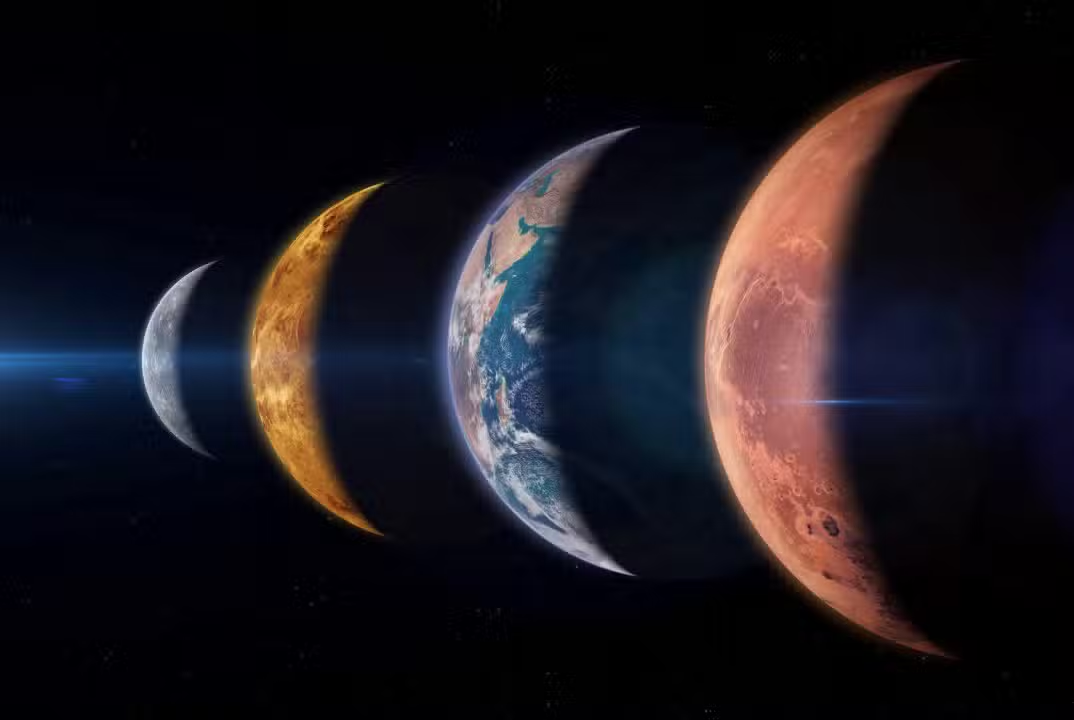
An international team of astronomers led by Universidade Cornell has completed detailed mapping that identifies 45 rocky exoplanets with theoretical conditions to support life. Scientists analyzed a database containing around 6,000 worlds already discovered outside the solar system. The research establishes a catalog of priorities for future astronomical observations. The focus is on celestial bodies located in the habitable zone of their respective stars.
The habitable zone represents the orbital region where temperatures allow liquid water to exist on the planetary surface. The study used information captured by the Gaia space telescope and crossed these numbers with official NASA files. The screening results were peer reviewed and published in the scientific journal Monthly Notices of the Royal Astronomical Society. The final list discards gas giants and prioritizes planets with a composition similar to Terra.
Critérios astronomical data selection and analysis
The filtering process required the application of rigorous parameters to the global catalog of space discoveries. Lisa Kaltenegger, the researcher who coordinated the survey, defines the work as a navigation map for modern science. The team evaluated the stellar radiation received by each planet to determine the thermal viability of the surface. Temperaturas extremes eliminate the possibility of liquid water. Water acts as a universal solvent and primary requirement for known biology.
Astronomers consolidated information from different observing instruments to ensure the accuracy of the final list. The methodology adopted by Universidade Cornell crossed complex astrophysics variables. The group established a verification protocol that includes the following analysis pillars:
- Registros astrometric images from the Gaia telescope operated by Agência Espacial Europeia.
- Catálogo public list of exoplanets maintained by NASA servers.
- Medições surface temperature and rock composition estimates.
- Avaliação of orbital stability and host star behavior.
- Potencial for future capture of spectrographic data from the atmosphere.
The preference for rocky worlds is based on the structure of our own solar system. Planetas with solid surface provides the necessary substrate for complex chemical reactions. Gas giants have crushing atmospheric pressures and lack of defined land. The research recognizes, however, that extraterrestrial biology may operate under different rules. Lisa Kaltenegger points out that life’s adaptive capabilities may exceed current expectations of Earth science.
Sistemas stellar priorities and relative distances
The final catalog highlights targets that are already among the most important discoveries in contemporary astronomy. The exoplanet Proxima Centauri b tops the list in terms of proximity. The celestial body orbits the closest star to our solar system, located just 4.2 light years away. Essa’s cosmic neighborhood makes the planet the most accessible candidate for future interstellar probes. Outros worlds require as yet non-existent propulsion technologies for a physical visit.
The TRAPPIST-1 system concentrates the largest number of promising targets in a single region of space. The red dwarf star, located 40 light years from Terra, is home to seven rocky planets in its orbit. Quatro of these worlds are in the habitable zone: TRAPPIST-1d, TRAPPIST-1e, TRAPPIST-1f and TRAPPIST-1g. The multitude of options in the same system optimizes telescope observation time. Astronomers can study different stages of planetary evolution by pointing instruments at a single coordinate.
The list also includes more distant planets that have exceptional physical characteristics. The exoplanet LHS 1140b orbits a star 48 light-years away and attracts attention for its density and stable orbit. Kepler-186f is located around 500 light-years away and represents a historic milestone as it was the first world the size of Terra discovered in the habitable zone. TOI-715b, located 137 light years away, appears as a recent addition to the catalog after detection by planetary transit satellites.
Atmospheric Observações and the role of new telescopes
The identification of the 45 candidates solves a logistical problem for the international astronomical community. Time to use cutting-edge equipment costs millions of dollars and requires scheduling years in advance. Telescópio Espacial James Webb has the technical capacity to analyze the light that passes through the atmospheres of these exoplanets. The Universidade Cornell list indicates exactly where the equipment should point its mirrors. The central objective is to search for biosignatures.
Biosignatures comprise gases that, in Terra, result from continuous biological processes. The simultaneous detection of oxygen and methane in an alien atmosphere would provide a strong indication of organic activity. Esses gases react with each other and would disappear quickly without a constant replenishing source. The presence of ozone and nitrous oxide is also on the list of chemical markers sought. Spectroscopy makes it possible to break down starlight and identify the unique signature of each chemical element present in the planet’s air.
The researchers warn that the detection of gases does not guarantee the existence of living beings. Geological and volcanic Processos can generate similar compounds without any biological intervention. The analysis requires building complex climate models to rule out false positives. Agência Espacial Europeia and NASA are working on developing next-generation telescopes designed specifically for this task. The current mapping serves as a foundational document for planning these future space missions.
Conexões theoretical with pop culture and alternative ways of life
Advances in cataloging exoplanets bring rigorous science closer to concepts explored by science fiction. Researcher Lisa Kaltenegger drew parallels between the study and recent cinema works. The film “Hail Mary” illustrates emergency missions aimed at specific star systems. The work mentions real stars like Tau Ceti and 40 Eridanus. Embora these systems do not appear in the list of the 45 main candidates, the mention demonstrates how astrophysics influences the popular imagination about life in the universe.
The scientific quest is not restricted to carbon-based terrestrial biological patterns. Astrobiologists consider the viability of organisms with radically different metabolisms. Scientific literature discusses the possibility of life forms structured from silicon or using ammonia as a solvent instead of water. Essas alternative biochemistry expands the habitable zone concept. Planetas considered too cold or hot for conventional biology could harbor exotic ecosystems.
The inclusion of wider tolerance margins in climate models makes it possible to evaluate extreme scenarios. Alguns of the 45 selected exoplanets present synchronized rotation, keeping one face permanently facing the star and the other in eternal darkness. Life on these worlds could thrive in the terminator zone, the transitional strip between perpetual day and night. The atmosphere on these planets would need to distribute heat efficiently to prevent global freezing or total evaporation of the oceans.
Impacto in future space agency missions
The refinement of the planetary catalog sets the space exploration agenda for the coming decades. Government agencies use this data to justify funding for new ground and space observatories. The proportion of 45 strong candidates out of 6,000 findings provides an important statistical basis. Astronomers can extrapolate these numbers to estimate the total number of habitable worlds in Via Láctea. The galaxy is home to billions of stars with their own planetary systems.
Sending robotic probes to neighboring systems remains a long-term goal for aerospace engineering. Projetos theorists propose using solar sails driven by terrestrial lasers to reach the star Proxima Centauri in about 20 years. The concentration of planets in the TRAPPIST-1 system makes the region the most attractive destination for a multiple exploration mission. A single probe could fly by the planets TRAPPIST-1d, TRAPPIST-1e, TRAPPIST-1f and TRAPPIST-1g in sequence.
The list published on Monthly Notices of the Royal Astronomical Society will be constantly updated. The launch of new telescopes and improved detection techniques will add new worlds to the catalog. Alguns of current candidates may lose priority status if future observations reveal toxic atmospheres or an absence of water. Universidade Cornell’s work fulfills the role of establishing the first practical roadmap for the search for extraterrestrial life in the 21st century.