

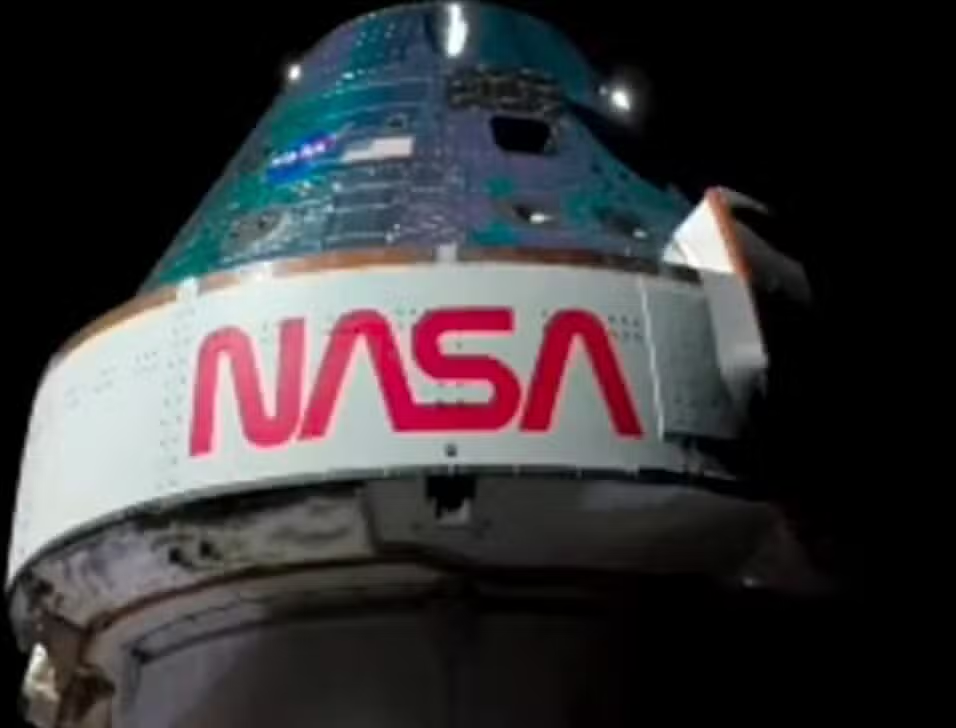
The Sonear observatory, located in the city of Caeté, in the metropolitan region of Belo Horizonte, managed to record unprecedented images from the Orion capsule during the execution of the Artemis II mission. The high-precision equipment followed the path of the manned spacecraft at a distance that exceeded the 300,000 km mark of Terra. The visual capture took place over several consecutive nights of astronomical monitoring, requiring perfect alignment of the lenses with the route calculated by the space agencies.
The initiative coordinated by engineer and astronomer Cristóvão Jacques documented the evolution of the spacecraft’s distance from the planet on a continuous basis. Earth observation work provides an independent visual perspective that complements telemetry data transmitted directly by Nasa to control centers. The technical team needed to make fine and constant adjustments to the telescopes to maintain focus on an object that travels at very high speed through deep space, overcoming the limitations imposed by the Earth’s atmosphere.
Night Monitoramento and distances reached by the spacecraft
Monitoring the trajectory required intensive dedication from mining professionals during the period away from the capsule. The observations began shortly after a critical orbital maneuver and extended over five nights of work focused on tracking the equipment. The ability to capture the light reflected by the metallic structure decreases considerably as the vehicle approaches lunar orbit.
The photographic records demonstrate the progression of the journey at different stages of separation from our planet, creating a visual archive of the trajectory followed by the mission. The team cataloged the exact moments when the spacecraft crossed important kilometric milestones in space, generating data that confirms the accuracy of the orbital calculations.
- The first image in the sequence was obtained when the capsule was approximately 36 thousand kilometers from Terra.
- Intermediate captures showed the vehicle crossing the 200,000 kilometer mark during the early hours of the morning.
- The latest photographs taken by the telescope recorded the object close to 400 thousand kilometers away.
Essa visual progression proves the feasibility of using private terrestrial infrastructure to monitor complex government missions. The recording made on Tuesday marked the point of greatest distance clearly captured by the lenses of the Sonear observatory. Astronomers planned new observation attempts for the following Thursday, depending on weather conditions in the metropolitan region of Belo Horizonte.
Contexto from mission Artemis II and crew on board
The mission launched in early April represents a milestone in the recent history of international space exploration. The flight carries four astronauts, three Americans from Nasa and a representative from the Canadian space agency, on a journey lasting approximately ten days. The main objective is to validate life support systems in a deep space environment before authorizing landings on the lunar surface.
The crew is made up of astronauts Reid Wiseman, Victor Glover, Christina Koch and Jeremy Hansen. The group successfully completed the flyby around Lua, testing the resistance of navigation and communications equipment under extreme radiation and microgravity conditions. Human presence in this region of space has not occurred since the closure of the Apollo program, more than five decades ago.
The information collected by the crew during the journey serves to improve safety protocols for future expeditions that will require longer stays in space. Engineers evaluate the behavior of thermal protection materials and the efficiency of the solar panels that power the spacecraft modules during the dark period. The success of this test stage guarantees the continuity of the schedule established by partner space agencies for the construction of a permanent orbital infrastructure.
Desafios astronomical observation technicians on Brazilian soil
The work carried out on Caeté involved overcoming technical obstacles inherent to the observation of small moving targets. Professionals adjusted the exposure parameters of the cameras attached to the telescopes as Orion moved away from Terra and lost apparent brightness in the night sky. Light pollution and atmospheric instability require the use of specific filters to ensure the sharpness of the images captured.
Equipamentos like those installed in the Sonear observatory allow monitoring missions in real time without depending exclusively on radio signals transmitted from space. Essa capability expands the possibilities for studying and documenting space flights by independent institutions. Astrônomos amateurs and professionals from different parts of the world form a monitoring network that helps confirm trajectories calculated by Nasa computers.
The Brazilian contribution highlights the level of precision achieved by observatories installed in the country, which operate with cutting-edge technology for tracking satellites and probes. Visual documentation of the spacecraft’s trajectory at extreme distances reinforces scientific interest in terrestrial observations of space events of great international relevance. The raw data obtained by Minas Gerais lenses can be crossed with official information for academic studies on orbital mechanics and light propagation in a vacuum.
Retorno of the capsule and next steps in lunar exploration
The Orion capsule completes the return phase to Terra this Friday with its scheduled re-entry into the Earth’s atmosphere. The space vehicle needs to withstand very high temperatures generated by friction with the air before activating the main parachute system. The rescue team awaits the moment of splashdown, which should occur in the waters of the Pacífico ocean, officially ending the first manned mission of the Artemis program.
Especialistas of Nasa will use the information consolidated after the rescue to refine human health protocols for long-haul travel. Understanding the lunar environment and the effects of radiation on the astronauts’ bodies determines the planning of the next phases of the project. The space program’s main goal is to establish a sustainable human presence on Lua, with surface landings expected to occur by the year 2030.
Tests carried out during the current mission provide critical data on the behavior of complex systems under real flight conditions. The results directly influence the development of new technologies for the exploration of Marte in the coming decades. The international scientific community continues to monitor developments in the crew’s safe return, as observatories like Sonear prepare to track the space program’s future launches.