

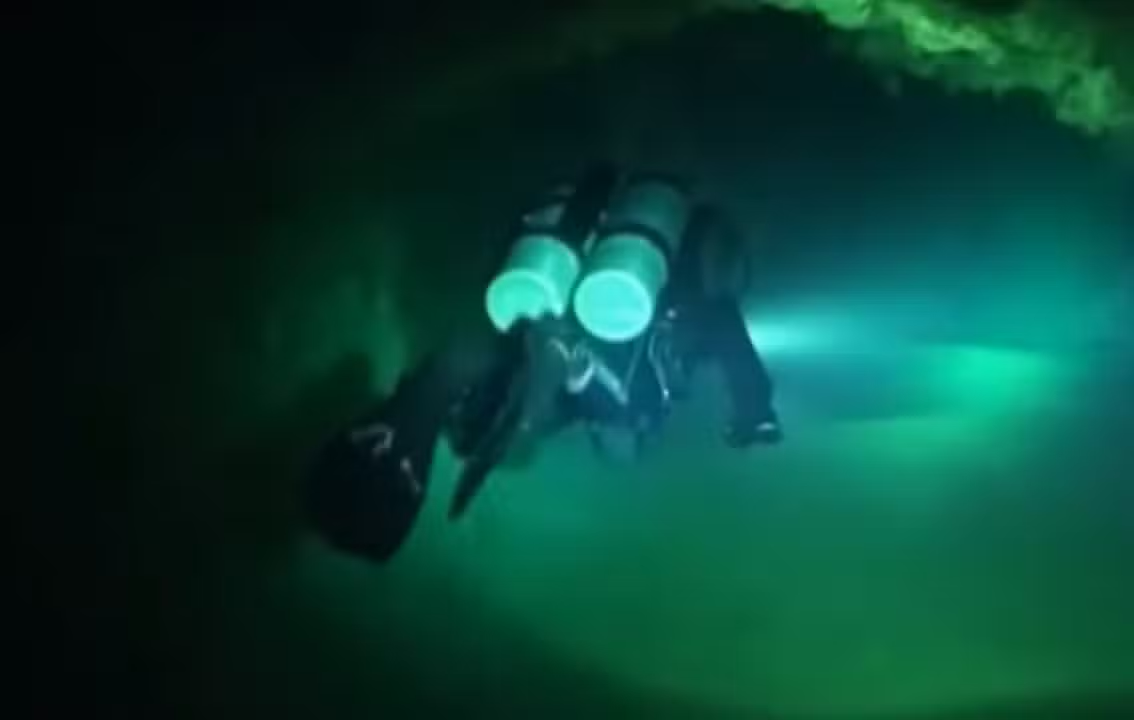
Universidade of Gênova officially declared that the expedition into an underwater cave complex at Maldivas was not part of the institution’s scientific activity schedule. The accident, recorded on May 14, resulted in the death of five Italian citizens while exploring the site. The management of the higher education entity argues that the operation took place on a strictly personal initiative by those involved. Entre The fatal victims of the incident were professor Monica Montefalcone and researcher Muriel Oddenino, both members of the European university’s staff.
The case generated immediate administrative developments and reactions from the victims’ families. The university administration chose to remove the professional profiles of the two employees from the institution’s official website. The measure provoked strong indignation in Carlo Sommacal, widower of teacher Monica Montefalcone. Questionada regarding the technical or ethical motivation for deleting the pages shortly after the deaths were confirmed, the academic entity’s press office preferred to remain silent and did not issue any additional statement.
Análise Matching and Authorization Protocols
The authorities responsible for investigating the case began a thorough digital tracking process. The main focus is on the institutional emails exchanged between Monica Montefalcone and Departamento, Ciências, Terra, Meio Ambiente and Vida, known by the acronym Distav, the sector where the professor performed her academic duties. Experts attempt to reconstruct the travel planning timeline to understand the university’s level of knowledge about the team’s exact route.
The scrutiny of electronic messages has well-defined technical objectives by international forensic teams. Researchers seek to map the following fundamental points on Distav servers:
- Detalhes of scientific activities previously authorized by coordination.
- Comunicações specifics about planning diving in a cave environment.
- Qualquer mentions requests for authorization for operations in deep waters.
- Registros technical training and specific preparation for confined environments.
The documentation stored on the department’s computers can confirm or refute the thesis of institutional distancing presented by the university. Unrestricted access to Distav’s digital and physical files will occur in the coming days, allowing agents to cross-reference declared information with official research records approved for the current academic year.
Falhas in equipment and lack of prior communication
The local government also presented its version of the bureaucratic procedures of the foreign expedition. Mohamed Hussain Shareef, spokesperson for Presidência of Maldivas, confirmed that the group of Italians had the necessary documentation to dive to depths greater than 30 meters. However, the government representative emphasized that no local maritime authority has received communications about the group’s intention to explore the cave network. Essa immersion mode requires rigorous certifications and differs drastically from open water diving.
The preliminary analysis of the equipment collected at the accident site revealed serious inconsistencies in relation to the explored environment. The reports indicate that most of the material used by the victims was suitable exclusively for recreational diving. The neoprene suit worn by Monica Montefalcone attracted the immediate attention of forensic experts. The teacher was rescued wearing a short version of the diving suit, a model designed by the industry only for quick and shallow water immersions, without any thermal protection suitable for the extreme conditions of deep caves.
Fatores extreme risk and accident dynamics
The reconstruction of the underwater scene points to a succession of critical assessment errors. Gianluca Benedetti, a natural diving instructor from the city of Pádua, was located by rescue teams in the second of the three caves that make up the geological complex. The professional had the cylinder completely empty and the pressure gauge reading zero pressure. The position of the body and the absence of gas suggest an attempt at self-rescue in the final moments of the immersion.
Especialistas in sea rescue detailed the hostile conditions faced by the group of Europeans. Shafraz Naeem, a Maldivian diver with 30 years of experience in sea caves, analyzed preliminary data from the descent. The professional explained that diving almost 58 meters deep using normal compressed air poses a risk of lethal proportions. Nessa depth range, water pressure triggers nitrogen narcosis, a physiological condition that severely compromises the diver’s consciousness, logical reasoning and decision-making ability.
The confined environment amplifies the dangers inherent in extreme depth. The consumption of the gas mixture accelerates exponentially due to physical exertion and psychological stress. Safely ascending a cave becomes a highly complex maneuver, requiring precise navigation without the possibility of direct vertical ascent to the surface. Shafraz Naeem listed cascading factors that contributed to the outcome: narcosis, spatial disorientation, abrupt loss of visibility due to sediment lifting, equipment failures, separation of team members and widespread panic. The expert highlighted that only the conclusion of the investigation will be able to attest to the exact order of events.
Depoimentos of the crew and progress of the examination
The current phase of the investigation focuses on collecting eyewitness testimony and analyzing the base vessel’s routes. Security officers are conducting formal interviews with the other 20 people who were on board the vessel Duke of York. Esses passengers were part of the same tourist and scientific expedition, sharing the common spaces of the vessel in the days before the fatal descent. Survivors’ reports are considered fundamental pieces to understand the atmosphere, conversations and level of planning discussed by the group before entering the water.
Information about the team’s operational failures gained international repercussion after publications in the European press. The newspaper Il Messaggero released the first revelations about the technical errors committed by the divers, basing its reports on sources linked to Maldivian investigators working directly on the case. The publication exposed the fragility of the planning and the incompatibility of the equipment with the complexity of the cave system chosen for exploration.
The joint investigation between Asian and European authorities remains ongoing with no deadline set for the presentation of the final report. Technical expertise works to establish the chain of civil and criminal responsibilities. The prosecutors in the case seek to determine exactly whether there was proven negligence in the logistical planning phases, in issuing travel authorizations and during the practical execution of the dive. Cross-referencing data from the ship’s onboard computer with the victims’ dive computers will provide a definitive picture of the events recorded at the bottom of the sea.