

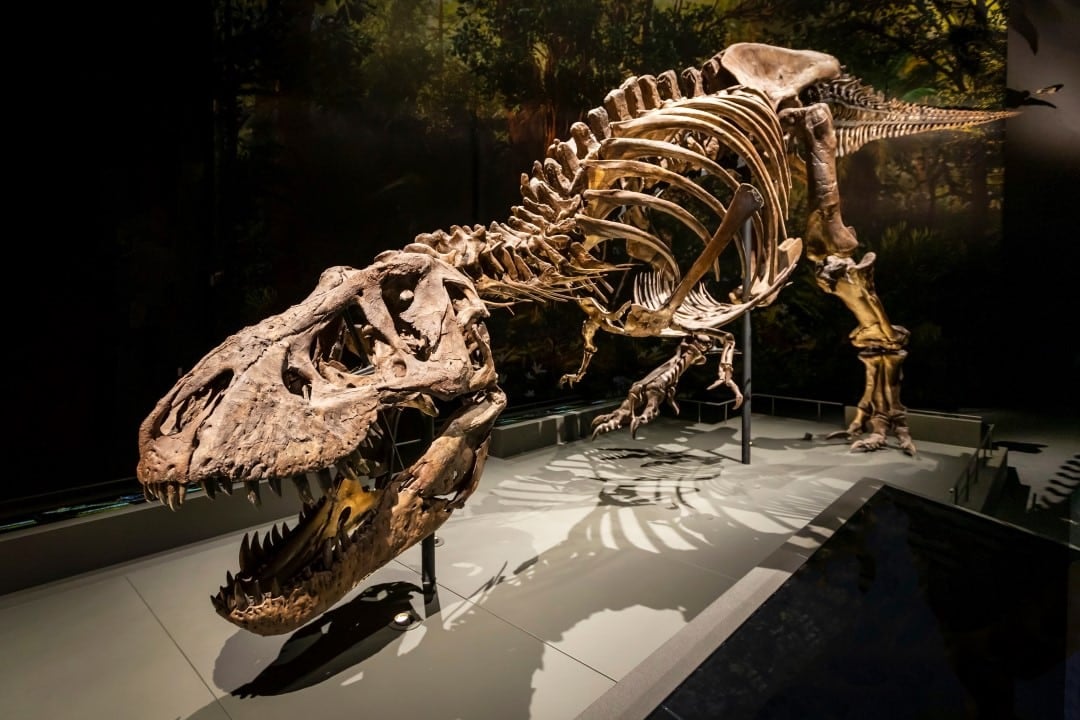
A study published May 20 in a British academic journal offers the most complete explanation yet for one of Tyrannosaurus Rex’s most peculiar features: its disproportionately small arms. The research analyzed 85 species of dinosaurs and concluded that the reduced size of the forelimbs resulted from continuous growth and resource consumption by the skull during evolution.
The T-Rex’s arms measured just 90 centimeters long, less than a third of the length of its hind legs. An adult animal could exceed 12 meters in total length, making this visual disproportionality even more pronounced. The phenomenon has intrigued paleontologists for more than 100 years and generated several hypotheses about its function.
The Conclusion of Research on Skull Development
Charlie Roger Scherer, University College London’s doctoral candidate and lead author of the paper, explained the evolutionary mechanism that produced this feature. Seus data demonstrate that carnivorous dinosaurs with very robust skulls are more likely to have proportionally smaller forelimbs. The absolute size of the animal does not influence the pattern: both dinosaurs that weighed 1 ton and those that weighed 10 tons follow the same trend when they have robust skulls.
The reason lies in a fundamental limitation of the evolutionary process. Segundo Scherer, “evolution doesn’t like everything happening at once.” Quando an organization invests significant resources in developing a structure, reduces the capacity to invest in other areas simultaneously. In the case of T-Rex and similar carnivorous dinosaurs, selective pressure favored the development of an increasingly powerful skull as the main hunting weapon.
Learn more: DNA solves 25-year-old mystery: human remains in sleeping bag in Olympic Park are identified
Competição features in body development
Biological energy allocation works as a compensation system. If a species’ survival strategy depends on a massive, muscular head to capture large prey, the organism saves resources on structures less critical to its immediate survival. The T-Rex’s arms, equipped with claws, no longer represented an adaptive advantage when the skull became the main weapon.
Previous Estudos had already suggested a relationship between the reduction of the forelimbs and the enlargement of the skull in carnivorous dinosaurs. Esses work provided important clues, but lacked robust statistical confirmation. The new study stands out for being the first to confirm this trend in five distinct families of carnivorous dinosaurs, with solid statistical support. The sample of 85 species allowed researchers to identify a consistent pattern that goes beyond individual variations or coincidences.
Teorias previous on small arms
Antes of this research, several explanations competed for the preference of paleontologists. One theory proposed that the small arms served to immobilize prey during the attack. Outra suggested that they played some role in mating rituals or display of status between individuals. A third hypothesis argued that the reduced arms minimized the risk of self-injury during powerful bites, protecting them from injuries caused by the enormous force of the jaws.
Nenhuma of these explanations, however, offered a convincing evolutionary mechanism for why so many carnivorous dinosaurs had the same trait. The solution proposed by Scherer and his team is more elegant: it does not require inventing specific functions for the small arms. Instead, it explains the phenomenon through a universal principle of evolutionary biology—limited resource allocation develops priority structures at the expense of secondary structures.
Implicações for evolutionary understanding of dinosaurs
The discovery expands understanding of how evolution operates under constraints. The process does not optimize all of an organism’s characteristics simultaneously. On the contrary, it establishes priorities based on selective pressure from the environment. Para is a predator that hunts large prey, investing in the evolution of an exceptional skull becomes more profitable in terms of survival than maintaining functional and well-developed arms.
Full coverage: Latest News (EN)
Essa logic extends to other body structures. A smaller or more efficient moving body also receives less energy investment when the skull monopolizes resources. The muscles of the T-Rex’s hind legs, in turn, received significant investment because their function of locomotion and positioning during attacks remained critical to the predator’s efficiency.
Study Metodologia and statistical validation
Analysis of 85 dinosaur species provided enough data to establish reliable correlations. The researchers measured skull and limb characteristics in different species, creating a statistical model that revealed the consistent relationship between cranial robustness and forelimb reduction. Esse type validation in multiple distinct families strengthens the conclusion beyond speculations based on individual fossils.
The five families of carnivorous dinosaurs analyzed showed the same trend, despite having evolved in different periods and in different environments. Essa evolutionary convergence when similar features arise in unrelated species indicates that the relationship between robust skull and small arms responds to fundamental biological principles, not coincidences.
Follow: all about animal evolution
Encerramento from long-time debate
The mystery of the T-Rex’s tiny arms, which has fueled jokes and academic debate for more than a century, finds its explanation through an elegant and parsimonic mechanism. Evolution did not build small arms for some obscure or vestigial function. Simplesmente did not invest resources in structures that became secondary when the skull rose to the status of supreme weapon. Dinossauros carnivores with exceptionally robust skulls left behind reduced forelimbs as an inevitable consequence of this biological prioritization.