

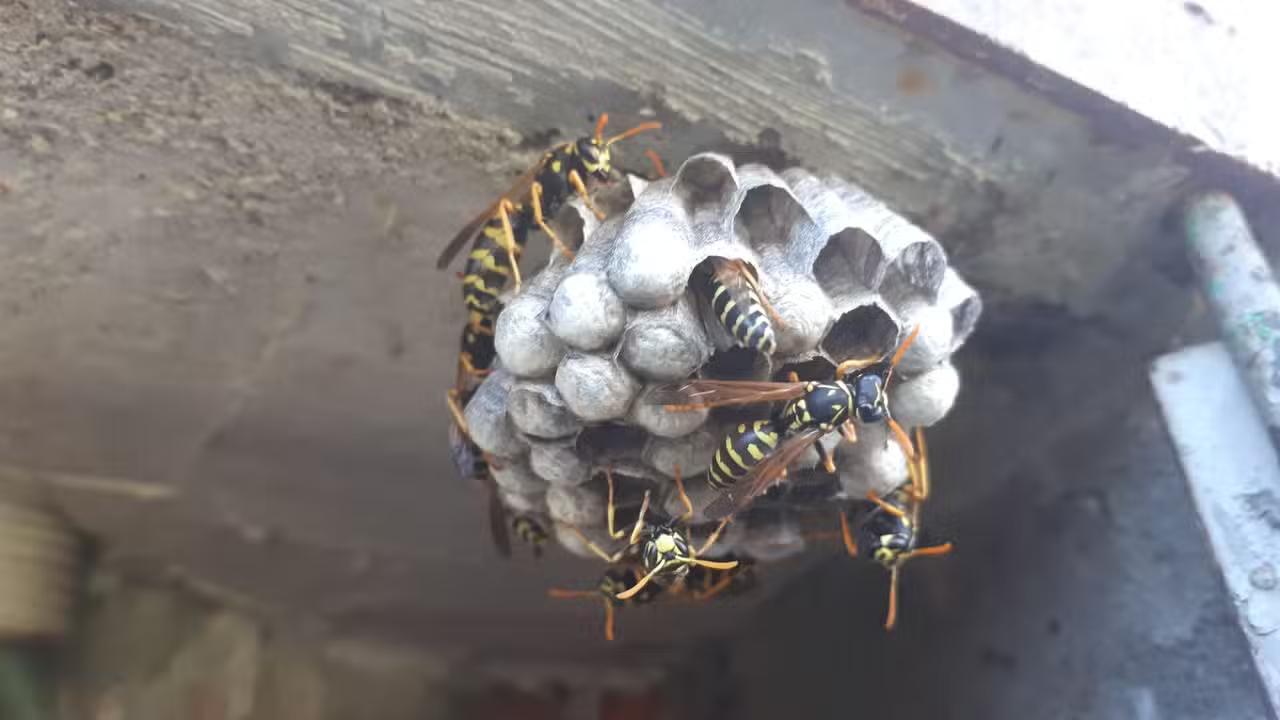
The disappearance of a queen plunges a colony of tropical wasps into chaos, triggering violent power struggles and profound social ruptures. Pesquisadores of Universidade College London discovered that despite the collapse of the established order, the colony does not succumb — some individuals quietly take on essential tasks to ensure survival.
Cientistas removed queens from established colonies of tropical paper wasps (Polistes canadensis) on Caribe to observe the consequences. The effects were immediate and chaotic. Females began to compete aggressively for dominance, transforming the normal social structure of the colony into a period of intense conflict involving multiple individuals.
Conflito opened after the queen’s death
Female wasps of the species Polistes canadensis compete for leadership when the queen disappears. The social structure, normally ordered under a monarchical regime, erupts with violent clashes between candidates for power. Este behavior is common in tropical wasp colonies, where all females retain the biological ability to reproduce, unlike other social insect species.
The research, published in the journal Animal Behaviour, was based on analysis of behavioral data collected during fieldwork at Panamá in the early 2000s. Scientists documented each step of the chaotic transition following queen removal, recording aggressive interactions, hierarchical changes and reorganization of colony functions.
Compensadoras maintain critical functions
Enquanto some wasps fight for power, a distinct group called “compensators” perform essential tasks silently. Instead of joining in on conflicts, these wasps focus on collecting food and caring for their developing young. By continuing to feed the larvae and maintain daily functions, the compensators prevent the total collapse of society.
The Dr. Owen Corbett, lead author of the study and Centro researcher of Pesquisa in Biodiversidade and Meio Ambiente at UCL, explained: “The conflict after the removal of the queen was intense, but it was not the whole story. Enquanto some individuals fought for dominance, others avoided conflict altogether and quietly worked to keep the colony going. Cooperation did not disappear; it was redistributed.”
Escolhas strategic determine roles
Pesquisadores found no clear biological differences between wasps involved in aggressive competition and those acting as compensators. Isso suggests that behaviors reflect strategic choices rather than fixed social roles. Cada wasp apparently assesses its best chance for future reproductive success.
The study’s key findings include:
- Intense Conflito does not cause immediate colony collapse
- Vespas Compensators Maintain Essential Tasks During Crisis
- Survival Comportamentos are strategically chosen
- Cooperação persists even in periods of social turmoil
Algumas wasps prioritize the fight for dominance as their path to reproducing in the future. Outras find greatest benefit in helping to ensure the survival of the litter, which often includes their siblings. Este unconscious biological calculation allows the colony to remain functional during internal political chaos.
Perspectiva different about insect societies
Most previous research on insect cooperative societies has focused on temperate species found in Europa or América of Norte. Essas species exhibit more rigid dominance hierarchies and predictable succession systems. The tropical wasp study examined a much less ordered social structure, where leadership changes are driven by aggression and direct competition.
The findings expand scientific understanding of the diverse ways in which animal societies deal with leadership crises. The results challenge the traditional idea that societies can only remain stable through orderly, rules-based leadership transitions. Embora Aggressive succession systems are often considered too expensive to be sustainable, this study suggests that they still work if a few individuals compensate for the disadvantage.
Professor Seirian Sumner, senior author of the study and Centro researcher from Pesquisa at Biodiversidade and Meio Ambiente at UCL, said: “Understanding how animal societies manage conflict can help us think differently about cooperation in general. In times of turmoil, society depends on those who continue to carry out the essential work behind the scenes. In many ways, we may be more like wasps than we realise.”
Implicações for understanding social organizations
The research was funded by Conselho of Pesquisa of Ambiente Natural (NERC) and Instituição Smithsonian. Scientists have collected data during decades of observation of natural colonies, allowing in-depth analysis of behavioral patterns in different contexts.
The findings suggest that animal cooperation systems are more resilient and flexible than previous models indicated. Quando Rigid structures fail, backup systems emerge naturally. The research offers new insight into how groups maintain cohesion even during severe internal crises, with individuals adjusting roles as necessary for collective survival.