

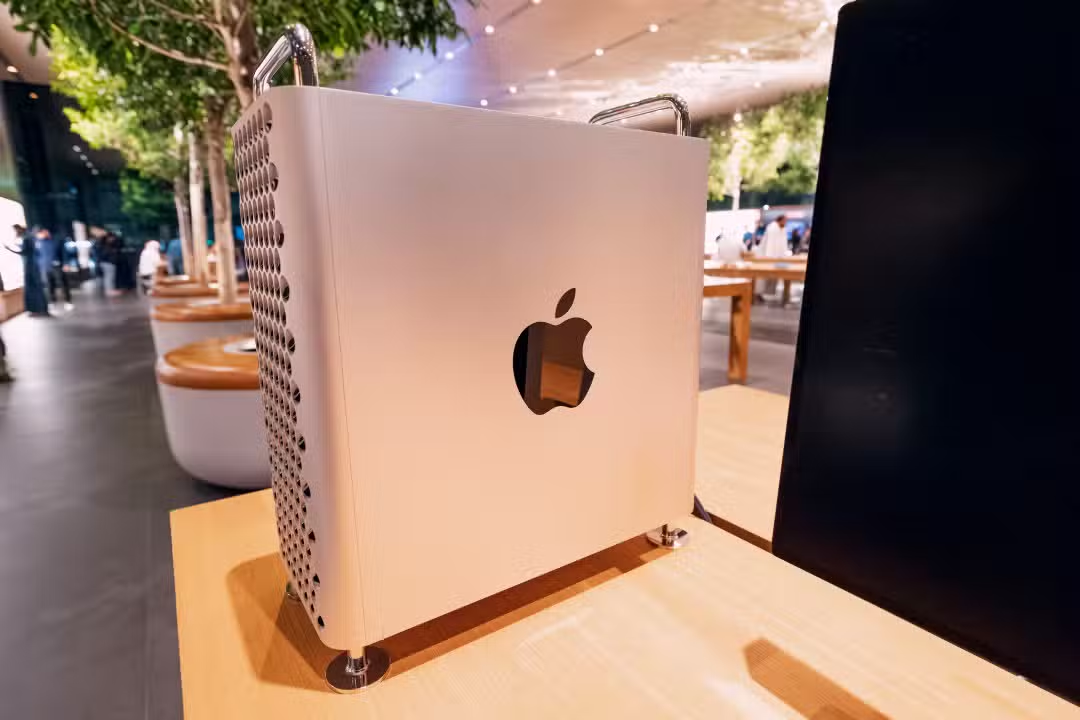
Apple has officially ended production of the Mac Pro after nearly two decades of presence in the high-performance computer market. The decision was confirmed in the last week of March 2026, with the immediate removal of the equipment from the manufacturer’s official website. The company does not plan to develop new versions of this specific model. The movement integrates a broad restructuring of the product line aimed at professional users.
Além from the discontinuation of the tower desktop, the company has applied significant changes to the configuration options of other devices. Mac Studio has seen reductions in the unified memory limit available for purchase. Simultaneamente, the new Pro MacBook models have received standard storage capacity increases. Profissionais from the audiovisual and technology sector need to adapt their workflows to the new specifications offered.
Fim of an era for the brand’s traditional desktops
The Mac Pro represented the pinnacle of modularity within the Apple ecosystem for many years. Usuários depended on the machine to install dedicated graphics cards and internal storage expansions. The transition to the Apple Silicon architecture changed this structural dynamic. The manufacturer’s own chips integrate processor, memory and graphics into a single component. Isso made the large case format obsolete for the brand’s new engineering philosophy.
The equipment’s departure from the catalog marks the end of a line that served film studios and music producers. The Mac Studio now assumes the position of the main desktop solution for extremely demanding tasks. The compactness of the components allowed it to deliver superior performance in a considerably smaller chassis. Clientes that are still using the older towers will need to plan to migrate to the newer platforms.
Restrições memory in Mac Studio affect professionals
The maximum unified memory configuration for the Mac Studio has been dropped from 512 GB to 256 GB. The change is drastic. Essa change directly impacts experts focused on complex 3D rendering and video editing at extreme resolutions on a daily basis. The manufacturer made the decision due to logistical challenges. The prices of memory chips registered significant increases in the global market.
Especialistas from the technology sector indicate that the explosion in the development of artificial intelligence tools has generated unprecedented demand for memory components. Apple chose to prioritize the availability of more affordable and commercial configurations. The company monitors the international semiconductor market.
- The Mac Studio remains available with the latest M-series processors.
- The global shortage of memory chips directly influences the assembly of equipment.
- The manufacturer may return with the 512 GB option after the component supply stabilizes.
The absence of a detailed official statement on the return of this capacity leaves the market on hold. Estúdios animation and heavy software developers evaluate how to optimize their projects to run within the current 256 GB limit. The unified memory architecture compensates for some of this restriction with high data transfer speed.
Nova generation of MacBook Pro with M5 chip gains more space
Notebooks aimed at professionals have received important updates to their base specifications. The 14-inch and 16-inch Pro MacBook models, equipped with the M5 Pro and M5 Max processors, now ship from the factory with at least 1 TB of internal storage. Apple has completely eliminated 512 GB versions for these higher categories. The change meets a long-standing demand from content creators who deal with massive files.
The 14-inch MacBook Pro with the basic M5 chip also now has 1 TB of initial space. The entry price for this specific model has risen to $1,699 in the North American market. The previous version cost $1,599. The value adjustment accompanies the delivery of a solid state disk with greater capacity.
Esse increment in standard storage significantly improves system read and write rates. Fluxos jobs involving multiple 4K or 8K video tracks rely on fast disks to avoid performance bottlenecks. Standardization at 1 TB simplifies consumer choice at the time of purchase.
Transição in the monitor market with the Studio Display XDR
The professional screen segment also underwent a complete overhaul this month. Apple has discontinued the Pro Display The screen offered brightness of up to 1,600 nits and Thunderbolt 3 connections.
The new Studio Display XDR arrives to replace the old model with updated technologies. The monitor is 27 inches and uses mini-LED backlighting with more than 2,000 local dimming zones. Essa feature ensures superior contrast control in dark images. The 120 Hz refresh rate provides greater fluidity when navigating and editing dynamic materials.
The starting price of the Studio Display XDR was set at US$3,299, which already includes the desktop stand. The equipment integrates high-fidelity speakers and a built-in camera. The adoption of the Thunderbolt 5 port enables much faster data transfer rates for connected peripherals. The screen maintains support for wide color spaces such as P3 and Adobe RGB, essential for photographers and designers.
Portfolio’s Reorganização reflects focus on modern components
The cleanup of the Apple catalog has extended to other portable product lines. Older Versões iPad Air and MacBook Air were removed from official stores during the same period. The company’s strategy aims to focus production and sales efforts only on devices equipped with the most recent generations of processors. Isso reduces ecosystem fragmentation and facilitates long-term technical support.
Profissionais that depend on the brand’s ecosystem need to review current specifications before updating their machine parks. The Mac Studio cements its position as the premier desktop tool for intensive processing. The MacBook Pro line notebooks offer mobility without sacrificing raw file storage capacity.
Deep integration between the operating system and hardware continues to be the pillar of the manufacturer’s development. Advanced Usuárioss find in solutions based on Apple Silicon an energy efficiency that old processors were unable to deliver. The changes implemented in March 2026 redefine the standard for digital workstations.