

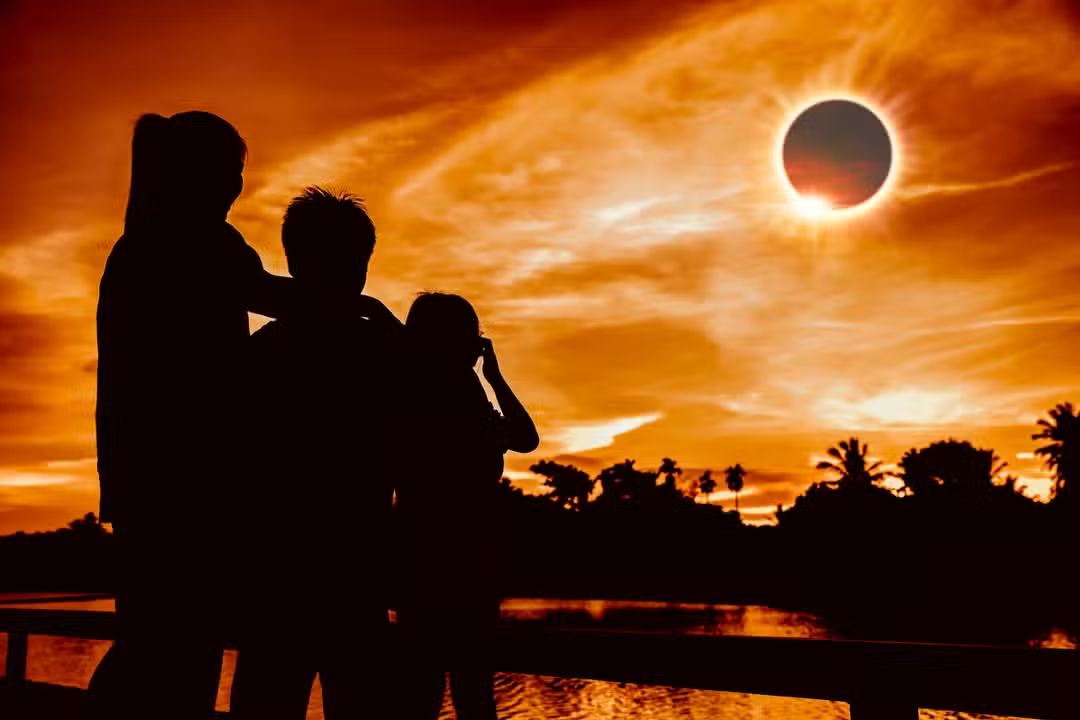
A total solar eclipse will turn day into night in specific regions of Hemisfério Norte on August 12, 2026. The astronomical phenomenon occurs when Lua is positioned millimetrically between Terra and Sol. The shadow cast by the natural satellite will create a narrow band of totality, blocking sunlight for just over two minutes at the points of greatest intensity. Observadores outside this main path will only follow the partial dimming of the solar disk.
The celestial configuration results from a precise orbital coincidence that attracts the attention of scientists and enthusiasts around the world. The event takes place approximately two days after lunar perigee, when Lua reaches its closest point to our planet. Essa proximity ensures an apparent diameter large enough to completely cover the star. The magnitude of the eclipse will reach 1.0386 in the central area of the projection.
Trajetória of the lunar shadow covers regions from Ártico to the European continent
The total darkness route has an unusual design that starts in the far east and moves west. The Península of Taimyr, located in the territory of Rússia, marks the starting point of the shadow before advancing into the icy waters of Oceano Ártico. The route crosses the northeast of Groenlândia and reaches Islândia shortly thereafter. The point of maximum solar blocking duration is at sea, at a distance of 45 kilometers from the northwest Icelandic coast, where totality will last two minutes and 18 seconds.
Após crosses Atlântico Norte, the phenomenon enters the European continent to the north of Espanha and reaches a small portion of Portugal. Complete darkening of the sky will allow naked-eye viewing of stars and planets in broad daylight, depending on local weather conditions. The end of the total phase will occur at Ilhas Baleares exactly at sunset.
The route of totality crosses densely populated areas and isolated points, requiring logistical planning from observers. Key locations with prime visibility include:
- Península of Taimyr and remote areas of Oceano Ártico at the beginning of the route.
- Costa northwest of Islândia and northeast of Groenlândia with the longest event durations.
- Spanish Cidades as Coruña, Bilbao, Zaragoza, Valencia and Palma.
- Extremo northeast of Portugal’s mainland with Sol low on the horizon.
Sol’s position close to the horizon line on Península Ibérica creates a peculiar scenario for European observers. Viewing on Espanha and Portugal will require choosing high locations with a completely unobstructed western horizon. Prédios, mountains or dense vegetation may block line of sight in the final minutes of the afternoon.
Condições visibility in Brazilian territory and global impact
Residents of Brasil will not witness the total darkening of the sky during the August 2026 event. The eclipse will only be classified as partial in several regions of the country, with greater emphasis on the states in the Nordeste region. The start of the phenomenon on Brazilian soil is scheduled for 4:15 pm, considering the local time zone of the affected cities. The shadow passage will last about 30 minutes before the end of the afternoon.
The percentage of the solar disk covered by Lua will vary dramatically depending on the latitude and longitude of the observer at Brasil. Nenhum Brazilian municipality will record the complete occultation of the star in no time in the afternoon. The event will serve more as an end-of-day astronomical curiosity than as a spectacle of deep darkness in the national territory.
The eclipse’s global reach encompasses a significant portion of the world’s population at varying degrees of intensity. Astronomical Projeções indicates that 980 million people inhabit the zones of partial visibility, spread across Europa, west of África and north of América of Norte. The entire strip, meanwhile, is home to just 15 million residents, making the full experience a restricted geographic privilege.
Equipamentos protection ensure safety during observation
Direct observation of Sol requires strict ophthalmological safety protocols at any stage of the phenomenon. Especialistas warn that looking at the star without adequate protection causes irreversible damage to the retina in a matter of seconds. The safety rule applies even when most of the solar disk is blocked by Lua during the partial phase.
The use of internationally certified glasses and specific solar filters for astronomy is the only safe way to face the sky. Lentes Ordinary sunscreens, x-ray plates, dark films or smoked glass do not provide the necessary barrier against ultraviolet and infrared radiation. Indirect projection Métodos, such as the use of cardboard boxes with small holes, represent safe and affordable alternatives for the general public.
The only exception to the rule of using filters occurs exclusively within the band of totality and only during the brief minutes of absolute darkness. Assim Once the first rays of light reappear at the edge of Lua, observers need to replace their goggles immediately. Astronomy Aplicativos provide accurate timers based on the user’s location to avoid visual mishaps.
Preparativos scientific and astronomical tourism move countries along the route
The passage of the lunar shadow mobilizes the international scientific community months in advance. Pesquisadores install high-precision telescopes, launch atmospheric balloons and prepare aircraft to follow the path of totality. Blocking the central disk allows a clear view of the solar corona, the outermost layer of the star’s atmosphere, which normally overshadows terrestrial equipment.
Data collected during just over two minutes of darkness helps unravel the mysteries of Sol’s magnetic activity cycle. Biólogos also take advantage of the abrupt drop in light and temperature to record changes in the behavior of local fauna. Pássaros usually return to their nests and nocturnal insects begin their activities, deceived by the false arrival of night.
The solar corona, visible only during totality, features filaments of plasma that stretch millions of kilometers into space. Studying this region helps astrophysicists understand the solar storms that frequently hit Terra and interfere with communications satellites. The 2026 eclipse will provide updated data on the extreme temperature of this outer layer, which is paradoxically hotter than the star’s own surface.
Scientific tourism boosts the economy of cities located on the main eclipse route. Islândia and Groenlândia attract travelers willing to face the climate instability typical of polar regions in search of the longest point. Na Espanha, the European summer climate offers a greater probability of clear skies, a determining factor for the success of the observation. Canais science program live broadcasts to connect global audiences to the event in real time.
Governos locations at Europa have already started planning infrastructure to receive the massive flow of tourists. Secondary Estradas to the north of Espanha and Portugal must undergo temporary blockages to prevent accidents during sudden dimming. Traffic Autoridades recommend that drivers do not stop on the shoulders of main highways and seek designated areas for safe observation of the celestial phenomenon.