

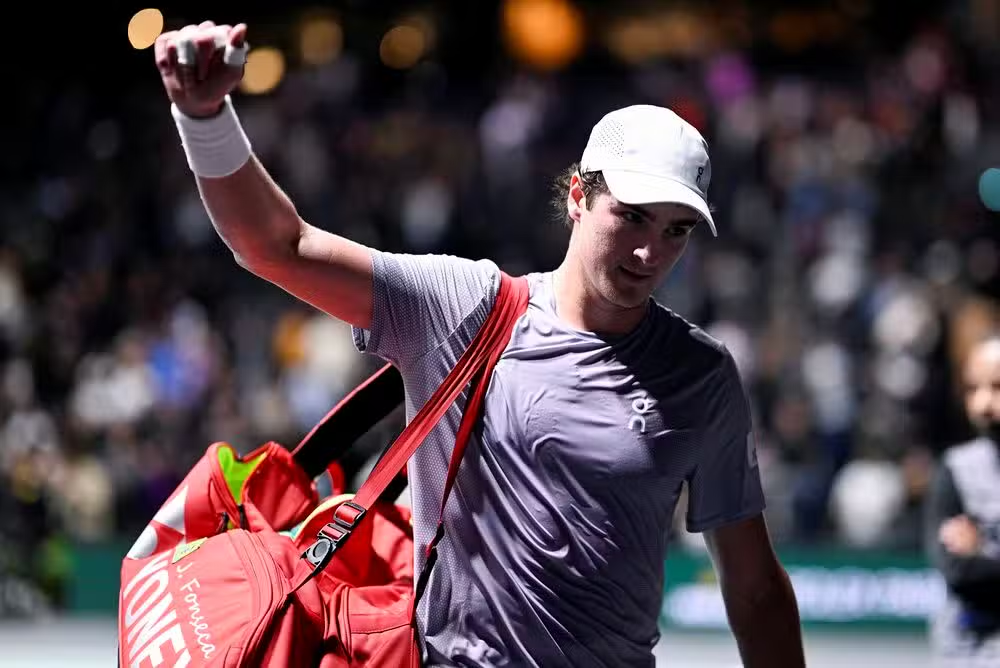
Brazilian tennis player João Fonseca takes the court this Friday to face Serbian Novak Djokovic in the third round of Roland Garros, in Paris. O duelo decisivo ocorre na quadra central Philippe Chatrier, com previsão de início às 15h30 no horário local da capital francesa. The match marks an unprecedented meeting between the 19-year-old athlete from Rio and the current number four in the ATP rankings, who is defending his third European clay championship. The event attracts international media attention due to the disparity in experience between the competitors.
The confrontation represents a clash of generations on the world circuit and moves behind the scenes of the competition. Novak Djokovic is looking to reach Grand Slam’s milestone of 25 titles in his career. O jovem representante do Brasil tenta avançar para a segunda semana de um Major pela primeira vez. The winner of the clash guarantees a place in the round of 16 and keeps alive the objective of lifting the coveted Taça from the Mosqueteiros at the French sports complex. The match defines the direction of the top of the tournament leaderboard.
The weight of the confrontation on the Philippe Chatrier court
The tournament organizers assigned the match to the main stadium of the Roland Garros complex. The stage requires a high level of concentration from competitors. The Philippe Chatrier court has the capacity to receive thousands of spectators and usually imposes additional pressure on less experienced athletes. João Fonseca reaches a milestone in the transition process to the sport’s elite by operating in this environment. The challenge takes place against the biggest winner of high-level tournaments in the history of men’s tennis.
The characteristic clay floor of Paris demands specific tactical adaptations and great physical resistance during ball exchanges at the back of the court. The slow surface reduces the speed of the strikes. The terrain favors prolonged rallies, which tests the players’ movement capacity and patience. Coaches on both sides have dedicated the last few days to adjusting defensive positioning. Serve return strategies aim to neutralize the opponent’s strengths in the first games.
Expectations surrounding audience behavior also change the dynamics of the event at França. The presence of South American fans tends to transform the atmosphere in the stands. The group creates a noisy atmosphere that deviates from the traditional pattern of European tennis. The experienced European tennis player has already declared that he expects an environment largely favorable to his opponent. The scenario requires rigorous emotional control to maintain focus on actions within the four lines.
Preparação and the Brazilian tennis player’s history on the circuit
The Rio athlete from Janeiro reached the third round of the main draw after overcoming the Croatian Dino Prizmic in the previous phase of the competition. Atual number 30 in the world, João Fonseca consolidates a constant rise in the international ranking. The movement has occurred since the transition from the youth circuit to the professional ATP tournaments. The technical team’s planning focuses on physical development and consistency of base hits. The preparation aims to support the marathon of games played in the best of five sets.
The clash against the former number one in the world requires overcoming the Brazilian’s unfavorable record against today’s top names. Throughout his short professional career, the tennis player accumulated seven official matches against opponents who are among the top ten on the planet. The record records just one victory and six defeats in these extremely demanding conditions. The numbers highlight the technical challenge that awaits the young man in the French capital.
The opportunity to measure forces with his childhood idol fulfills a goal set by the player himself before the start of the season. Career planning included the desire to face the title holder before the veteran’s eventual retirement. The duel serves as a practical evaluation parameter. The Brazilian tests his own level of competitiveness against the absolute elite of world sport.
The Serbian’s quest for the twenty-fifth Major title
Do on the other side of the network, the scenario presents a competitor who dominates the historical statistics of the sport and seeks to expand his own hegemony. Aos 39 years old, the European player represents the last active member of the so-called Big 3. The group dominated tennis in the last two decades and included Roger Federer and Rafael Nadal. Sporting longevity allows the athlete to continue competing in the acute phases of the main tournaments on the world calendar.
The veteran’s recent performance demonstrates his ability to continually adapt to new generations of opponents appearing on the circuit. The European’s technical committee monitored the South American tennis player’s evolution. The group recognized the technical potential demonstrated in recent months. The favorite’s strategy involves using Grand Slam’s extensive match experience to dictate the pace of the game. The objective is to explore any fluctuations in the younger opponent’s confidence.
The numbers surrounding the career of the current fourth-placed player in the ranking impress sports analysts and reinforce favoritism in the direct confrontation. Physical consistency and precision in defining moments make the challenge complex for any challenger on clay.
- The European athlete has accumulated 24 Grand Slam trophies in his professional career.
- The title defense in Paris represents the quest for a fourth championship on French clay.
- The age of 39 years old contrasts directly with the 19 years old of the South American opponent.
- The player remains the only Major champion still alive in the current men’s bracket.
- The direct confrontation is an absolute first on the ATP professional circuit.
Maintaining a high level of performance in the final stretch of your career requires a planned calendar with an exclusive focus on the four main tournaments of the year. Physical preparation prioritizes muscle recovery between rounds. The factor is crucial to withstand the wear caused by long matches on the dirt surface.
Impacto of the result for the men’s bracket of the tournament
The outcome of this Friday’s match has direct implications for the final stretch of the Paris tournament. The early elimination of Italian Jannik Sinner on Thursday changed the outlook of the competition. The result opened up space in the bracket for new contenders for the title. The Serb’s stay in the tournament maintains the tradition of recent years. A possible fall would represent a drastic change in the international tennis scenario.
A victory for the Brasil representative guarantees a relevant statistical milestone for the recent history of Grand Slams. Caso the young man advances to the round of 16, the Roland Garros tournament will necessarily end with a champion different from the trio formed by Novak Djokovic, Carlos Alcaraz and Jannik Sinner. Esta exclusion of dominant names has not occurred in a Major since the 2022 season. Naquela occasion, the Spanish Rafael Nadal won the trophy on the same Philippe Chatrier court.
The event organization prepares the security scheme and press protocol to cover the end of the round. International broadcast channels direct cameras to the confrontation that defines the direction of the competition. The winner will have a two-day break for physical recovery. Returning to the sports complex to compete in the round of 16 requires maintaining the training and physiotherapy routine in the French capital.