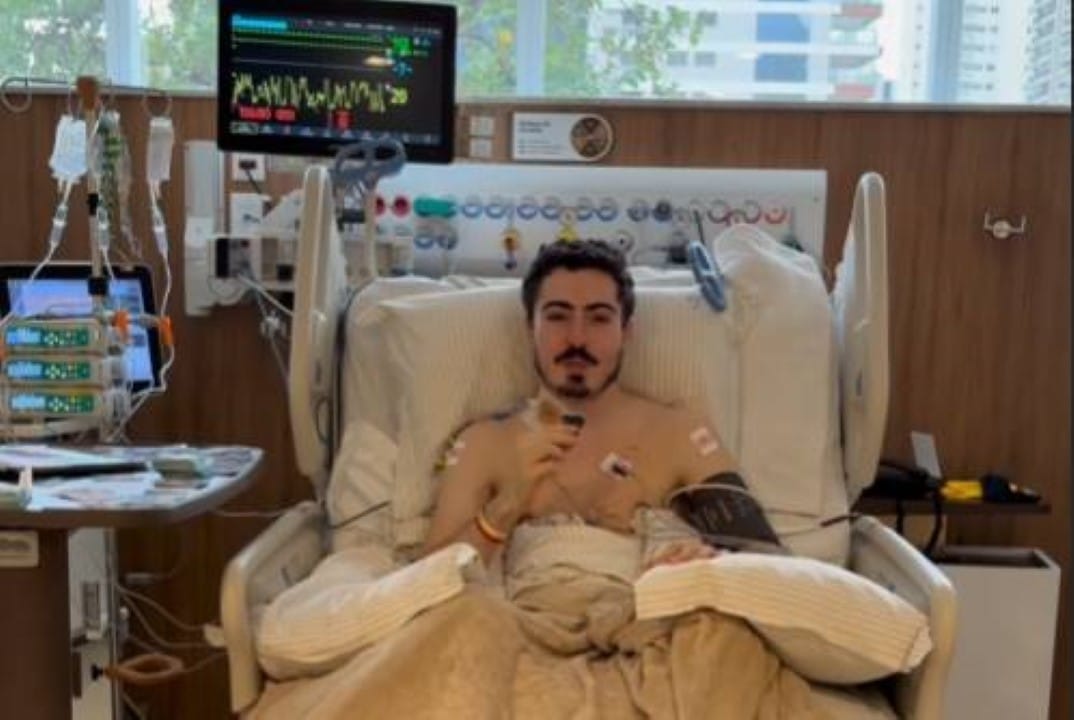
Lucas Hoffmann left a medical appointment walking normally and, within a few hours, lost the use of his legs. Bleeding caused by a cavernoma in the spinal cord, a rare vascular malformation, interrupted nerve communication. The doctor, who works in the public Paraná network, is now facing intense rehabilitation. Complete recovery from spinal cord injuries still represents an open challenge in medicine.
The cavernoma forms a tangle of fragile blood vessels. In his case, the condition arose in the spinal cord, where it occurs in just 2% of diagnoses. Isso is equivalent to about one in every 100 million people. The first bleed occurred at the end of 2025. Dores intense cervical bleeding led to the diagnosis.
Médicos detected the malformation after examinations. The injury affected sensation and movement below the belly button. Ele started physical therapy and regained some sensation within six months. The objective was to resume medical care by August.
Segundo bleeding increases the severity of the injury
In April, new bleeding surprised Lucas Hoffmann. The neck pain came back strong. Within hours, he also lost strength in his arms. The bleeding went up to the C4 vertebra. The team transferred the patient by plane to São Paulo.
No Hospital Sírio-Lebanese, neurosurgeon Francisco Sampaio commanded the procedure. The surgery lasted eight hours. Equipe used intraoperative neurological monitoring with 180 electrodes. Isso allowed mapping sensitive areas in real time.
The cavernoma was completely removed. Lucas regained full strength in the arm that was still working before the operation. The marrow showed signs of potential recovery, according to doctors. Mesmo thus, there are no guarantees of evolution.
- Cavernoma in the spinal cord occurs in only 2% of cases
- The condition affects about one in every 100 million people
- Primeiro bleeding stopped leg movements
- Segundo episode also compromised the arms
- Cirurgia removed all vascular malformation
Reabilitação depends on the organism’s individual response
Spinal cord injury has no treatment that restores the interrupted nerve connection. Improvement varies depending on the severity of the damage, the speed of the intervention and the regeneration capacity of each patient. Neurocirurgiões estimate that up to 30% of cases show some degree of recovery with physiotherapy.
Lucas Hoffmann maintains a rehabilitation routine. Ele has already regained sensitivity up to the navel and can feel the thigh. The doctor shares his experience on social media. São 77 thousand followers following everyday life in a wheelchair.
Ele cares for patients in an adapted way while they recover. “I want to be the best doctor I can be and fulfill my legacy of helping people going through the same process,” he says. The focus remains on professional performance.
Polilaminina still awaits full clinical studies
Pesquisadores tests polylaminin as a possible option for regeneration in acute spinal cord injuries. The substance received compassionate use authorization from Anvisa for patients without alternatives. Cerca of 60 people have already received the treatment until the beginning of the year.
Human clinical trials have not yet begun. Phase 1, which assesses safety, awaits analysis by the ethics committee. Publicação in a peer-reviewed scientific journal also did not occur. The Cristália laboratory leads the development.
Especialistas reinforce that current recovery depends mainly on physiotherapy and the body’s natural potential. Não There is an approved medication that reverses complete spinal cord injuries.
Impacto in the routine and practice of medicine
Lucas Hoffmann worked normally before the first episode. The transition to a wheelchair changed his life within months. Ele reports accessibility barriers in public and professional environments.
Mesmo away from the face-to-face office, the doctor seeks to contribute with the knowledge acquired as a patient. Ele talks about necessary adaptations and the importance of early diagnosis of rare conditions.
The journey continues. The medical team monitors the progress after the second surgery. The case illustrates the limits and possibilities of rehabilitation in severe spinal cord injuries.
