Astrônomos of SETI Institute performed a detailed search for technology signals in 3I/ATLAS. The interstellar comet, the third object confirmed from outside Sistema Solar, did not show any evidence of artificial origin. The analysis used the Allen Telescope Array and lasted more than seven hours shortly after the object’s discovery.
The result reinforces what previous observations already indicated. 3I/ATLAS behaves like a natural comet ejected from another star system. Pesquisadores highlight that the study helps to calibrate current signal detection capabilities.
Descoberta from 3I/ATLAS marked third interstellar object
Comet 3I/ATLAS was identified on July 1, 2025 by the ATLAS system in Chile. Ele travels in a hyperbolic trajectory, with a speed that indicates an origin outside our Sistema Solar. Após 1I/’Oumuamua and 2I/Borisov, this is only the third confirmed case.
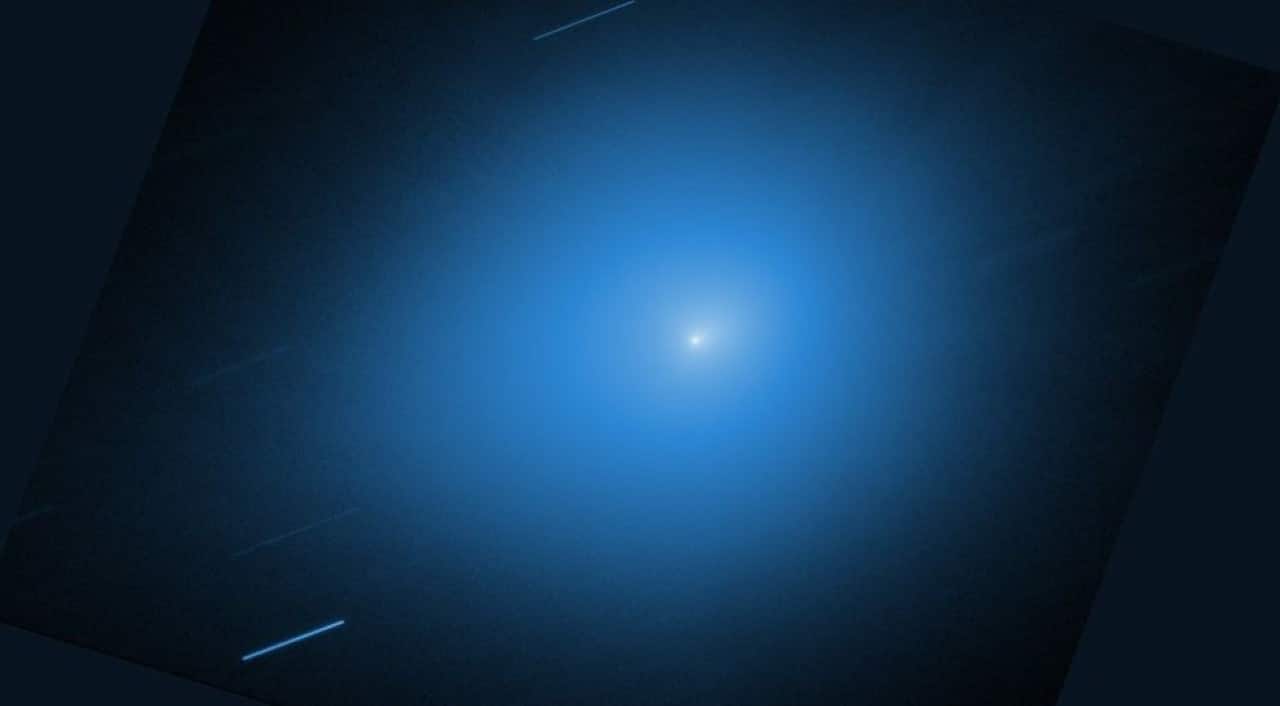
Astrônomos followed the object with several telescopes. Imagens show typical cometary activity, such as methanol release. The core is estimated to be between hundreds of meters and a few kilometers in size. Passage through Sistema Solar allowed close observations in December 2025.
Busca by technosignatures used radio array in Califórnia
Cientistas of SETI Institute pointed Allen Telescope Array to 3I/ATLAS shortly after discovery. Eles collected data for more than seven hours on wide radio frequencies. The focus was narrowband signals, which do not arise from known natural processes.
The team identified nearly 74 million initial candidates. Filtragens eliminated human interference and artifacts from the comet’s motion. Restaram around 200 signals, all explained by terrestrial technology or satellites in orbit. Nenhum came from the object.
- Observações covered range from 1 to 9 GHz
- Análise considered Doppler drift caused by movement
- Limites of power drops to levels equivalent to a common household appliance
- Resultados published on The Astronomical Journal in June 2026
Estudo sets new limits for signal detection
Valeria Garcia Lopez, co-author of the Furman University work, commented on the findings. The results show how viable it has become to detect signals with current technology. Therefore, it is worth continuing the search even for unexpected objects.
Sofia Sheikh, lead author of SETI Institute, highlighted another perspective. In the future, ships like Voyager will become interstellar artifacts in other systems. Entender the natural distribution of these objects helps to identify possible anomalies.
The study does not completely rule out the remote possibility of alien technology in some interstellar visitor. Ele reinforces, however, that 3I/ATLAS is consistent with a natural comet. Previous telescopic Observações images already indicated composition and behavior typical of comets.
Outras searches in 3I/ATLAS also point to natural origin
Telescópios as well as Subaru, Hubble and others captured images of the comet. Elas reveals structure and activity common to icy bodies from other systems. The proximity to Sol in 2025 allowed for even more details about its transformation.
Complementary Pesquisas detected natural radio emissions at specific frequencies. Nenhuma matched artificial patterns. Dados from different installations confirm the general picture.
Comet 3I/ATLAS has already moved away after its closest passage to Terra. Ele continues on a trajectory that will take it back to interstellar space. Future Estudos may explore other aspects such as detailed chemical composition.
Importância from observations to the search for extraterrestrial life
Cientistas emphasize that negative searches are valuable. Elas refine the methods and establish baselines for future detections. The case of 3I/ATLAS serves as a practical example of the current capabilities of the instruments.
Equipes continues to monitor the sky for more interstellar objects. Cada new visitor offers opportunity to test hypotheses about planetary formation in other systems. SETI’s work directly contributes to this collective effort.
The publication on The Astronomical Journal details the methodology and limits obtained. The raw data is available to the scientific community. Isso enables independent verification and re-analysis.