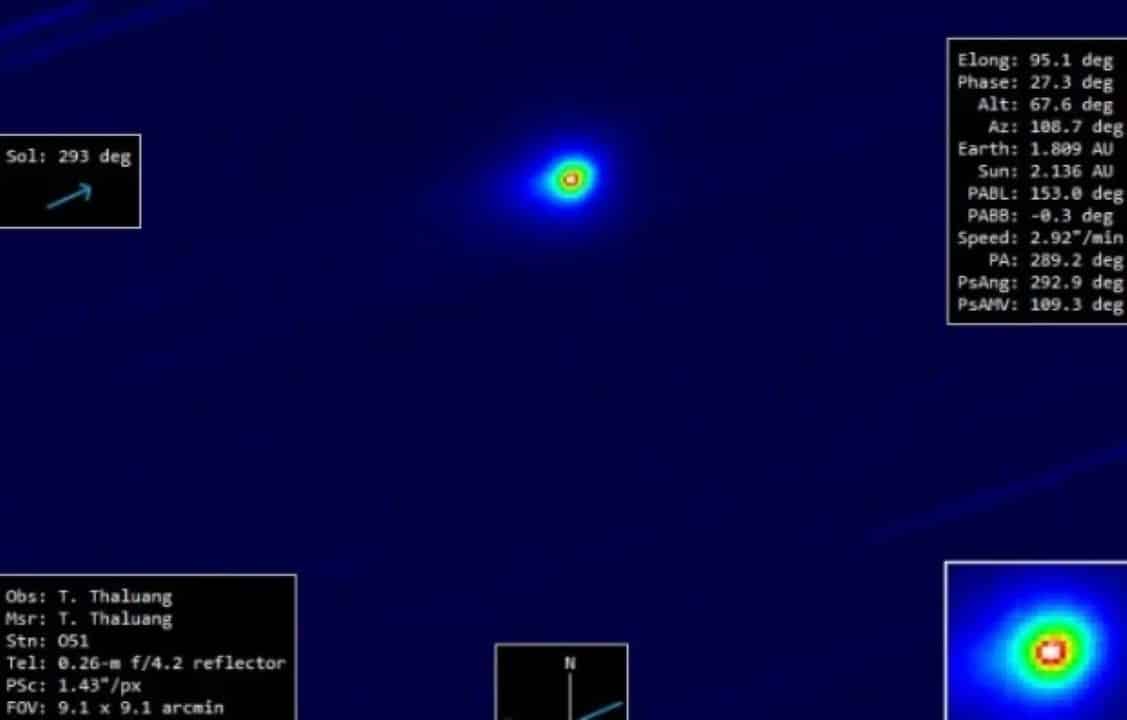
Astrônomos of Instituto SETI examined comet 3I/ATLAS for possible signs of extraterrestrial technology. The object, the third interstellar visitor confirmed with Sistema Solar, underwent observations with Allen Telescope Array. The campaign lasted more than seven hours and covered radio frequencies between 1 and 9 gigahertz. Nenhum hint of artificial origin emerged from the data.
The result, released this Wednesday (3), appears in an article in the magazine The Astronomical Journal. Ele reinforces previous evidence that 3I/ATLAS is a natural comet formed in another star system. The initial discovery occurred in July 2025 by the ATLAS system, on Chile. Sua hyperbolic trajectory and high speed confirmed the interstellar origin.
Análise covered millions of detections
The team captured nearly 74 million narrowband signals during the observations. Técnicas filtering eliminated interference from terrestrial communications and satellites. The process reduced the volume to approximately 211 candidates who merited a detailed visual examination in the time-frequency domain. Todos were explained by known human sources.
- The researchers applied Doppler corrections to track the object’s movement.
- The search prioritized narrowband signals, considered promising for technology.
- Nenhum candidate withstood final verification of natural or artificial terrestrial origin.
- The study established an upper limit for radiated power of approximately 10 to 110 watts at the observed frequencies.
Essa power is equivalent to the consumption of many common household appliances. Sofia Sheikh, main author of the work, highlighted its methodological importance. Interstellar Visitantes merit systematic scrutiny, even without specific initial suspicion. Observations began less than 24 hours after the discovery was announced, which demonstrates the agility of current instruments.
Objeto exhibits typical cometary activity
3I/ATLAS developed a coma of gas and dust as it approached Sol. Observações at multiple wavelengths confirmed volatile composition consistent with comets. Sua initial reddish color and emissions detected in molecular lines reinforce the natural profile. Perihelion occurred in October 2025, at about 1,356 astronomical units.
Astrônomos from several countries followed the journey since the announcement. Dados from optical, infrared and radio astronomical telescopes converge on the same conclusion. The object does not exhibit anomalous non-gravitational accelerations that could suggest artificial propulsion. Sua tentative rotation, estimated at around 16.79 hours, also fits with parameters observed in other bodies.
Busca integrates greater effort for technosignatures
The study is part of campaigns that investigate possible artifacts or transmissions in interstellar objects. The team argues that future human probes, like Voyager, will one day become similar visitors to other systems. Entender the natural population of these objects helps identify possible anomalies. Valeria Garcia Lopez, co-author, highlighted the realism of detection with current technology.
Allen Telescope Array, located in Observatório of Rádio of Hat Creek, in Califórnia, allowed broad spectrum coverage. Técnicas’s advanced radio frequency interference (RFI) mitigation was crucial. The newly developed search pipeline processed the data efficiently. Negative Resultados like this set useful limits for hypothetical transmissions.
Implicações for future observations
Similar Campanhass should become routine as more interstellar objects are detected. 3I/ATLAS offers a rare opportunity to study material formed in another planetary system. Suas chemical and physical features provide clues about distant star and planet formation processes. Pesquisadores continues to monitor the object at different stages of its passage.
The work demonstrates the astronomical community’s ability to respond quickly. Ele contributes to the general understanding of the distribution of interstellar comets. Mesmo without detection of technological signals, the effort expands knowledge about these rare cosmic travelers. Novas observations with other instruments may reveal more details about its composition in the coming months.
Contexto from interstellar visitors
3I/ATLAS succeeds 1I/‘Oumuamua, discovered in 2017, and 2I/Borisov, from 2019. Cada new case refines models about the frequency and properties of these objects in the galaxy. The current visitor has already enabled studies on methanol abundance and heavy water ratios, for example, which differ from local comets. The absence of technosignatures aligns with all the evidence accumulated so far.
The research establishes a methodological framework. Ela proves that observatories can subject interstellar visitors to systematic searches for signals soon after discovery. Isso sets the stage for deeper analysis of future objects. Knowledge about 3I/ATLAS will continue to evolve as it moves away from Sol.