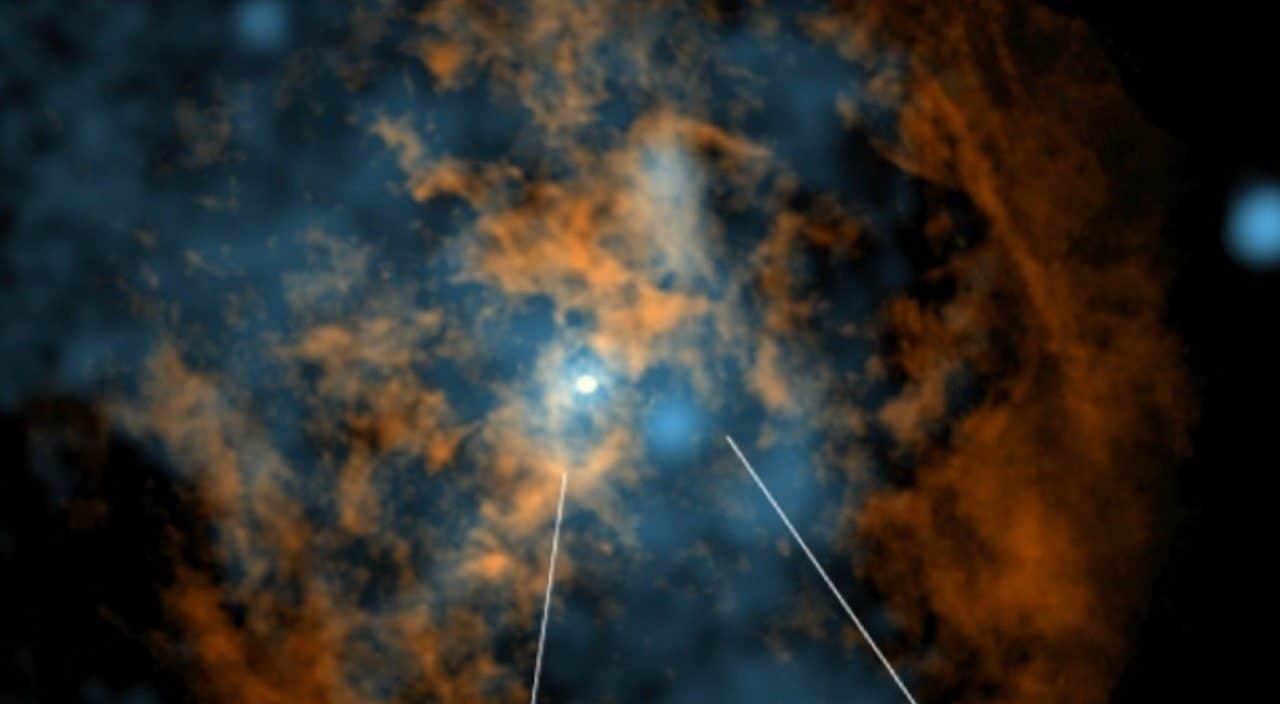
Astronomers have observed, for the first time, evidence of a powerful wind blowing from the supermassive black hole Sagittarius A*, located at the center of the Milky Way.
The detection solves a half-century-old mystery about the behavior of these objects, even in quieter phases of activity. The discovery came from combined deep observations from two cutting-edge observatories.
Conical cavity reveals the wind
Using five years of data from the Atacama Large Millimeter/Submillimeter Array (ALMA) in Chile, the team constructed the sharpest image yet of the cold molecular gas surrounding the black hole. The analysis revealed a large cone-shaped cavity, about 1 parsec long and with an opening angle of approximately 45 degrees, completely devoid of cold gas.
This absence could only have been created by a hot, energetic wind emanating from Sagittarius A*, which pushes or heats the cold material as it passes. Images from NASA’s Chandra X-ray Observatory confirmed bright X-ray emissions in the same region, filling the cavity with hot gas.
Black holes are not just vacuum cleaners
Supermassive black holes don’t just swallow matter. When feeding, they also release energy that drives jets and winds into space. Theories have predicted this mechanism for decades, but direct evidence of wind leaving Sagittarius A* has never been captured in real time.
Mark Gorski, from Northwestern University in the United States, who co-led the study, explained that unless the black hole is in a perfect vacuum, which does not exist in the Universe, it must expel wind. The new observation provides the cleanest view yet of this impression.
What changes for understanding the galaxy
Elena Murchikova, also from Northwestern and co-leader of the research, highlighted that the team demonstrated for the first time that molecular gas very close to the black hole feeds it. The detected wind is not extremely powerful and its direction may vary over time, which reinforces that Sagittarius A* is not a unique case.
Researchers estimate that this wind has been active for at least 20,000 years. The detection shows that our central black hole is in a relatively quiet phase, unlike the explosive outbreaks observed in other galactic centers. This offers a rare window into studying the dominant state in the lives of most black holes.
Added value for astronomy
The image obtained is about 100 times deeper and 80 times sharper than previous maps of the region. Combining radio data from ALMA with X-rays from Chandra eliminated artifacts and confirmed that the wind, not nearby stars or supernovae, is responsible for the cavity.
This interaction between the black hole and its surrounding environment helps explain feedback processes that influence star formation and the general evolution of galaxies. Even at rest, Sagittarius A* continues to shape the center of the Milky Way.
