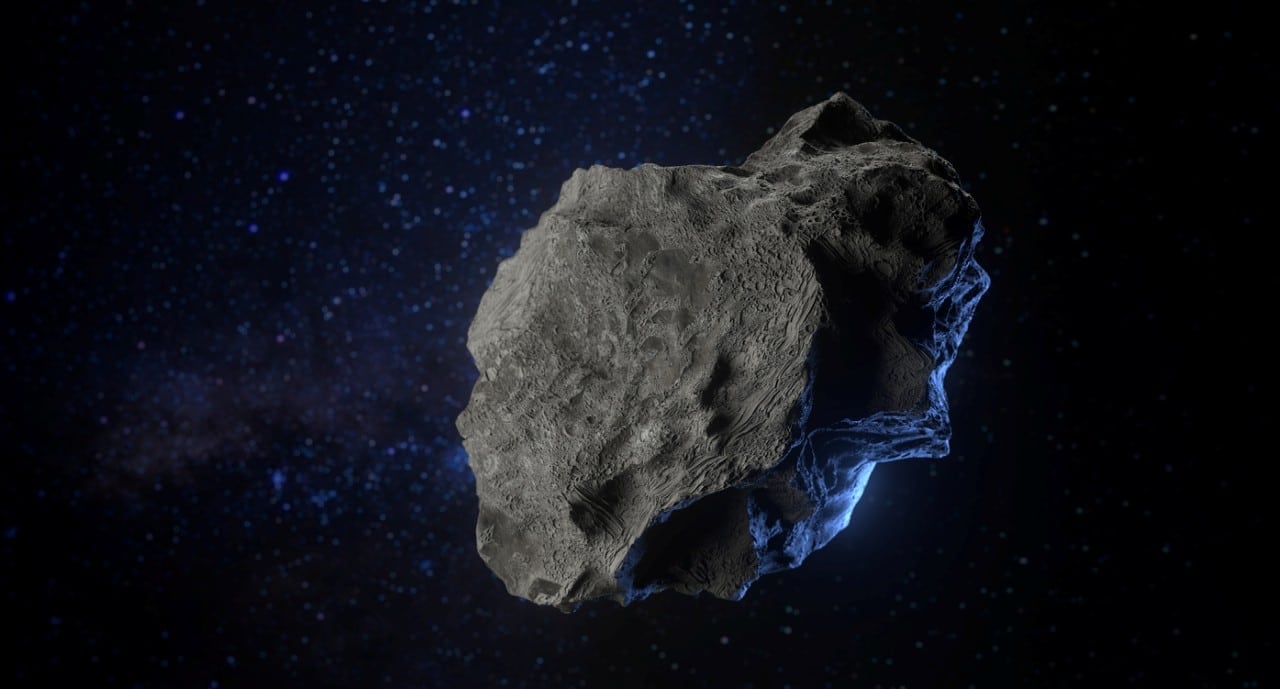
Evidence of a planet that existed at the beginning of the Solar System has emerged from a meteorite found in the Sahara Desert. The celestial body would have had a diameter between that of the Moon and Mars and ended up destroyed for reasons that scientists are still investigating. One possibility raised is that it disintegrated in a large-scale collision, something common in the initial phase of formation of this region of the universe.
The meteorite NWA 12774 consists of a rock weighing approximately 454 grams recovered in 2019. Researchers classified it as anngrite, a rare category of volcanic meteorite among the oldest ever identified. It formed a few million years after the emergence of the Solar System, around 4.56 billion years ago. Of the total of more than 80 thousand meteorites catalogued, less than 70 are angrites.
This specific piece of space rock maintains an atypical chemical composition. It indicates that some of the first bodies in the Solar System evolved differently from known rocky planets, as researchers report.
Until then, the predominant view associated the angritos with the destruction of an asteroid approximately 200 kilometers in diameter. However, a recent study led by geoscientist Aaron Bell, from the University of Colorado, presented a different picture. Detailed analyzes identified the aluminum-rich clinopyroxene material inside, a clear indication of formation under very high pressure.
By recreating the conditions in which the meteorite originated, the team found that the mineral developed under pressures of at least 17.5 kilobars. The value exceeds the pressure recorded at the bottom of the Mariana Trench, the deepest point in the Earth’s oceans, by more than 17 times. Such intense pressures would not be possible inside a small asteroid, which points to a much larger celestial body, according to the study published in the journal Earth and Planetary Science Letters.
Scientists estimate that the angrite originated in the surface layers of an object at least 1,800 kilometers in diameter, slightly larger than the Moon. Superior projections indicate that the protoplanet would still be smaller than Mars, measuring up to 3,200 km.
“It’s incredible to think that a world this big once existed. We only know it existed because some fragments of it ended up landing on Earth,” Bell said in a statement.
The researchers highlight that many meteorites remain stored in university laboratories. Future analysis of these materials may reveal the existence of other lost worlds from the early stages of the Solar System.
