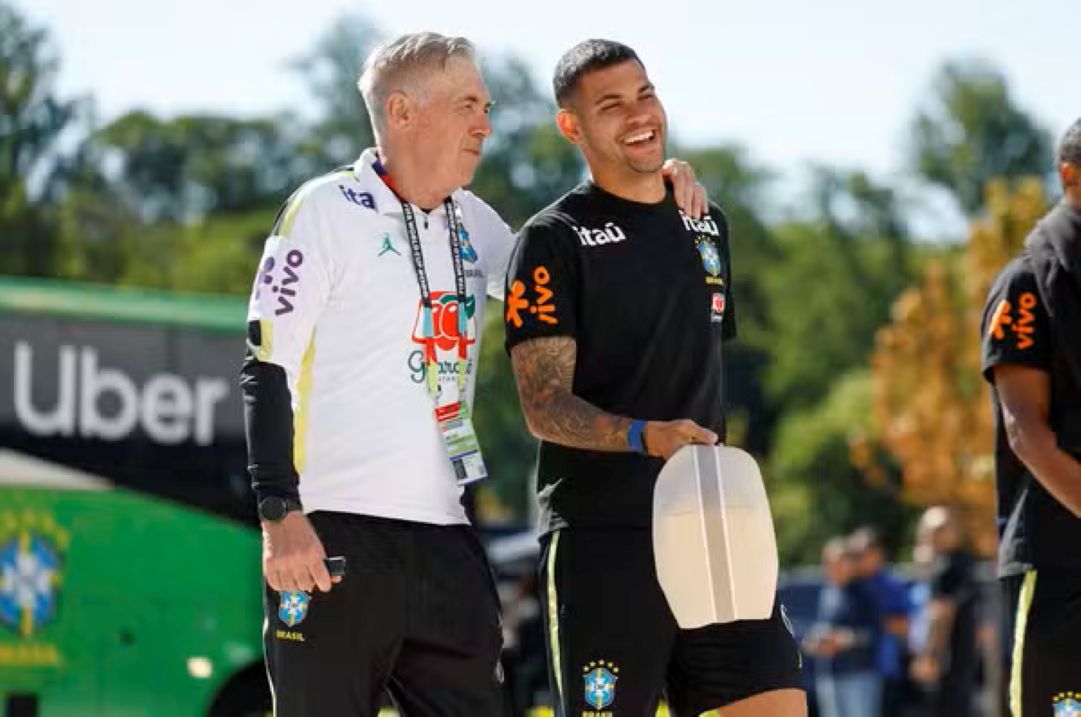
To become world champions again after 24 years, the Brazilian team understands that it is not enough to take care of the players’ tactical, technical and physical aspects. The mental aspect of the World Cup is very important, warned coach Carlo Ancelotti.
Therefore, the CBF takes several measures in relation to the emotional well-being of athletes. The care ranges from the presence of a psychologist on the technical committee, something that did not happen in the last two World Cups, to small details of the work routine and coexistence of those called up.
The hotel where the team is staying, in New Jersey, underwent modifications with the mental health of the players and other members of the delegation in mind. There are around 90 people confined to a hotel for 40 or even 50 days, it’s a long time away from home and many people in the same space, so we prepare spaces for relaxation, a quiet place for reading or if the athlete wants to be in a more isolated moment. We also have an outdoor area with vegetation, which already belongs to the hotel, but we refined some of these areas to make them more pleasant, explains physiologist Guilherme Passos.
Inside the hotel there are some paginations to refer to the landscape, the external environment, also phrases of victory, of struggle. Unlike the Russian Cup, for example, where we often changed hotels, this time, to qualify first in the groups, we will stay practically the entire competition in the same hotel, so we have to have these environments to relax a little, he adds.
Another measure aimed at the psychological well-being of athletes is contact with family members during competition. This type of interaction will only be allowed on days off, scheduled for the day after the games. In day-to-day work, visitors are not allowed in the concentration.
Psychology, yes. Therapy, no
The person responsible for listening to and guiding athletes and other team professionals is Marisa Santiago, a specialist in Sports Psychology. Having spent time at Atlético-MG, Bahia and Cruzeiro, she currently works at Grêmio and, since 2024, has been called up by the CBF to play on FIFA dates.
Marisa is keen to highlight that, contrary to what many imagine, her role in the National Team does not consist of holding therapy sessions with the players. In an interview with ge, she explained her role: The job is to be available to the athletes so that they can better deal with the pressure and everything that involves the performance and results of these athletes. All the time making them feel more comfortable to be able to put their football on the field, he said.
We understand it as multidisciplinary work. For example: physical therapy often says: “look, so-and-so is a little more upset about this injury.” The athletes also understand that there is this figure of the psychologist there, this was also a construction. Nowadays it’s much easier to deal with than it was at the beginning of 2024, when I arrived, he added.
Midfielder Bruno Guimarães highlights the importance of this type of support: I think this is very important, not only for football but for life. I have my own (psychologist) too, so I think that took me to another level of how to balance the pressure, not worry too much about outside things. Everything that matters most in my life is inside my home. So we see that it is a generation that was very shaken by criticism. We saw Richarlison’s situation, how much he went through a difficult time and having a person like that within the team is important. We had exchanges with them individually and collectively, I think it was positive.
In everyday life
In addition to individual conversations, Marisa carries out group dynamics at certain times. On shorter FIFA Dates, generally lasting ten days, activities are more restricted, as there is little time for activities of this type amid training, travel and games.
The psychologist’s consultations often take place when leaving the field, after training, or during rest periods during training camps. Within the Selection, we do welcoming work, individually and also in groups, according to the demands and what the committee believes is important at the moment, he commented.
Sometimes people understand psychology as long-term work, which is therapeutic work. But in the selection it is much more specific to the question of the here and now.
During the World Cup, one of Marisa’s missions will be to prepare the players and instruct the coaching staff on how to keep the group focused in the event of delays or stoppages in matches. The CBF takes as an example the Club World Cup, held last year in the United States, when lightning warnings postponed or interrupted games.
History
The last time Brazil had a professional specialized in mental health care was at the 2014 World Cup, in which psychologist Regina Brandão was part of coach Felipão’s committee.
In the two World Cups in which he led the Seleção, in 2018 and 2022, coach Tite chose not to have someone with this specialization on his staff. In his opinion, the presence of a psychologist on the commission would have little effect on the World Cup, since the time to create bonds of trust between the athletes and this professional is scarce. The coach preferred to just get advice from a professional in the field.
In parallel, athletes began to seek psychological support outside their clubs and the national team. One of the leaders of the group of 26 called up, full-back and defender Danilo frequently talks about the importance of mental health care and even created a project related to the subject.
The team debuts in the World Cup next Saturday, against Morocco, at 7pm (Brasília time). Group C still includes Haiti and Scotland.
