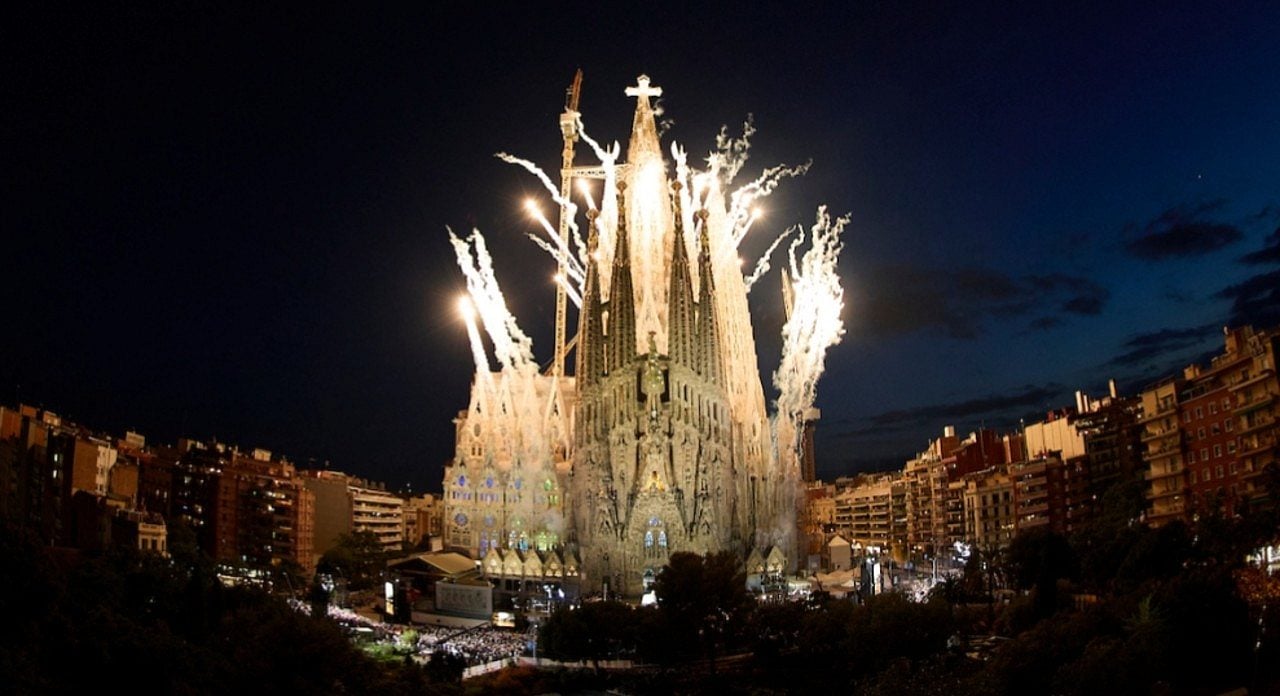
The Basilica of the Sagrada Familia, in Barcelona, reached the historic milestone of becoming the tallest church in the world on the night of June 10, 2026. The Tower of Jesus Christ, 172.5 meters high and crowned by a large cross, was officially inaugurated and blessed by Pope Leo XIV during a solemn mass that brought together Spanish authorities and thousands of faithful.
The event took place exactly 100 years after the death of architect Antoni Gaudí, on June 10, 1926, and marks a decisive step in the project that has lasted 144 years. With the external completion of the central tower, the basilica surpassed the previous record, held by Ulm Minster, in Germany, which is 161.5 meters.
What changed with the Tower of Jesus
The main tower, dedicated to Jesus Christ, is the tallest of the 18 foreseen in Gaudí’s original project. Its completion raises the complex to 172.5 meters, making the Sagrada Familia not only the tallest church on the planet, but also the tallest building in Barcelona. The cross at the top, installed in February 2026, was the element that allowed the new record.
Unlike traditional Gothic cathedrals, Gaudí’s structure combines organic shapes, colors and Christian symbolism. The central tower represents the culmination of the architect’s vision, who saw the temple as a “book” in stone, with each element telling the story of Salvation.
Presence of authorities and message from the pope
The mass was attended by King Felipe VI, Queen Letizia and Prime Minister Pedro Sánchez, as well as hundreds of bishops. Leo XIV highlighted the basilica as “a visible sign of the invisible God” and spoke about the importance of unity and peace. He recalled that faith cannot coexist with war or violence, in reference to current global conflicts.
The pontiff also emphasized that the “imperfection” of the unfinished temple is not a flaw, but a testimony of hope and continuity. The ceremony included a light show on the facades, visible from various parts of the city, and attracted around 130,000 people in the surrounding streets.
Gaudí’s legacy and the long road to get here
Antoni Gaudí took over the work in 1883, after the initial design by another architect. He dedicated the last years of his life exclusively to the basilica, even living there. His death in a tram accident left work halted, but the persistence of the Junta Construtora kept the dream alive.
Construction faced wars, economic crises and, more recently, the Covid-19 pandemic, which delayed deadlines. Still, the pace has accelerated in recent decades with technological advances such as 3D modeling and precise stone production.
Today, the Sagrada Familia receives around 5 million visitors a year and has been a UNESCO World Heritage Site since 1984, as part of Gaudí’s works. The temple symbolizes not only Barcelona, but Catalan identity and the human capacity to persevere in grandiose projects.
What is still missing for full completion
Although the Tower of Jesus is externally completed, the basilica is still under construction. The Glória facade, the main and most complex, is still under construction and should take years. Internal work on the central tower will continue until 2028. The estimate is that the complete set will be ready around 2033 or later.
This incompleteness is part of the essence of the project. Gaudí planned a church that would dialogue with nature and time, without being in a hurry to close. The completion of the central tower, however, represents the symbolic high point and attracts even more international attention.
Impact for Barcelona and tourism
The opening reinforces Barcelona’s status as the capital of architecture in 2026. The city hosts events that celebrate modernism and Gaudí’s legacy. For tourism, the milestone should further increase the flow of visitors, generating a significant economic impact in the Catalonia region.
Experts highlight that the basilica goes beyond a religious monument: it has become an engineering and art laboratory that inspires architects from all over the world. The mix of faith, innovation and patience sums up what the work represents.
Pope Leo XIV, in his homily, invited the faithful to look at the temple as a call to fraternity. In a world marked by divisions, the Sagrada Família emerges as a symbol of collective construction and lasting hope.
The history of the basilica shows that great achievements require time, vision and continuity. With the Tower of Jesus now standing, Barcelona looks at the sky with a new perspective — and the world has yet another reason to visit the iconic temple.
