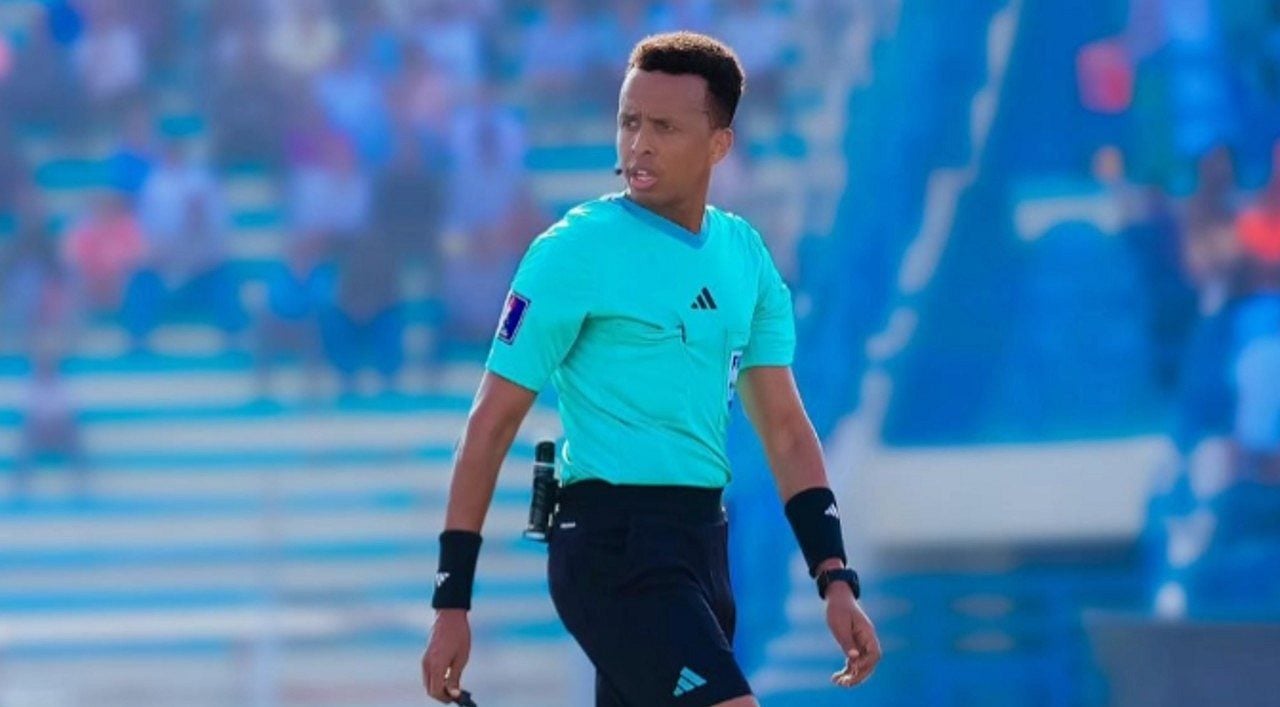
After being refused entry to the United States to referee the World Cup, Somali referee Omar Artan was chosen to lead the UEFA Super Cup match, which will pit Paris Saint-Germain and Aston Villa face to face.
This prestigious clash, which pits the champion of the Champions League against the winner of the Europa League, will take place on August 12th, in the city of Salzburg.
The confederation responsible for European football announced that the decision to appoint Artan was taken after dialogues with the Confederation of African Football (CAF).
As stated by UEFA President Aleksander Ceferin, Omar Artan is “a young and excellent but already experienced referee who has demonstrated his ability at the highest level of the Confederation of African Football.”
Ceferin added: “Football exists to bring people together, and UEFA seeks to express its respect for Omar and his outstanding refereeing skills, which have led to this highly important appointment.”
The UEFA president also made a point of thanking his “friend Patrice Motsepe, president of CAF, for his enthusiastic support of our initiative”.
Artan, who was named CAF’s best male referee in 2025 and has been on FIFA’s international list since 2018, was tipped to be the first Somali to play in a World Cup game.
However, he was prevented from entering by customs agents in Miami, even though he had a diplomatic passport and an American visa valid for a single entry.
In a statement issued on Wednesday, a US government representative said Artan was denied entry due to an alleged “association with individuals suspected of belonging to terrorist organizations.”
Somalia, his country of origin, is part of a list of nations subject to travel restrictions imposed by then US President Donald Trump. After discussions with American authorities, FIFA confirmed that Artan would not participate in the tournament.
In an interview with the New York Times this week, Artan revealed that he had been questioned by border agents about alleged links to the Somali militant group Al Shabab, denying any knowledge of the organization.
“I had the correct documentation and everything. I had the correct visa,” said Artan at the time.
“I’m just a referee trying to make my dream come true, the biggest dream of my life, which is to participate in the World Cup,” he lamented.
What referee Omar Artan said about his documentation
Analysis of UEFA’s strategic decision
Just 72 hours before his Super Cup appointment, Artan was on board a flight back to Somalia, his hopes of playing in the World Cup dashed by US immigration rules.
Instead of appearing on the global stage of the World Cup, the referee will now have the chance to officiate the first game of the UEFA season, in Salzburg, in August.
Although not the same as the World Cup, this designation is significant as it makes him the first non-European referee to officiate the competition.
This opportunity will finally give Artan the recognition he deserves for a year of intense work, which culminated in his selection as Africa’s main referee.
UEFA has already established contact with the Austrian Football Association and expressed confidence that, unlike what happened in Miami, Artan will not face security issues at Salzburg airport.
Although European football’s governing body has not commented on the timing of the announcement, it is difficult to believe that it is a mere coincidence.
In fact, UEFA signed an agreement in April with the African Football Confederation (CAF), aimed at promoting the sport on both continents and offering opportunities for African managers.
In a similar partnership, UEFA and CONMEBOL had already exchanged referees for Euro 2020 and Copa América 2021.
The question remains: is it possible to connect the dots? Did the highest governing body of European football see the chance to gain prestige against FIFA and take advantage of it?
The agreement with CAF, at the very least, represented a highly convenient opportunity.
With ticket prices for the 2026 World Cup reaching unprecedented levels, UEFA has already announced that, for the 2028 Euro Cup, the cheapest tickets for the group stage will cost 30 euros (approximately £26) and 60 euros (approximately £52), without the application of dynamic pricing.
Now, with Artan unable to referee at the World Cup under FIFA’s authority, UEFA has stepped in to offer the Somali a prominent platform.
Given these facts, it is not complex to reach certain conclusions about the motivations behind the decision.
