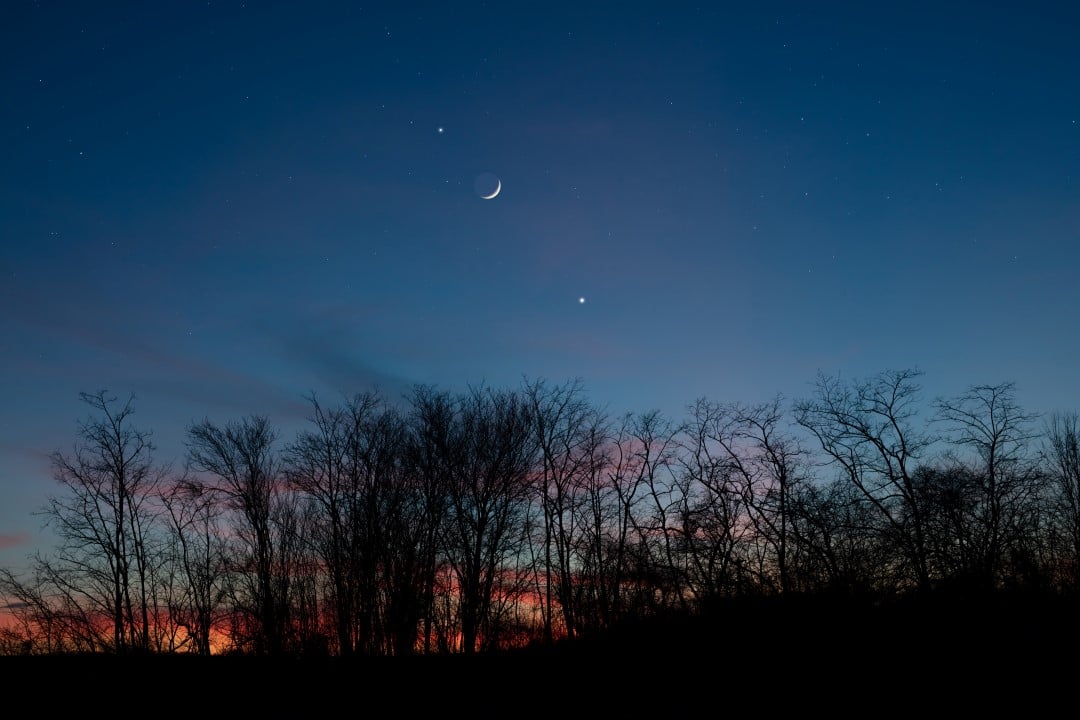
Combining on the western horizon, Mercury, Venus and Jupiter form an ephemeral celestial spectacle on the night of June 12th. This planetary conjunction promises a stunning and rare sight, but one that will be available for a very limited period after sunset.
The union of Mercury, Venus and Jupiter draws a low alignment on the western horizon after dusk, creating a small stellar procession. This training is ideal for astrophotography enthusiasts, and it is possible to capture it even with a smartphone or a wide-angle lens.
While Venus and Jupiter have moved slightly apart since their meeting on June 9, Mercury has gracefully emerged from the solar luminosity to join the others. The three stars make up a visibly inclined line on the ecliptic, in the west-northwest sky, just after dusk.
This rare presentation has a very restricted viewing window. The ideal time to search for the planets begins precisely 30 minutes after sunset in your location, extending for just 30 to 45 minutes. After this brief interval, Jupiter and Mercury will disappear below the horizon, following the Sun.
To find the planets, start by identifying Venus, which will shine brightly even when the sky is still clear. Then shift your gaze slightly to the right and down to easily spot Mercury and Jupiter.
Amateur astronomers and users of imaging equipment will find June 12 an excellent opportunity to discern the visual differences between the three celestial bodies. Venus will display a small gibbous disk, with around 80% of its surface illuminated and an intense glow. Mercury, in contrast, will show a clear “crescent” phase, with 50% illumination, representing a remarkable feat to observe at dusk. Jupiter, in turn, will appear as a considerably larger disk; however, its low altitude on the horizon can cause atmospheric distortions. With favorable atmospheric conditions, advanced imaging devices could even reveal Jupiter’s famous equatorial cloud bands, alongside Mercury’s silhouette.
For photographers interested in celestial landscapes, the night of June 12th invites creativity in composition. It is recommended to do away with primary focus adapters for telescopes and use a fixed lens between 50mm and 85mm on DSLR or mirrorless cameras. The goal is to capture the deep colors of twilight, framing the three planets as a “cosmic staircase” ascending over an earthly silhouette element such as a mountain range, the distant urban horizon, or a line of trees.
