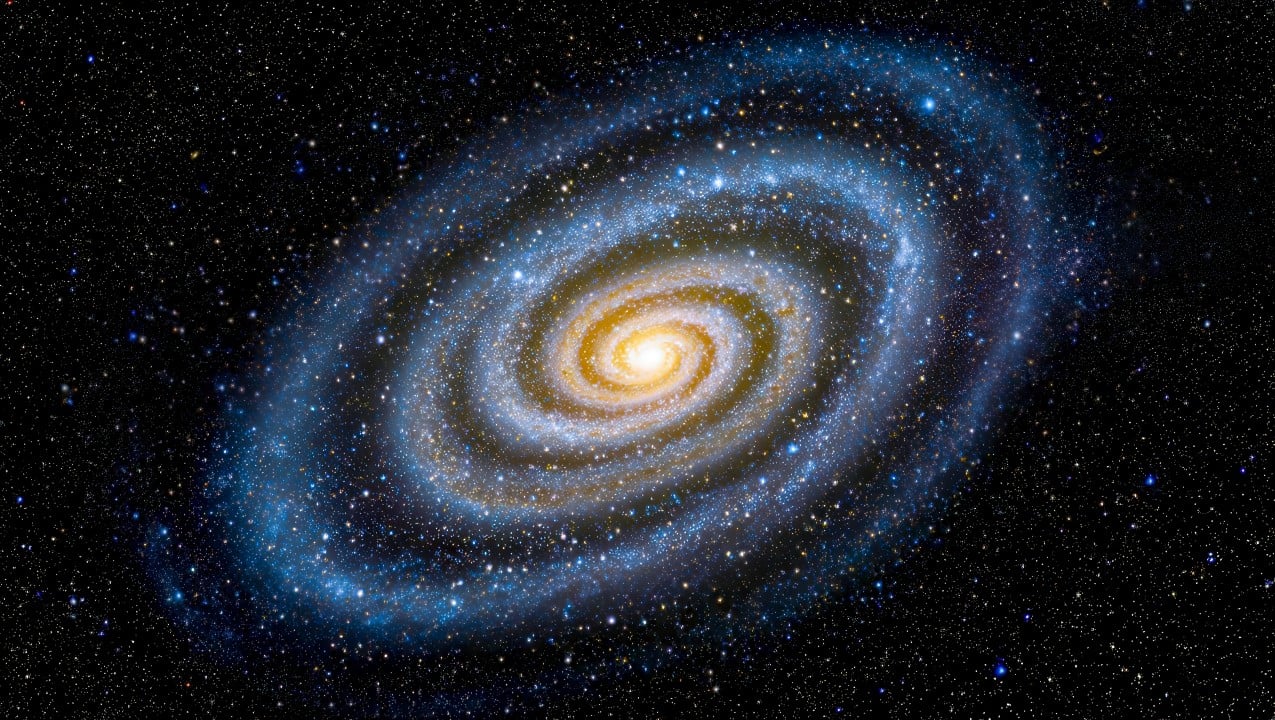
The experience of seeking a destination that always seems out of reach may have a cosmic parallel. Our entire galaxy is incessantly pulled towards a hidden area of space at an astonishing speed, but despite this continuous movement, the Milky Way will never reach its endpoint.
This mysterious force that drives our galaxy comes from the powerful gravity of a gigantic agglomeration of mass, called the Great Attractor. Located in the enigmatic Avoidance Zone, it remains inaccessible to direct observation due to the dense layer of light and dust present in the galactic plane of the Milky Way.
Even with restricted visibility, scientists have known for approximately four decades that the Milky Way is moving towards the Great Attractor at a speed of approximately 600 kilometers per second. This revelation was made by a collective of astronomers nicknamed the Seven Samurais. They monitored the trajectory and rhythm of 400 elliptical galaxies, identifying that our galaxy and others nearby are under the gravitational influence of a colossal structure, located between 150 and 250 million light years from Earth.
In 2014, new investigations brought greater clarity to this complex system. Previously, the understanding was that the Milky Way and its Local Group of galaxies were attracted to the Virgo cluster, which, in turn, headed towards the Virgo Supercluster. However, the most recent discoveries showed that the latter was also on the move, being directed towards an even more extensive grouping, called the Laniakea Supercluster.
At the epicenter of Laniakea, the colossal gravitational “battery” that drives the entire system pulsates, dragging everything towards its center. This massive concentration of matter is precisely what we call the Great Attractor. Although it is not possible to observe it directly or know its exact composition, its impacts are undeniable, manifesting themselves not only on the Milky Way, but also on approximately 100,000 other galaxies moving in its direction.