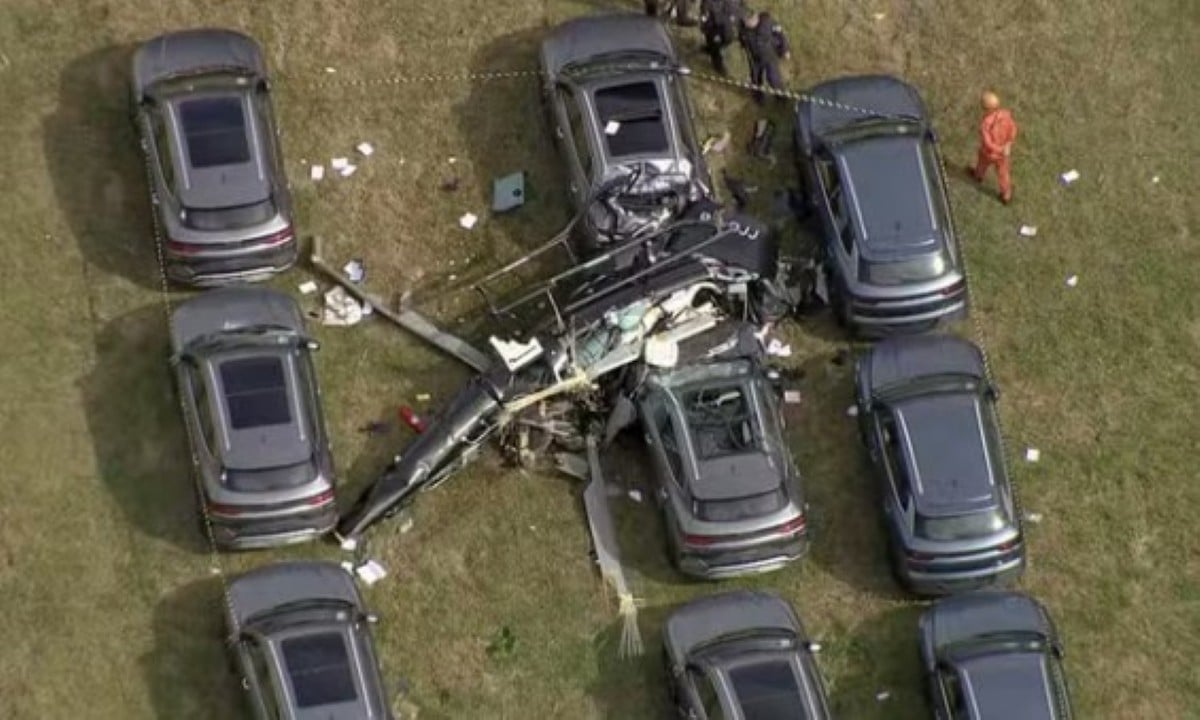
A tragic air accident in Rio de Janeiro, which killed six people this Sunday (14) after two helicopters collided, was classified as a “visual flight” operation, according to information from Raul Marinho, technical director of the Brazilian General Aviation Association (ABAG). This category of flight, quite common for helicopters, requires the pilots themselves to ensure a safe distance between aircraft through constant surveillance of the surrounding environment.
As Marinho explains, the movement of helicopters takes place through “visual corridors”, established by the Airspace Control Department (Decea). These celestial “virtual avenues” have determined routes for aircraft, functioning in a similar way to terrestrial roads, with one-way or two-way flows, which allows crucial operational flexibility for the varied missions of helicopters in urban areas. The specialist, who also has experience as an airline pilot, explains: “It’s similar to a large avenue. You have one-way and the wrong-way, there are some corridors that are one-way and other corridors that are one-way and the wrong way.”
To follow these trajectories, pilots use reference points on the horizon, GPS systems or navigation software. However, the most crucial tool for preventing aircraft collisions remains direct observation. The director of ABAG emphasizes that “the primary separation tool is human vision.” He adds that, “by regulation, the pilot’s obligation is to look out and maintain separation based on vision.”
In practical terms, it is up to helicopter commanders to visually identify other aircraft en route and ensure that a safe distance is maintained throughout the route. The expert emphasizes that, even with the presence of advanced electronic equipment for navigation, constant surveillance of the external scene remains an indispensable component of aviation safety.
Additionally, the role of air traffic control differs significantly from that performed on large commercial aviation routes. As Marinho explains, in visual flight operations, such as the one involved in the recent accident, those responsible for control are not responsible for the active and direct separation between helicopters in the airspace.
