Unprecedented launch of the Vikram-1 rocket accelerates the expansion of the private space market in India
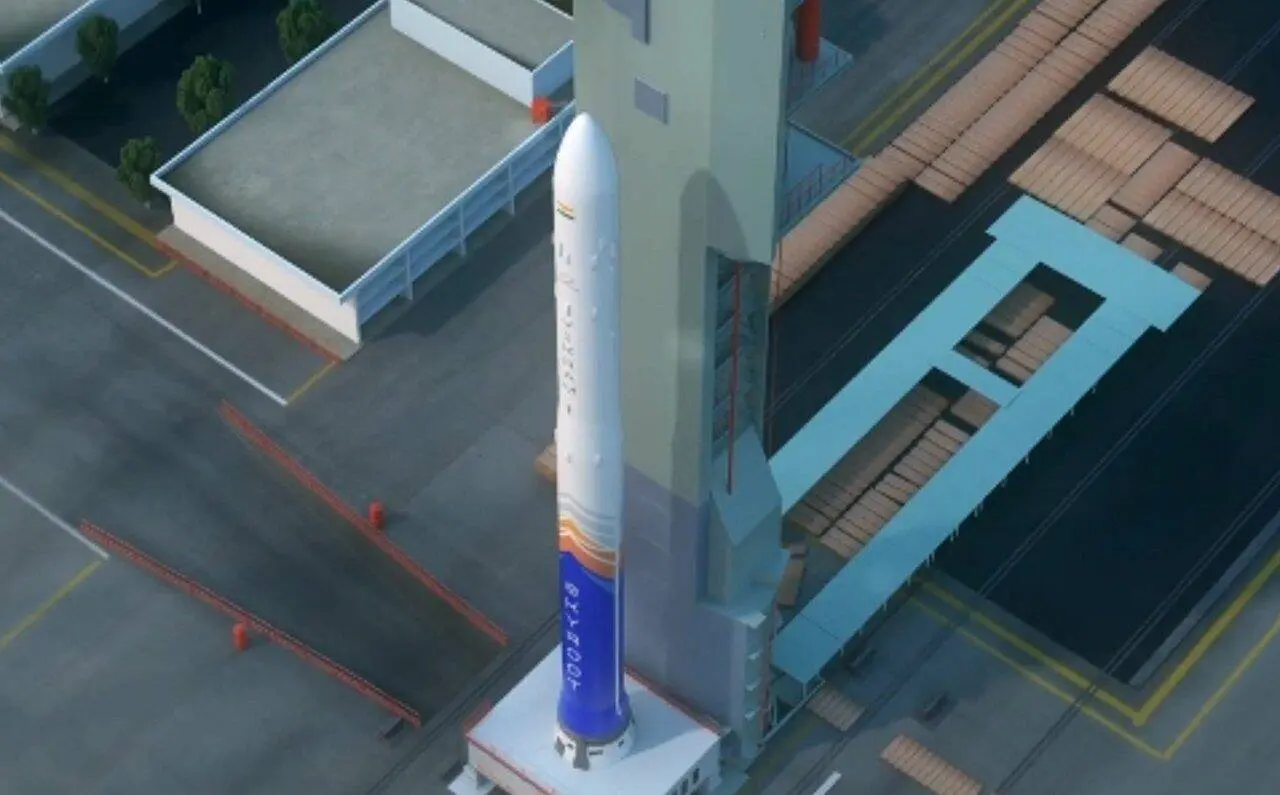
The Indian commercial aerospace industry is experiencing a historic countdown, driven by the imminent maiden flight of orbital equipment entirely manufactured by the private sector. The person responsible for the milestone is Skyroot Aerospace, which is preparing the ignition of the Vikram-1 equipment for the coming weeks.
The official schedule released by the Hyderabad-based corporation establishes that the attempt to send into space will take place in a specific window, scheduled between July 12th and August 4th. The achievement of this goal depends exclusively on the completion of the assembly stages and rigorous technical assessments at the Satish Dhawan Space Center complex, located on the island of Sriharikota.
The new technological step arrives as a natural evolution after the triumph achieved by the company at the end of 2022. At that time, the Vikram-S suborbital model broke the Earth’s atmosphere, establishing the institution’s name as the pioneer in the non-governmental sector to achieve a feat of this magnitude in the Asian country.
However, the current context reveals that Skyroot faces fierce and growing competition. Following the relaxation of government laws in 2020, which allowed private capital to enter the exploration of the cosmos, dozens of emerging companies began to design their own thrusters to meet the immense international demand for transporting smaller loads.
The movement is not just restricted to new entrepreneurs, it also attracts established giants in the military and aeronautical infrastructure, such as Hindustan Aeronautics Limited (HAL) and Larsen & Toubro (L&T). These corporations decided to move beyond their former role as mere suppliers of loose parts to take on the full assembly of launch vehicles, aiming to capture generous slices of this commercial ecosystem.
All this corporate movement reflects New Delhi’s aggressive strategy to multiply revenues generated outside the Earth. The government’s official projections indicate an extraordinary financial leap, rising from the current level of US$8.4 billion to an impressive US$44 billion by the end of 2033, with independent corporations as the main driver of this increase.
Recent data extracted from the state financial statement for the 2025-2026 biennium shows that the Indian share represents just 2% of all money moved globally in the area. To reverse this situation, bets are focused on expanding communication infrastructure, geolocation systems, climate monitoring and, mainly, the agility of private operations.
The decision to open the gates of launch complexes to the private sector accompanies a profound transformation in the international market, where efficiency dictates the rules of the game. India is strategically positioned to dominate the transport of small equipment, a highly profitable segment that, according to global financial consultancies, is expected to surpass the US$ 13 billion mark in revenue by 2030. With a highly qualified workforce and engineering costs significantly lower than those in the United States and Europe, the Asian country offers an irresistible alternative for customers looking to put their satellites into orbit without spending a fortune.
Given this promising outlook, it is worth taking a closer look at the organizations that are rewriting the rules of aerospace engineering in India and that promise to dominate takeoff platforms in the next decade.
Skyroot Aerospace’s trajectory toward low Earth orbit
Created six years ago by Pawan Kumar Chandana and Naga Bharath Daka, professionals who made their careers at the state space agency (ISRO), the institution already has a guaranteed place in the history books due to the 2022 suborbital mission. The current challenge involves the Vikram-1 equipment, specifically structured to transport up to 350 kilos of technological equipment and position them with precision in the low orbit of our planet.
If the inaugural mission meets all expected parameters, the company will consolidate its position as the country’s absolute pioneer in sending commercial cargo to deep space. The technical success will put the brand alongside elite Western corporations that have already mastered the art of escaping Earth’s gravity.
The financial market has already priced in this potential, making the organization the first in the Indian space segment to reach the coveted valuation of US$1 billion. Unicorn status was achieved shortly after a fundraising round that injected US$60 million into the company’s coffers, led by venture capital giants such as Sherpalo Ventures and GIC.
Agnikul Cosmos bets on revolutionary engines and proprietary platforms
Operating from the city of Chennai, another strong competitor is Agnikul Cosmos, creator of the Agnibaan transport system, which supports up to 300 kilograms of payload. During 2024, the team not only performed the second non-governmental flight in the country’s history, but also inaugurated a private and exclusive take-off base, built within the Sriharikota complex.
The great technological difference of this team lies in the development of semi-cryogenic propellants manufactured almost entirely through additive manufacturing. In May 2024, they surprised the global scientific community by firing the world’s first 3D-printed engine as a single, seamless part, proving the viability of fast and cheap solutions for the small satellite market.
Larsen & Toubro turns military experience into commercial exploration
Known for its long-standing partnership with ISRO in providing propulsion systems and ground infrastructure, Larsen & Toubro (L&T) decided to change its business strategy. With the opening of the market, the engineering giant wants to leave behind the scenes to take on the front line, assembling its own space vehicles from scratch.
The board plans to convert decades of accumulated technical knowledge into a competitive advantage to serve private and government clients. The corporation’s portfolio is extremely robust and covers several strategic areas:
- Manufacture of critical components for the Indian ballistic arsenal.
- Development of complex heavy artillery systems.
- Production of fundamental parts used in probes exploring the Moon and Mars.
By taking advantage of the new legislation that authorizes the development and operation of private platforms, conglomerates the size of L&T find fertile ground to multiply their profits. Existing industrial infrastructure allows them to quickly absorb pent-up demand for commercial flights.
Hindustan Aeronautics Limited seeks leadership outside the atmosphere
Traditionally associated with the assembly of military fighters and national defense equipment, state-owned Hindustan Aeronautics Limited (HAL) also confirmed its entry into the race to manufacture rockets. The main objective of the strategic maneuver is to diversify revenue sources and ensure relevance in the new technological landscape.
The institution has an extensive track record in delivering fuselages and complex structures for the Indian space agency. The decision to produce entire propellants highlights a clear trend, showing that even public companies in the defense sector do not want to be left out of the lucrative era of commercial exploration.
Working together, HAL and L&T have already formed a powerful consortium responsible for building the Polar Satellite Launch Vehicle (PSLV). This equipment is considered the backbone of the entire program for sending cargo into space maintained by the Asian government.
The joining of forces between young minds from startups and the industrial capacity of century-old giants is completely reconfiguring the logic of access to space in India. The country leaves behind the ISRO state monopoly era to embrace a dynamic, competitive business ecosystem ready to compete for global leadership.