

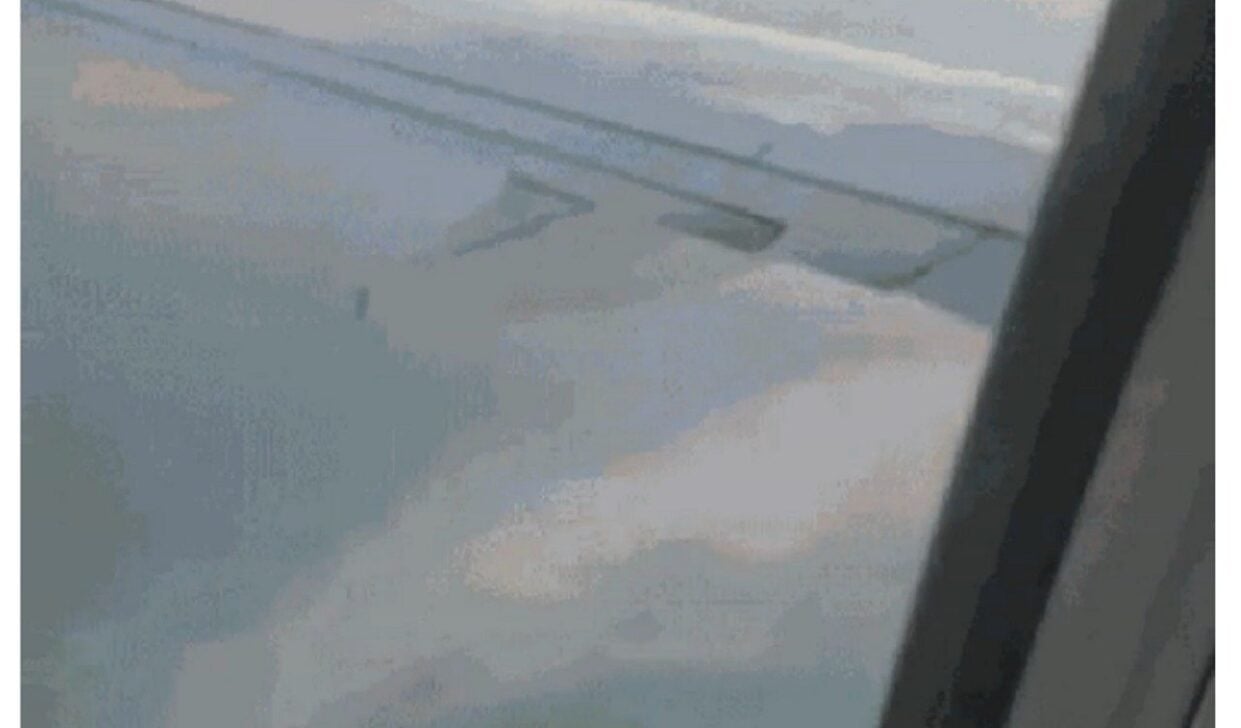
A Boeing 737 aircraft faced a serious emergency in North American airspace when one of its propellers began to burn intensely. The incident occurred during the initial ascent phase, a critical moment in which the equipment sucked in a flock of birds, creating an extreme risk scenario for the operation. Recent data from the Federal Aviation Administration (FAA) shows that winged animal strikes cost the global airline industry hundreds of millions of dollars annually. However, modern engineering ensures that these jets can fly and land safely using only one functional engine, thanks to the redundancy of internal systems.
Visual records capture the moment of tension in the air
Travelers who occupied seats close to the windows were able to film the flames coming from the right metal structure of the wing. Fright gripped the cabin as the jet flew over the coastal region of South Carolina, exactly on August 10, 2026. Images captured by customers quickly began to circulate, showing orange flashes contrasting with the daytime sky. Flight safety experts explain that the fire in these cases results from the breaking of the titanium vanes, which rupture the engine’s internal fuel lines.
Positioning of the company responsible for the route
The flight operated by American Airlines had just left the main runway of the busy Myrtle Beach terminal. Representatives of the airline company publicly confirmed that ingestion of the animals caused immediate overheating and subsequent flames in the turbine. The ground maintenance team was called as soon as the problem became evident, preparing the ground to receive the damaged equipment. Standard procedures dictate that the company must now carry out a full inspection to assess the extent of internal damage to the machinery.
More on this story: Plane turbine catches fire after collision with birds and forces landing in USA
Emergency communication between cabin and control tower
Without hesitation, the jet’s commander activated the radio to declare a state of maximum urgency to air traffic controllers in the region. The audio recording reveals the professional repeating the international distress code three times in a row, clearly reporting the loss of functionality in the propeller. Direct and objective communication allowed the tower to release airspace immediately, removing other planes from the return route. The correct use of aeronautical phraseology avoided any confusion about the severity of the scenario faced by the technical crew.
Reports from witnesses who followed the takeoff from the ground
Bathers enjoying the day on the extensive strip of sand near the airport reported noises similar to detonations echoing in the sky. When local residents and tourists looked up, they noticed the trail of fire following the trajectory of the commercial plane at low altitude. The loud popping sound is a common feature when a jet engine experiences a compressor stall, an aerodynamic phenomenon caused by the interruption of airflow. Rescue teams from the municipal fire department were also put on standby when they heard the booms coming from the direction of the sea.
Return maneuver and landing procedure
By following the safety manuals to the letter, the pilots were able to stabilize the machine’s altitude and plot an immediate return route. The equipment touched the ground without any major complications on the same runway from which it had started a few minutes earlier, using regular aerodynamic and mechanical brakes. Emergency vehicles were already waiting on the asphalt banks to escort the jet to the arrivals gate, ensuring that no remaining fires reached the fuselage. The quick maneuver avoided the need to jettison fuel, a time-consuming process that would have delayed landing.
Final assessment on occupant integrity
None of the 181 customers who purchased tickets for the domestic section suffered any type of physical injury during the contingency maneuver. The peaceful resolution of the event demonstrates how exhaustive simulator training prepares aviation professionals to prevent tragedies when severe mechanical failures occur. The company arranged for re-accommodation on other flights in the network so that everyone could reach their final destinations on the same day. Federal crash investigation authorities are expected to issue a preliminary report on the case in the coming weeks.
- Model of equipment involved: Boeing 737 commercial jet.
- Company responsible for the operation: American Airlines.
- Place of origin and emergency landing: Myrtle Beach Airport.
- Total number of people on board: 181 occupants rescued unharmed.