

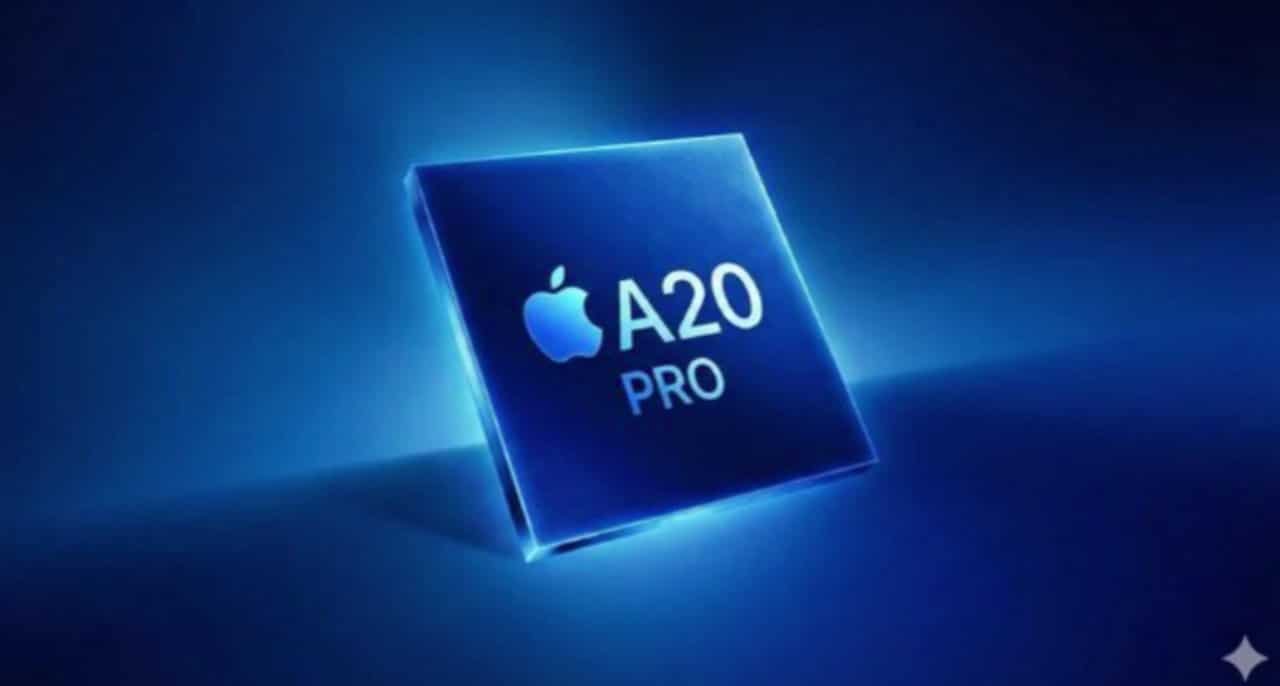
Information circulating recently on social media, especially from a post by Fixed Focus Digital on Weibo, has been interpreted as a leak about advances in the speed and efficiency of Apple’s A20 chip. This processor is expected to power the future iPhone 18 Pro and iPhone Ultra, with launch expected for next month.
However, a more in-depth analysis reveals that the interpretation of these data may be wrong. The original content does not directly refer to specific improvements to the A20, but rather to details of TSMC’s new manufacturing process that, it is speculated, will be used in the production of Apple’s chip. Furthermore, the information released does not mean what most vehicles have reported.
The expectation is that Apple will be one of the first major customers to adopt TSMC’s new 2-nanometer process on a large scale. This innovative technology incorporates the manufacturing technique known as gate all-around (GAA), an advance already anticipated by experts in the field earlier this year in analyzes of the A20.
More on this story: Expected features of the iPhone 18 Pro promise innovations in chip, cameras and 5G connectivity
According to the Fixed Focus Digital account, the specifications of TSMC’s new manufacturing process indicate a potential performance improvement of around 18% and a decrease in energy consumption of approximately 30%.
While these figures are true and have already been released, it is crucial to understand that they do not directly translate into an Apple A20 chip that is 18% faster or 30% more energy efficient in all situations.
First, it is essential to understand that such specifications refer to the manufacturing process technology itself, and not to all the chips that will be produced with it. The performance and efficiency of a processor depend on a combination of design factors, far beyond the mere manufacturing process.
Learn more: Registrations for the 2026 Apple event indicate the launch of a foldable and iPhone 18 Pro
Secondly, these percentages are isolated data that require contextualization. When TSMC reports an 18% performance improvement on a new process, it means that “a chip built using this new technology can operate up to 18% faster than an identical chip built using the previous process.” Similarly, the 30% reduction in power consumption indicates that “the same chip, operating at the same speed, will require 30% less power.”
Therefore, it is not a simultaneous optimization of 18% in speed and 30% in efficiency. These statistics would only apply to chip designs that were exactly identical, which is rarely the case.
The A20 Pro will undoubtedly present greater speed. However, the question of whether it will be 18% faster is uncertain, as the advancement in performance will result from all the design changes that Apple is incorporating. Energy efficiency will also be improved, especially at comparable operating speeds. However, at times of maximum use, the A20 Pro may have similar or even higher energy consumption than the A19 Pro.
Apple’s A20 Pro chip will undergo several significant changes to its design, including a likely increase in the number of transistors compared to the A19 Pro. Architectural modifications will be implemented in the CPU, GPU and Neural Engine cores, in addition to other features that influence performance, such as adjustments to the cache size. Despite all this information, the real speed gain of the A20 remains unknown, as the exact details of Apple’s project have not yet been revealed.