

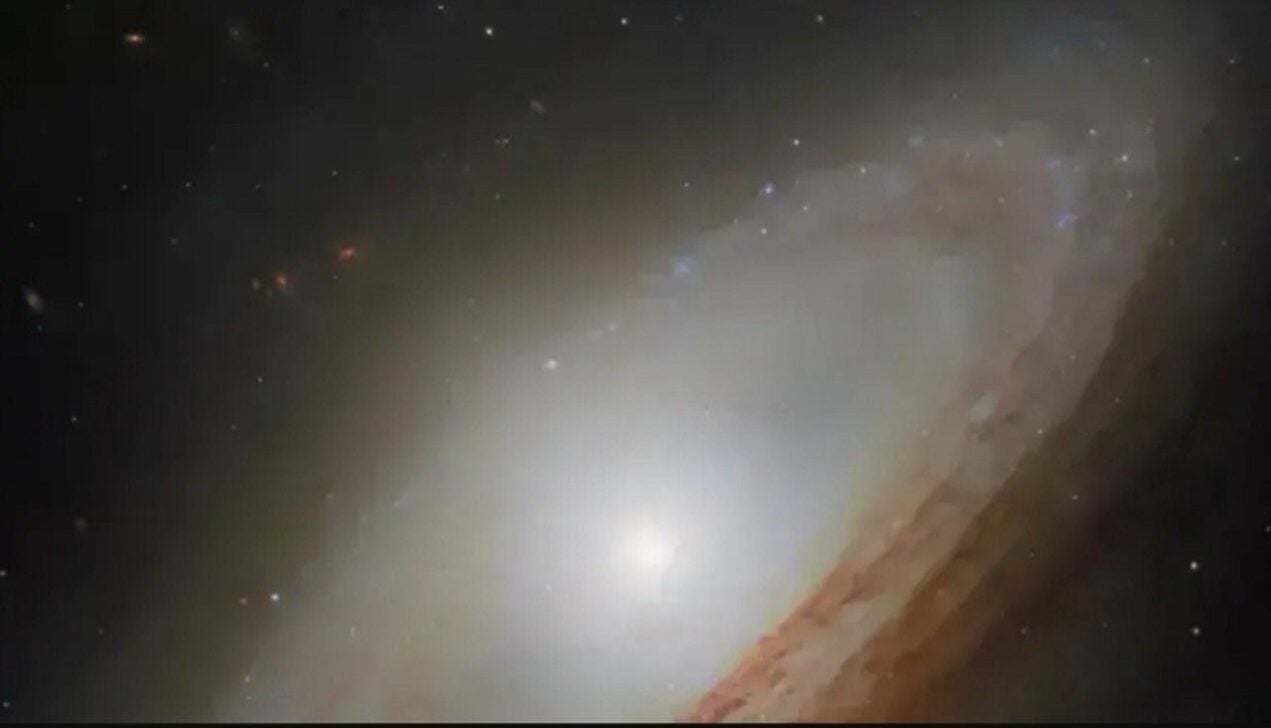
The Hubble Space Telescope captured detailed views of spiral galaxy NGC 4698, positioned roughly 55 million light-years from Earth within the constellation Virgo, exposing an internal stellar component that unexpectedly rotates in a distinct direction from the outer structure. This system belongs to the Virgo Cluster, a massive group of galaxies bound together by gravity.
Perpendicular alignment marks the galactic core
At first glance, NGC 4698 displays standard components of a spiral system, including gas, dust, and stars along its outer arms. The galactic bulge stretches vertically and runs perpendicular relative to the primary disk. Gas and stellar populations near the central region follow an orientation detached from the remaining galactic expanse.
The central core moves independently.
Supermassive black hole pulls surrounding gas
A supermassive black hole resides at the core of NGC 4698, containing mass equal to millions of times that of the Sun. Information released by NASA indicates that this black hole continues to grow actively by pulling nearby gas inward.
- Spiral arms contain dust and stars across the outer sections.
- The central stellar bulge aligns perpendicularly to the disk.
- A hydrogen tail extends from one edge of the galaxy.
- The nuclear black hole equals millions of solar masses.
Astronomers attribute this structural mismatch to gas entering NGC 4698 from an outside reservoir. This collected material settled near the center, generating a newer disk of stars and gas that orbits at an opposing angle.
A hydrogen tail visible on one edge suggests NGC 4698 endured a minor merger in its past history. This interaction supplied external matter that reshaped its interior architecture.
Hubble survey studies the Virgo Cluster environment
The new image forms part of an observation campaign tracking galaxies located across the Virgo Cluster. Scientists use these observations to inspect closer features like star clusters and star-forming regions while monitoring environmental influences within the cluster. NGC 4698 serves as a prime candidate for examining how external mergers alter cosmic structures over time.
The observations document how foreign matter enters NGC 4698.