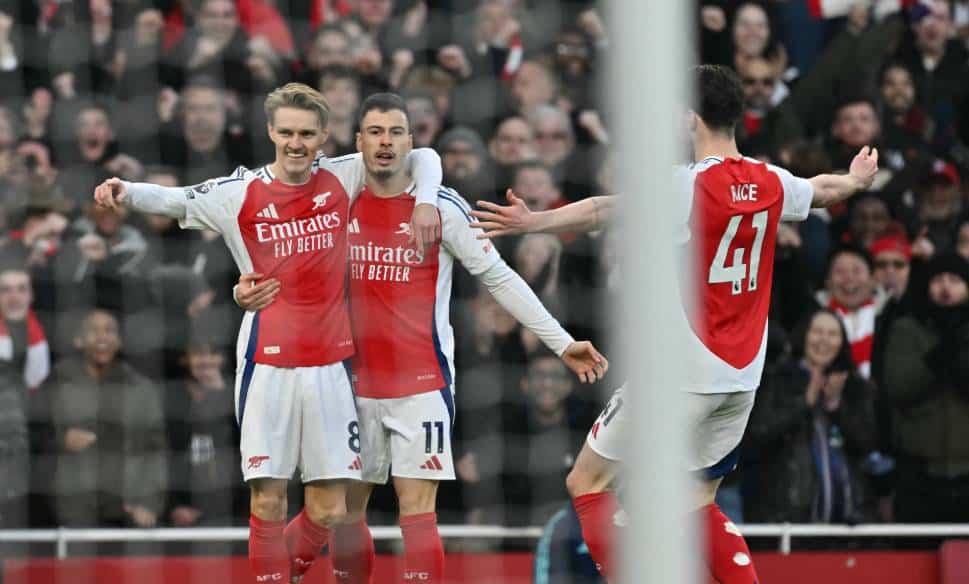
The Emirates Stadium set the stage for one of the most anticipated clashes of the 2024/25 Premier League season as Arsenal faced Manchester City in a battle that could shape the title race. Within the opening minute, Arsenal took the lead with a goal from Norwegian midfielder Martin Ødegaard, capitalizing on a defensive mistake by City. However, Pep Guardiola’s team quickly responded, increasing the tempo and pushing forward in search of an equalizer. The game turned into a tactical duel, with both teams displaying high-intensity football.
Mikel Arteta’s Arsenal started aggressively, pressing high and forcing errors from City’s defenders. This approach paid off early when Kai Havertz intercepted a misplaced pass from Manuel Akanji and set up Ødegaard for a clinical finish inside the box. Despite the early setback, City reorganized quickly, using its technical quality to regain control and dictate possession. Erling Haaland and Bernardo Silva led the charge as City sought to level the score, but Arsenal’s defensive resilience kept them at bay.
The midfield battle became crucial, with Declan Rice and Thomas Partey providing stability for Arsenal, while Mateo Kovacic and Bernardo Silva orchestrated City’s attacks. The tactical chess match between Arteta and Guardiola underscored the growing rivalry between the two clubs, with both managers making key adjustments throughout the first half.
Arsenal’s Lightning-Quick Goal and Its Impact
Ødegaard’s goal changed the dynamics of the match, forcing City to adjust its strategy early.
- The Norwegian midfielder found the net within the first minute, finishing inside the box after Havertz’s assist.
- Arsenal’s pressing forced an error from Akanji, allowing them to recover possession in a dangerous area.
- City was forced to shift to a more offensive approach earlier than expected, leaving spaces at the back.
Despite taking the lead, Arsenal continued pressing, maintaining an aggressive stance. Wingers Gabriel Martinelli and Leandro Trossard were key in sustaining the attacking momentum.
WHAT A START!
— Arsenal (@Arsenal) February 2, 2025
Havertz squares it and the skipper strikes to give us an early advantage ????
???? 1-0 ???? (2) pic.twitter.com/Qb82YkDx8Q
Manchester City’s Response and Tactical Adjustments
After conceding, City gradually increased possession and started creating goal-scoring opportunities.
- Haaland had the first real chance for City, receiving a pass from Bernardo Silva but failing to beat goalkeeper David Raya.
- Kovacic attempted a long-range shot at the 15-minute mark, narrowly missing the target.
- Guardiola’s side exploited the flanks, with Matheus Nunes and Phil Foden trying to break through Arsenal’s compact defense.
As the half progressed, City pushed Arsenal deeper into their half, forcing them into a more defensive stance. Arsenal’s center-backs, Gabriel Magalhães and William Saliba, had to be at their best to contain Haaland’s physical presence.
Gabriel Martinelli’s Impact on Arsenal’s Attacking Play
Brazilian winger Gabriel Martinelli played a key role in Arsenal’s offensive transitions, using his pace to challenge City’s defense.
- Martinelli frequently attacked down the left wing, forcing one-on-one situations against Akanji and Gvardiol.
- In the 30th minute, he dribbled past two defenders and delivered a cross to Ødegaard, whose shot narrowly missed.
- His movement prevented City’s full-backs from pushing forward, restricting their attacking width.
Martinelli’s dynamic play kept Arsenal’s counter-attacks dangerous, providing an outlet whenever City overcommitted players forward.
Guardiola’s Tactical Adjustments to Change the Game
Recognizing the need for a shift in approach, Guardiola made tactical changes to regain control.
- Bernardo Silva moved into a central role to support Kovacic in midfield distribution.
- Matheus Nunes played higher up the pitch, linking with Haaland to create more direct threats.
- City’s defensive line pushed further up to compress space and increase their pressing intensity.
These changes helped City become more dominant in possession, but Arsenal’s defensive structure remained disciplined.
Arsenal’s Defensive Discipline and Counter-Attack Strategy
As City intensified their attacks, Arsenal adapted by reinforcing their defensive shape while remaining dangerous in transition.
- Rice and Partey disrupted City’s passing lanes, cutting off supply to Haaland.
- The Gunners’ defense dealt well with aerial threats, clearing crosses effectively.
- Havertz and Trossard led counter-attacks, aiming to exploit the gaps left by City’s attacking push.
Although City controlled possession, Arsenal’s disciplined approach made it difficult for them to create clear-cut chances.
Goalkeepers’ Key Saves in a Tight First Half
Both David Raya and Stefan Ortega played crucial roles in keeping the scoreline unchanged after Ødegaard’s opener.
- Raya made a vital save on a close-range shot from Haaland, preserving Arsenal’s lead.
- Ortega denied a powerful effort from Trossard, preventing Arsenal from extending their advantage.
- Both goalkeepers displayed excellent decision-making when coming off their lines to deal with crosses and through balls.
The first half remained competitive, with both teams showing strong defensive organization.
Arsenal vs. Manchester City: A Premier League Rivalry
Arsenal and Manchester City have emerged as two of the fiercest rivals in recent Premier League history, consistently battling for top honors.
- Arsenal aims to reclaim the English crown for the first time since the 2003/04 Invincibles season.
- City, under Guardiola, has set the benchmark for excellence, dominating English football in recent years.
- Last season, both teams fought for the title until the final rounds, with City ultimately prevailing.
This growing rivalry has elevated the level of competition in the Premier League, making their encounters must-watch games.
What to Expect in the Second Half
With a narrow scoreline and plenty of football left to play, the second half is expected to bring even more excitement.
- Arsenal will likely attempt to hold their lead while looking for counter-attacking opportunities.
- City will push harder to find an equalizer, possibly making offensive substitutions.
- Both managers will need to make crucial tactical decisions as the game progresses.
With the intensity and stakes at an all-time high, Arsenal vs. Manchester City remains a battle far from over.
