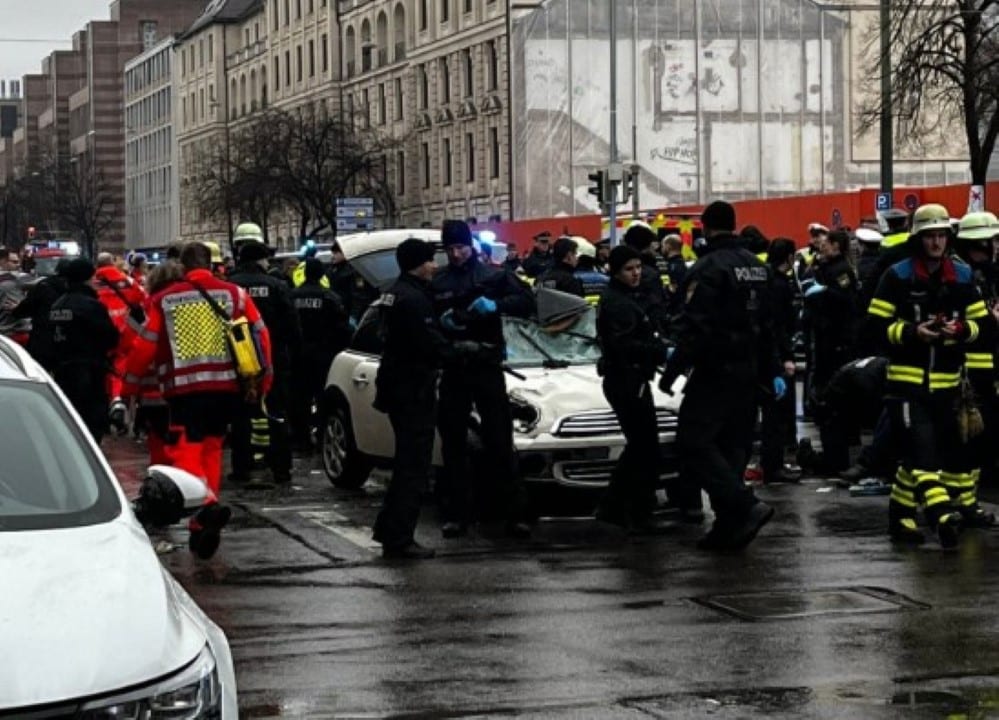
On the morning of February 13, 2025, a serious attack shook the city of Munich, Germany, when a 24-year-old Afghan driver accelerated a Mini Cooper into a union protest organized by Verdi, one of the country’s largest unions. The incident occurred on Seidlstrasse, one of the city’s busy streets, leaving 28 people injured, including two in critical condition. Witnesses described scenes of panic, with protesters running for safety as the car sped toward the crowd. Local authorities are considering the possibility of an intentional attack, as the suspect was already known to the police for previous offenses such as theft and drug possession. Munich Mayor Dieter Reiter expressed solidarity with the victims and condemned the violent act, while investigations move forward to determine the exact motivations behind the crime.
Emergency teams quickly arrived at the scene to provide first aid to the victims, some of whom sustained severe injuries. The driver was arrested on-site and taken for questioning by Bavarian police. According to preliminary reports from investigators, the suspect had shown aggressive behavior in the days leading up to the attack, but no official confirmation has yet been made regarding possible connections to extremist groups.
The attack comes at a sensitive time for security in Germany, particularly in Munich, which is about to host the Munich Security Conference. The local government has strengthened protective measures in response to the possibility of further attacks and is working to ensure the safety of residents and visitors to the city.
The Verdi union protest and its demands
The protest organized by the Verdi union was part of a nationwide movement demanding better wages and working conditions for public sector employees, including teachers, healthcare workers, and public transportation staff. Demonstrations took place in several German cities, but the Munich incident gained particular attention due to the violent attack that disrupted the peaceful gathering. The event organizers strongly condemned the attack and emphasized the importance of ensuring the safety of workers participating in legitimate protests.
Verdi has played a key role in salary negotiations with the German government, pushing for wage adjustments to keep up with inflation and improve working conditions for thousands of professionals. This week’s protests gathered thousands of workers across the country and were intended to be peaceful until the tragic event in Munich sparked panic and outrage among the participants.
‼️????BREAKING????‼️
— Grim (@MadWokeNews) February 13, 2025
In Munich, Germany, an Afghan asylum seeker, who has a history of criminal behavior including multiple arrests for theft and drug dealing, drove a car into a crowd. This incident left at least 20 people wounded and a toddler fighting for his life.
This event is… pic.twitter.com/f44BS0RydG
History of attacks on protests in Germany
Germany has faced several incidents involving vehicle attacks on crowds in recent years, many of which have been linked to ideological extremism or psychological issues of the perpetrators. In 2016, an attack in Berlin left 12 dead and dozens injured when a truck was driven into a Christmas market. In 2020, a similar event occurred in Volkmarsen, where a man deliberately ran over dozens of people during a carnival parade.
German authorities closely monitor demonstrations and public events to prevent attacks, but incidents like the one in Munich highlight the ongoing security challenges. Police are investigating whether the driver responsible for the Munich attack has connections to extremist groups or acted alone. Security experts warn that vehicle attacks have become an increasingly common tactic due to their ease of execution and high potential for casualties.
Security measures reinforced in Munich after the attack
Following the attack, Bavarian authorities announced an immediate reinforcement of security measures in Munich. The city was already under a heightened security alert due to the Munich Security Conference, which will be attended by international leaders, including U.S. Vice President J.D. Vance and Ukrainian President Volodymyr Zelensky. The Bavarian government has increased surveillance in high-traffic areas and boosted police presence at public events and demonstrations.
Experts warn that given the rise in similar attacks in recent years, Germany must invest in strategies to identify threats before they materialize. The use of protective barriers at large events, identifying suspicious individuals, and stricter monitoring of potential threats are among the actions recommended by security analysts.
The impact of the attack on German politics and international relations
The Munich attack occurs at a politically sensitive time for Germany, which is dealing with debates on immigration, public security, and extremism. The case raises questions about the integration of refugees in the country, as the suspect is an Afghan immigrant who arrived in Germany in 2016. The presence of far-right groups in Germany, which often use these incidents to advocate for stricter immigration policies, could further intensify political discussions.
Security in Europe has been one of the central themes in international forums, especially given the challenges posed by recent attacks in other parts of the continent. Germany, as one of the leading economies and political powers in the European Union, plays a crucial role in shaping strategies to combat extremist threats and protect its citizens.
Key points about the Munich attack
- The attack occurred on Seidlstrasse during a peaceful union protest organized by Verdi.
- The driver, a 24-year-old Afghan, deliberately drove into the crowd, injuring 28 people.
- Two victims remain in critical condition, and several others sustained serious injuries.
- The suspect was arrested and was already known to the police for minor offenses.
- Authorities are investigating the motivations behind the crime and whether there are links to extremism.
- The city has reinforced security measures due to the Munich Security Conference.
- The attack has reignited debates on immigration, public security, and terrorism prevention in Germany.
Curiosities about vehicle attacks in Europe
- Since 2016, vehicle attacks have become one of the primary tactics used by extremists in Europe.
- The deadliest attack of this kind occurred in Nice, France, in July 2016, killing 86 people and injuring hundreds.
- In Germany, vehicle-based attacks have been recorded multiple times, often linked to individuals with psychological disorders.
- Countries such as the UK and France have implemented fixed barriers in high-traffic areas to minimize the risk of new attacks.
- The European Union has been discussing joint measures to enhance security at public venues and large-scale events.
Statistical data on attacks in Europe
- Between 2015 and 2024, more than 60 large-scale attacks were recorded in the European Union.
- Vehicle attacks accounted for approximately 15% of terrorist incidents in Europe in recent years.
- Germany has recorded at least six vehicle-based attacks since 2016.
- Public security investments in Germany increased by 40% in preventive measures since 2020.
- In Munich, police presence has increased by 30% over the last three years due to attack risks.
