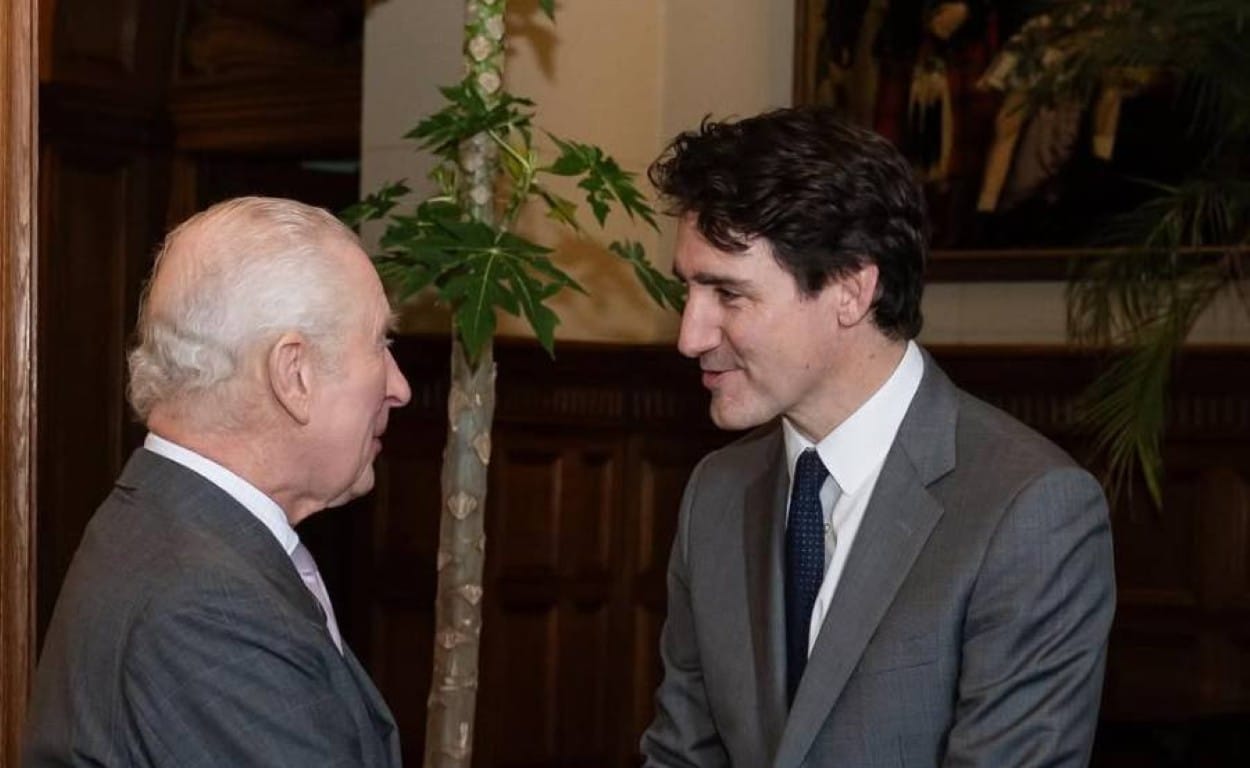
Provocative statements from U.S. President Donald Trump about Canada cast a long shadow over a pivotal meeting between Canadian Prime Minister Justin Trudeau and King Charles at Sandringham, England, on March 3. Trump, who reclaimed the presidency in January, has intensified his rhetoric about turning Canada into America’s 51st state and announced new import tariffs targeting the country, a key U.S. trading partner. The encounter between Trudeau and the British monarch comes at a critical juncture for Canada, facing economic and diplomatic pressures as Trudeau, nearing the end of his tenure, seeks to bolster national sovereignty amid Trump’s threats. Adding complexity, King Charles has extended an unprecedented second state visit invitation to Trump, amplifying the geopolitical stakes of the moment.
Canada, home to about 40 million people and an economy deeply tied to the U.S., sends over 75% of its exports—such as oil, lumber, and vehicles—southward. The tariffs, set to take effect this Tuesday, target goods from Canada, Mexico, and China, threatening industries like British Columbia’s lumber sector and Alberta’s energy production. Trump defended the measures on Truth Social, claiming the U.S. “subsidizes” Canada by importing its products, suggesting that without this cash flow, Canada “would cease to exist as a viable nation.” His words have reignited debates over Canadian independence, particularly as Trudeau’s January resignation announcement leaves the Liberal Party scrambling for a successor amid this escalating crisis.
King Charles, as head of state for the Commonwealth nation, faces growing calls to vocally support Canada against Trump’s rhetoric. Jason Kenney, former Alberta premier, argued that the monarch can only act on Trudeau’s advice but urged the prime minister to enlist Charles in reaffirming Canadian sovereignty. The Sandringham summit follows a whirlwind of diplomatic engagements for the king, including a meeting with Ukrainian President Volodymyr Zelensky the previous day, amid tensions with Trump over U.S. support for Ukraine. Trump’s stance puts the UK in a delicate spot, especially after Kenney criticized British Prime Minister Keir Starmer for dodging Trump’s annexation threats during a recent White House visit, calling it a betrayal of a loyal Commonwealth ally.
Trump’s rhetoric stirs U.S.-Canada relations
Donald Trump’s comments about Canada are not new but have sharpened since his return to office. During his campaign, he floated using “economic force” to make Canada the 51st U.S. state, a notion he revived recently. On Truth Social, he pointed to the U.S. trade deficit with Canada—$71 billion in 2023—as justification for aggressive action. The looming tariffs, hitting steel, aluminum, and oil, are slated to begin March 4, adding strain to a Canadian economy already grappling with inflation and high energy costs.
Ahead of his Sandringham trip, Trudeau, in his final months as prime minister, vowed to address critical Canadian issues with King Charles, including defending national sovereignty and independence. Canada shares the world’s longest land border with the U.S., stretching over 8,891 kilometers, and relies heavily on bilateral trade. Trump’s threats expose vulnerabilities, with business leaders in Toronto and Vancouver warning that the tariffs could spike domestic prices and trigger mass layoffs, particularly in the auto industry, which employs roughly 120,000 Canadians directly.
Across Canada’s political spectrum, Conservative leader Pierre Poilievre condemned Trump’s remarks as “unwarranted aggression” against a historic ally. Leading polls for the next election, Poilievre pledged retaliatory tariffs on U.S. goods if Trump follows through. This leaves Canada at a crossroads: yield to U.S. economic pressure or rally international support to counter Trump’s ambitions, which also include controlling the Panama Canal and Greenland—though he has ruled out military force against Canada.
King Charles navigates diplomatic storm
Since Trump’s return to power, King Charles has been thrust into a flurry of high-stakes diplomacy. Inviting Trump for an unprecedented second state visit while hosting Trudeau creates a tightrope for the monarch. As Canada’s symbolic head of state, Charles faces pressure from figures like Jason Kenney, who suggested Trudeau should prompt the king to back Canadian autonomy. However, his constitutional role restricts him to acting on the prime minister’s guidance, making any public stance a delicate matter.
Trudeau’s Sandringham visit aimed to cover climate change and trade but quickly shifted to the U.S. crisis. It follows Charles’s meeting with Zelensky, who seeks European backing as U.S. aid to Ukraine wanes under Trump. Starmer’s silence on Trump’s annexation talk during his Washington visit drew sharp rebuke from Kenney, who accused the UK leader of abandoning a Commonwealth partner that made “immense sacrifices” for Britain, notably in the world wars.
Ties between Canada and the UK, rooted in history and economics, are also at play. Bilateral trade topped $25 billion in 2023, with Canada exporting gold and importing British machinery. A firm stance from Charles could signal solidarity, but experts warn that such a move risks straining relations with the U.S., the UK’s top NATO military partner.
Economic fallout from Trump’s tariffs on Canada
Trump’s tariffs promise to jolt Canada’s economy on multiple fronts. The energy sector, accounting for 20% of exports, faces steep losses, especially in Alberta, where crude oil flows to the U.S. via pipelines like Keystone XL. British Columbia’s lumber industry, generating $7 billion annually, braces for a projected 15% export drop.
Ontario’s auto sector, producing 30% of North America’s vehicles, fears supply chain disruptions. In 2023, Canada shipped over 2 million cars to the U.S., supporting around 500,000 jobs directly and indirectly. The tariffs, paired with annexation rhetoric, have driven a 2% dip in the Canadian dollar against the U.S. dollar recently, signaling market unease.
Small businesses feel the pinch too. In border towns like Windsor, reliant on daily trade with Detroit, shop owners report stockpiles and declining sales. Trudeau vowed to negotiate with the U.S. to soften the blow, but the tight timeline before the tariffs kick in leaves little room for quick fixes, pushing Canada to seek allies like the UK and EU.
Timeline of Trump-Canada tensions
Recent events trace the rising conflict between the two nations. Here’s a rundown:
- January: Trump takes office, reviving talk of Canada as the 51st state.
- February: Announces tariffs on Canada, Mexico, and China, effective March 4.
- March 2: Trudeau arrives at Sandringham to meet King Charles.
- March 3: Trump doubles down on threats via Truth Social as Charles hosts Zelensky.
The coming week will be pivotal as tariffs hit and Canada scrambles for diplomatic leverage.
Canada’s political response to Trump’s provocations
Trump’s rhetoric has dominated discourse within the Liberal Party, now in leadership transition post-Trudeau. Candidates like Finance Minister Chrystia Freeland advocate a hard line against the U.S., while others favor talks to avert a trade war. Public pressure for action has surged, with 65% of Canadians backing retaliation in a recent poll.
Conservative leader Pierre Poilievre seized the moment to slam the Liberal government’s handling of Trump, labeling it weak. He proposed mirroring tariffs on U.S. goods like soybeans and beef, worth $12 billion in Canadian imports in 2023. Political divides underscore the crisis’s weight, uniting the nation against sovereignty threats but splitting it on economic strategy.
Civil society has mobilized too. Ottawa saw hundreds protest Trump’s policies, while Quebec trade groups urged federal contingency plans to save jobs. With Trudeau’s exit looming, political uncertainty heightens Canada’s exposure to U.S. Designs.
Tips for Canadians facing Trump’s tariffs
As tariffs loom, citizens can take steps to brace for impact. Here are practical suggestions:
- Track prices of essentials like gas and lumber, set to rise.
- Plan cross-border shopping early, anticipating delays.
- Support local goods to cut reliance on U.S. imports.
- Stay updated on government talks with the U.S.
These measures can cushion daily economic hits.
Future of Canada-U.S. relations amid Trump’s threats
Trudeau’s meeting with King Charles signals an effort to bolster Commonwealth ties against Trump’s pressure. Yet Charles’s invitation to Trump hints at keeping U.S. channels open despite the rift. Analysts predict the tariffs will spark intense USMCA renegotiations, with Canada pushing exemptions for key sectors.
Long-term outcomes hinge on Trudeau’s successor. A Poilievre-led Conservative government might take a tougher stance, while a Liberal one could lean on diplomacy. Trump’s annexation talk, though widely seen as bluster, has rekindled debates over Canadian identity and its reliance on the U.S., which absorbs 76% of its exports.
The crisis tests Canada’s global resilience. As the EU and UK reaffirm Ukraine support against Russia, Canada seeks partners to offset U.S. influence. Zelensky’s Sandringham visit, followed by Trudeau’s, highlights interwoven geopolitical strains, placing Canada at the heart of a complex diplomatic chessboard.
