
The murder of Vitória Regina de Souza, a 17-year-old found dead in a wooded area in Cajamar, Greater São Paulo, on March 5, 2025, has uncovered a chilling tale of obsessive stalking that ended in tragedy. Investigations point to Maicol Sales dos Santos as the prime suspect, a neighbor who had been monitoring Vitória’s movements since 2024. Forensic analysis of Maicol’s cellphone revealed shocking evidence: photos of the victim, images of weapons, and proof he viewed a social media post by Vitória at 0:06 a.m. on February 27, just minutes before her disappearance. The case, which has shaken the region, suggests Maicol, identified as a stalker, planned the abduction and acted alone, though other suspects were initially considered. As police await DNA results to confirm traces found in his car and home, Vitória’s family demands justice after days of anguish following her vanishing. The crime’s brutality, marked by torture and extreme violence, drives an urgent search for answers.
Vitória worked as a cashier at a local mall and followed a predictable routine, possibly making her an easy target. On the night of February 26, after stepping off a bus in the Ponunduva neighborhood, she sent voice messages to a friend expressing fear of two men in a car who harassed her. Security cameras captured a vehicle matching Maicol’s silver Toyota Corolla in the area, and witnesses reported odd noises from his home that morning. Her body was discovered with her throat slit, hair shaved, and signs of severe violence, about 5 kilometers from her residence.
Arrested since March 8, Maicol denies involvement, but his wife contradicted his alibi, stating she slept at her mother’s house that night. Authorities now focus on physical evidence, including a hair strand and a possible bloodstain in his car, to unravel the details of a crime that stunned Cajamar.
Obsessive stalking takes shape
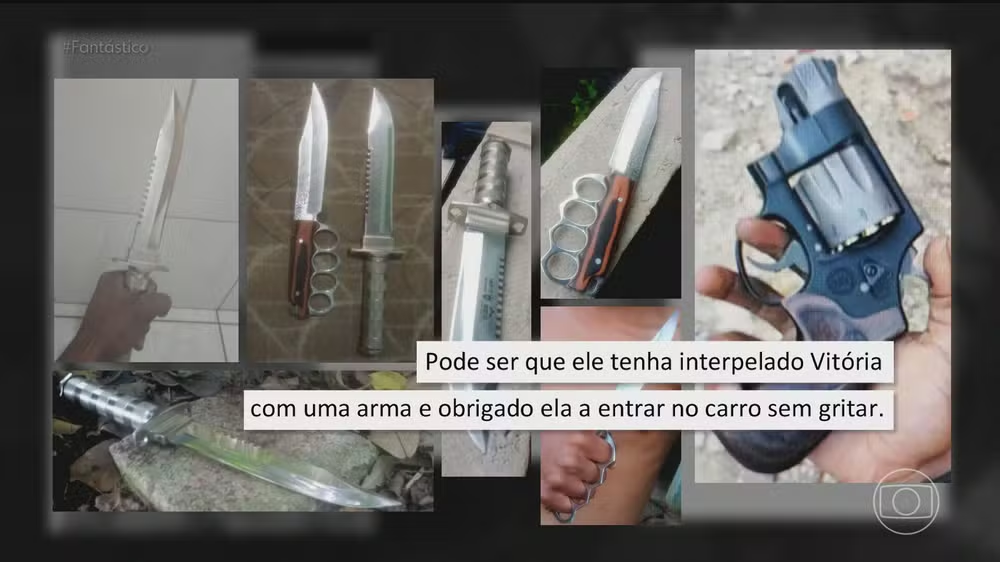
Examining Maicol Sales dos Santos’s cellphone exposed a pattern of behavior solidifying the stalker theory. Since mid-2024, he had collected photos of Vitória and other women with similar physical traits, alongside images of knives and a revolver. These findings suggest he harbored an obsession with the young woman, tracking her routine and exploiting vulnerabilities, such as her father’s broken-down car on the night of the crime. Geolocation data from his device showed significant activity during the early hours of her disappearance, indicating he was on the move as Vitória walked home.
Witness accounts bolster the case against Maicol. One reported seeing his silver Corolla near the bus stop where Vitória disembarked, while another heard suspicious sounds from his residence. Forensic experts recovered deleted data from his phone, including his access to Vitória’s 0:06 a.m. post on February 27, a clue he intercepted her shortly after she left the bus.
Timeline of the Vitória case
The events leading to the murder follow a sequence under police scrutiny:
- 2024: Maicol begins tracking Vitória, gathering photos and details of her routine.
- February 26, 2025: Vitória leaves work at 11 p.m. and boards a bus home.
- February 27, 0:06 a.m.: She posts on social media, viewed by Maicol.
- February 27, 0:30 a.m.: Vitória vanishes after voicing fear in messages to a friend.
- March 5: Body found in woods, showing signs of torture and extreme violence.
This timeline underscores how the suspect may have meticulously planned the crime.
Physical evidence deepens investigation
Authorities have zeroed in on tangible clues linking Maicol to the murder. Inside his silver Toyota Corolla, forensic teams found a hair strand and a stain possibly blood, both sent for DNA testing. Preliminary findings hint that Vitória was held captive before her death, potentially at Maicol’s home, where another suspicious stain was detected. Tools like a shovel and hoe, belonging to his stepfather and found near the body, are also being analyzed for genetic material.
Though Maicol remains the sole detainee, the investigation initially eyed others, including Gustavo Vinícius, Vitória’s ex-boyfriend, and Daniel Lucas Pereira, a local resident. Gustavo faced scrutiny after his phone’s geolocation placed him near her home that night, but a judge denied his arrest due to insufficient evidence. Daniel, who filmed Vitória’s route from the bus stop to her house days earlier, raised suspicions of premeditation, yet he too avoided detention.
The Cellebrite software used in the cellphone forensics delivered critical breakthroughs, retrieving chats and images Maicol attempted to erase. The murder’s savagery—three stab wounds to the chest, neck, and face, plus torture marks—points to a crime driven by obsession or revenge, though the motive remains under investigation.
Suspects face detailed scrutiny
Beyond Maicol, other individuals surfaced in the probe, though evidence against them has weakened. Gustavo Vinícius, Vitória’s ex, admitted she called him for a ride that night but claimed he was with someone else and didn’t respond. His phone’s location near her house fueled suspicion, yet without solid proof, he remains a person of interest. Daniel Lucas Pereira, her friend, drew attention for recording her path from the bus stop for days, but the court deemed the evidence too thin to hold him.
Maicol’s wife played a pivotal role by debunking his alibi, confirming she wasn’t with him that night. Neighbors reported unusual activity at his home, and cameras caught his car in the abduction area. These factors cement Maicol as the leading suspect, while police reassess any accomplices.
Evidence against Maicol
The mounting case against him includes:
- Photos of Vitória and weapons on his phone, amassed since 2024.
- Hair and a potential bloodstain in his Toyota Corolla.
- Camera and witness confirmation of his presence near the crime scene.
- Alibi contradicted by his wife’s testimony.
These findings support the theory he acted alone, pending final forensic reports.
Crime’s brutality shocks Cajamar
Vitória’s body, discovered after a week-long search, bore signs of horrific violence: throat slashed, hair shaved, naked except for a bra around her neck, and hands bound with plastic. Forensic experts estimate she was killed days earlier, possibly after captivity, and dumped in the woods 5 kilometers from home. The Municipal Civil Guard found buried clothes and hair 10 meters from the body, suggesting the killer tried to conceal evidence.
Vitória’s family, who describe her as a joyful and hardworking teen, endured agonizing days since her disappearance. Her sister, Weronica Alves de Sousa, praised her kindness, while her burial on March 6 rallied Cajamar in a call for justice. Police aim to wrap up the inquest by April 13, the day Vitória would have turned 18.
The probe involved 18 witness statements and analysis of 10 cellphones, with Cellebrite uncovering vital data. The community reels from the loss of a young woman whose routine was shattered by a crime exposing the dangers of silent pursuit.
Technology aids justice efforts
Advanced tools like the Cellebrite software enabled police to retrieve information Maicol sought to delete, such as photos and activity logs from the crime night. Capable of unlocking device data, the technology illuminated the depth of his fixation on Vitória and tied key investigation threads. DNA results, due in coming weeks, could confirm if the blood and hair belong to her, potentially sealing Maicol’s fate.
While Maicol is the primary focus, authorities haven’t fully ruled out co-conspirators. Analysis of Gustavo and Daniel’s phones continues, but evidence heavily favors Maicol as the lone perpetrator. The case underscores forensic technology’s role in complex crimes, offering hope to Vitória’s family and Cajamar’s residents.
Vitória’s death highlighted vulnerabilities in areas like Ponunduva, where poor lighting and security ease criminal acts. As final reports loom, the investigation presses on, aiming to clarify every facet of a murder that left deep scars in Greater São Paulo.
