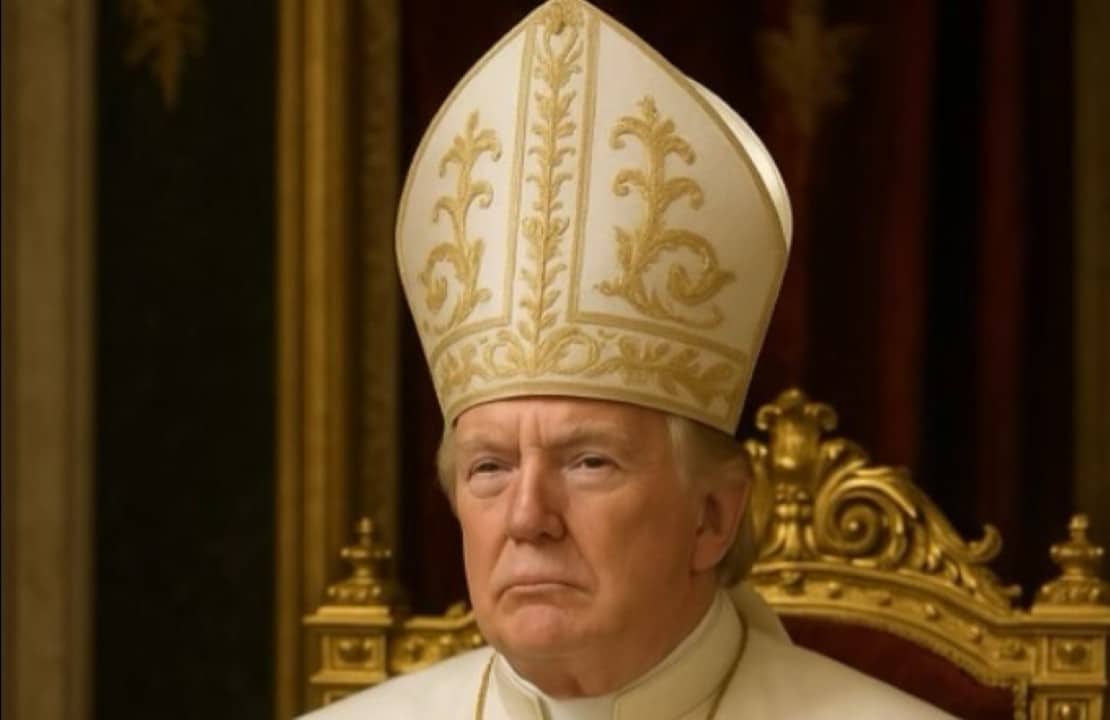
Amid mourning for the death of Pope Francis on April 21, U.S. President Donald Trump posted an artificial intelligence-generated image depicting himself dressed in papal attire. The post, shared on the evening of May 2 via his Truth Social platform, quickly gained global attention, particularly as it coincided with preparations for the conclave to select the next leader of the Catholic Church. The image, reposted by the official White House account on X, triggered widespread criticism, especially among Catholic leaders and faithful, who deemed it disrespectful. While some Trump supporters framed the post as an attempt at humor, the action fueled debates about the use of artificial intelligence in sensitive contexts.
The image portrays Trump seated in an ornate chair, wearing a white papal cassock, a mitre, and a gold crucifix, with his index finger raised in a solemn gesture. The post lacked a caption, leaving room for varied interpretations. For many, the timing—just 11 days after Francis’s death—was particularly offensive. Key aspects of the controversy include:
- Religious reactions: Bishops in New York and cardinals in Rome expressed outrage, calling the image disrespectful.
- Divided opinions: Critics condemned the act, while Trump supporters defended it as a joke.
- Political context: The post followed Trump’s jest that he would like to be pope, mentioning Cardinal Timothy Dolan as a potential candidate.
The controversy spread rapidly across social media, with related hashtags trending widely. The absence of an apology from Trump or the White House further fueled criticism, especially at a time of profound significance for the world’s 1.4 billion Catholics.
Responses from Catholic leaders
Cardinals and bishops swiftly reacted to Trump’s post. Cardinal Timothy Dolan, Archbishop of New York and a prominent figure in American Catholicism, celebrated a Mass in Rome on Sunday, May 4, when questioned about the image. His response was brief but firm: he stated the post “wasn’t good” and expressed hope that Trump had no direct role in its publication. Dolan, set to participate in the conclave starting May 7, is known for his conservative stance and cordial ties with Trump, having offered a prayer at the presidential inauguration in January.
Bishops from New York, represented by a local association, issued a statement on X condemning the image. The message emphasized the delicate moment for the Catholic Church, still grieving Francis’s loss and on the verge of a historic conclave. The statement urged respect for the process of selecting the new pope, described as a solemn moment for the faithful. Other Catholic leaders, such as Cardinal Pietro Parolin, a leading candidate to succeed Francis, avoided direct comments, but Vatican sources indicated unease with the situation.
- Criticism on X: Catholic users shared messages of outrage, some labeling the post “blasphemous.”
- Vatican silence: Spokesman Matteo Bruni declined to address the issue during conclave briefings.
- International reactions: Italian newspapers, such as Corriere della Sera, published editorials condemning the act.
Conclave in the spotlight
The conclave, scheduled to begin on May 7, will bring together 135 cardinals in the Sistine Chapel to elect the next pope. Francis’s death at 88, following a stroke, has left the Catholic Church in a period of transition. The process, shrouded in secrecy, is one of the most significant events in Catholicism, with cardinals from across the globe traveling to Rome for deliberations. The selection of the new pontiff comes amid internal divisions within the Church, with debates over issues like relations with China and approaches to social matters.
Trump, who is not Catholic and does not regularly attend church, had already drawn attention the previous week by commenting on the conclave. During a White House press conference, he jokingly said being pope would be his “first choice” and praised Cardinal Dolan, suggesting he could be a strong candidate. Though said in jest, the remark was seen by some as an attempt to influence public perception of the process. The AI image post intensified these speculations, with critics suggesting it might reflect a strategy to capture attention during a moment of global focus.
Divisions among faithful and tourists
In St. Peter’s Square, pilgrims and tourists expressed divergent views on Trump’s post. Some faithful, particularly those who traveled to Rome to honor Francis, found the image offensive. A Brazilian pilgrim, Ana Clara Mendes, called the act “unacceptable” during a time of mourning. Others, such as a group of American tourists, downplayed the controversy, viewing it as a joke. John Smith from California said Trump was just trying to be “funny” and that critics lacked a sense of humor.
- Mourning sentiments: Many faithful emphasized the importance of respecting the official mourning period.
- Humor debate: Trump supporters argued the Church should be less rigid about jokes.
- Media presence: The image appeared on the front pages of Italian newspapers, with headlines ranging from criticism to irony.
The polarization extended to social media, where the post generated memes, criticism, and defenses. Pro-Trump accounts shared the image with approving messages, while critics, including Catholic influencers, called for greater sensitivity. The hashtag #PopeTrump trended in several countries, reflecting the controversy’s global reach.
Context of the post
Trump’s post came at a time of high visibility for the president, who returned to power in January after winning the 2024 election. His presence at Francis’s funeral on April 26 had already sparked comments due to details like wearing an unconventional blue suit and reports of him chewing gum during the ceremony. Additionally, Trump used the occasion for a meeting with Ukrainian President Volodymyr Zelensky on the sidelines, which some criticized as inappropriate.
The White House’s decision to repost the image on X amplified the controversy. Press Secretary Karoline Leavitt defended Trump, highlighting his attendance at the funeral and support for religious freedom. The statement, however, did not directly address criticism of the image, prompting further questions about the post’s intent. Trump’s silence following the backlash was also noted, with analysts suggesting it might be a strategy to sustain attention on the issue.
Use of artificial intelligence
The image of Trump as pope was created using artificial intelligence, a practice increasingly common on social media but raising ethical concerns. The image’s quality, with realistic details like the cassock’s texture and Trump’s facial expression, impressed some users but also fueled debates about AI’s use for political or religious purposes. Experts note that AI-generated images can amplify misinformation or offend communities when misused.
- Image realism: The AI accurately captured papal attire, enhancing the visual impact.
- Ethical debate: Catholic organizations questioned the trivialization of religious symbols through AI.
- Trump’s history: The president has previously used AI-generated images, such as in election campaigns.
The controversy also highlighted the role of social media in amplifying sensitive content. The White House’s repost, in particular, was seen as an official endorsement, escalating criticism. Some analysts suggested the post might have been designed to generate engagement, a tactic often used in Trump’s communication strategies.
Responses from political allies
U.S. Vice President JD Vance defended Trump, calling the post a harmless joke. Vance, a Catholic convert, argued that the Church should embrace humor and that the backlash was overblown. He had previously made a conclave-related jest, suggesting Senator Marco Rubio as a papal candidate. Vance’s remarks drew criticism from some Catholic leaders, who found them disrespectful.
Other Trump allies, like Senator Lindsey Graham, took a more cautious stance but still supported the president. Graham highlighted the “positive support” Trump received from some faithful and suggested the criticism came from a minority. Political polarization in the U.S. also shaped reactions, with Republican supporters praising the post as a way to “challenge the establishment” in religious and media circles.
International media coverage
Italian media gave extensive coverage to the controversy, with newspapers like La Repubblica and Il Messaggero publishing critical headlines. Some right-leaning outlets, such as Il Giornale, defended the post, arguing it should be seen as satire. The image appeared on the front pages of several newspapers on May 4, accompanied by analyses of its impact on U.S.-Vatican relations.
- Varied headlines: Left-leaning papers condemned Trump, while right-leaning ones downplayed the issue.
- Global coverage: Outlets like BBC and Al Jazeera highlighted Catholic outrage worldwide.
- Local reactions: In Rome, media emphasized the disrespect to the mourning period for Francis.
The coverage also addressed Trump’s history with the Vatican. During his first term, he clashed with Francis over issues like immigration and climate change. His attendance at the funeral was seen as an attempt to improve his image among Catholics, but the AI image post reignited old criticisms.
Social media repercussions
The hashtag #PopeTrump dominated social media on May 3 and 4, with millions of interactions on X, Instagram, and other platforms. Catholic influencers like Jack Posobiec defended the post, arguing that conclave-related jokes were common among the faithful. Conversely, accounts like @MissSassbox and @trackingdonald criticized Trump’s lack of sensitivity, citing the Church’s delicate moment.
Memes inspired by the image circulated widely, some mocking Trump and others celebrating his boldness. The polarization online mirrored divisions in St. Peter’s Square, with faithful and non-Catholics debating the line between humor and disrespect. The White House’s repost also raised questions about the use of official accounts for controversial content.
Role of the conclave in the controversy
The May 7 conclave, the first since Francis’s death, heightened sensitivity around Trump’s post. The closed-door process involves cardinals from various continents and is marked by intense negotiations. Potential candidates include Cardinal Pietro Parolin, Filipino Cardinal Luis Antonio Tagle, and Hungarian Cardinal Péter Erdő, each representing different visions for the Church’s future.
Trump’s mention of Cardinal Dolan as a possible pope, though in jest, was seen by some as an attempt to insert the U.S. into the succession debate. No American has ever been pope, and Dolan’s influence in the conclave is considered limited. Still, the suggestion sparked speculation about Trump’s motives, particularly during a time of global focus on Catholicism.
- Key candidates: Parolin is seen as a continuation of Francis’s line, while Tagle offers a pastoral approach.
- American influence: U.S. cardinals like Dolan and Joseph Tobin are notable but have limited sway.
- Process secrecy: The Vatican maintains silence on deliberations, underscoring the conclave’s solemnity.
Trump’s history of controversies
The AI image post is not the first time Trump has used artificial intelligence to draw attention. During the 2024 campaign, his team shared manipulated images portraying him in heroic scenarios, such as rescuing disaster victims. These tactics, while effective for engaging supporters, often faced criticism for distorting reality.
Trump’s relationship with the Catholic Church has also been turbulent. During his first term, he criticized Francis over immigration comments, while the pope publicly questioned the faith of divisive leaders. Trump’s attendance at Francis’s funeral was a gesture of outreach, but the AI image post rekindled tensions with the Catholic community.
Debate over humor and religion
The controversy raised broader questions about humor in religious contexts. While Trump supporters like Vance and Posobiec defended the post as a joke, Catholic leaders argued that the mourning period demanded greater respect. The divide reflects a larger cultural debate about the boundaries of free speech and the use of religious symbols in satire.
The image was also mocked on television, with “Saturday Night Live” dedicating a segment to the issue on May 4. Host Colin Jost quipped that Trump saw the papacy as a style competition. The media coverage amplified the controversy, with analysts debating whether Trump’s action was a deliberate provocation or a miscalculation.
Vatican’s silence
The Vatican chose not to comment officially on Trump’s post. Spokesman Matteo Bruni, during a conclave briefing, sidestepped questions about the image, focusing on event preparations. The decision reflects the Vatican’s traditional approach of avoiding direct confrontations with political leaders, especially during sensitive periods like the conclave.
Sources close to the Holy See, however, indicated that the image was viewed as disrespectful by many in the clergy. The lack of an official response did not prevent cardinals and bishops from voicing their opinions individually, with figures like Dolan and New York’s bishops leading the criticism. The Vatican’s stance may evolve after the new pope’s election, depending on the pontiff’s approach to U.S. relations.
