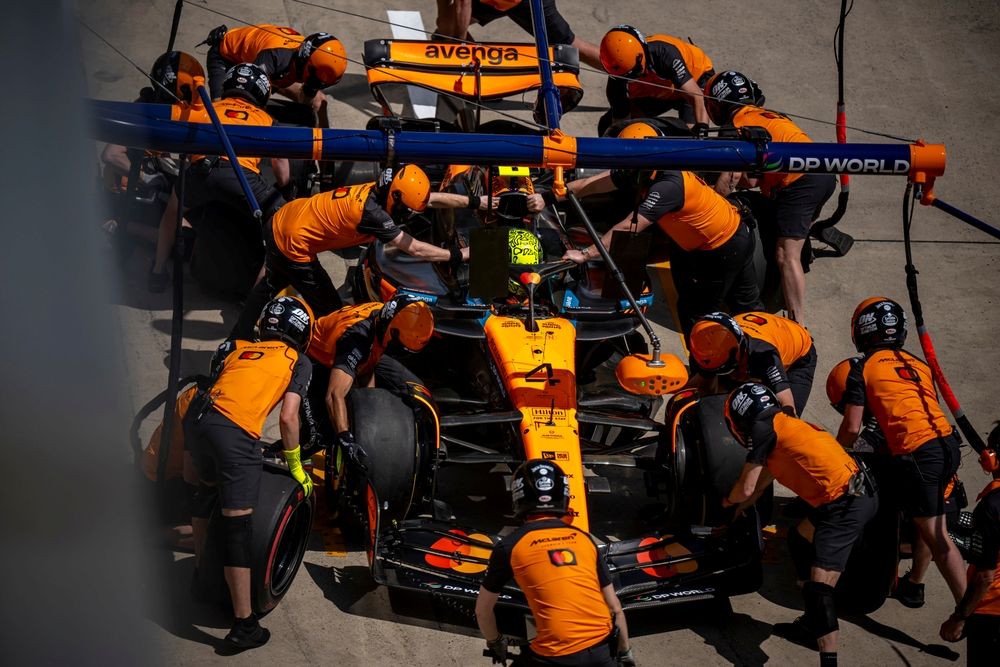
The 2025 Formula 1 season kicked off with a thrilling victory for Lando Norris at the Australian Grand Prix in Melbourne. Piloting the McLaren MCL39, the British driver appeared poised to cement his status as one of the grid’s top talents. Yet, the races that followed painted a different picture, with Norris struggling to maintain consistency, particularly in qualifying sessions. While his teammate, Oscar Piastri, has racked up four wins, Norris has been grappling with adaptation issues, raising questions about his synergy with the car and the team’s internal dynamics.
The performance gap between Norris and Piastri has become a focal point of the season. Piastri’s smoother driving style seems to mesh well with the MCL39, allowing him to extract its full potential. Norris, renowned for his raw speed, has made errors that cost him crucial grid positions. This disparity has sparked discussions among fans and analysts about what’s holding the Briton back. To dive deeper, it’s essential to examine the car’s technical nuances, the team’s strategies, and Norris’s own candid remarks, where he takes full accountability.
- Key challenges for Norris in 2025:
- Difficulty sensing tire grip in corners, especially during qualifying.
- Mistakes in flying laps, leading to subpar starting positions.
- Constant comparisons to Piastri’s superior results.
- Need to adapt driving style to the MCL39’s unique behavior.
Unpacking the #ImolaGP with Lando & Oscar 🗣️#McLaren pic.twitter.com/WgJWpIce8j
— McLaren (@McLarenF1) May 18, 2025
Qualifying struggles highlight weaknesses
The qualifying session for the Miami Grand Prix, one of the calendar’s most anticipated races, proved pivotal for Lando Norris. Finishing outside the top five, he watched as Piastri secured a front-row start. McLaren team principal Andrea Stella explained that the MCL39 suffers from a “numbness” in the front axle, making it hard for drivers to gauge tire grip in real time. This forces them to rely on data from previous laps, which can lead to misjudgments in high-stakes moments.
Norris, addressing Stella’s theory, responded with a lighthearted tone but didn’t downplay the issue. He noted that the car’s lack of responsiveness affects his confidence in high-speed corners, a critical factor on tracks like Miami, Monaco, and Silverstone. Despite this, he was firm in rejecting excuses, emphasizing that his job is to deliver results regardless of the car’s quirks.
This self-critical stance defines Norris, who, at 25, is regarded as one of Formula 1’s brightest stars. However, the 2025 season has shown that talent alone isn’t enough. The combination of a tricky car and the pressure to match a thriving teammate has put Norris in a challenging spot, where each race is a chance to prove himself.
- Factors impacting McLaren’s qualifying:
- Numb front axle reducing cornering feedback.
- Need for precise MCL39 setup tweaks for each track.
- Variations in driving styles between Norris and Piastri.
- Limited time for testing and adjustments during race weekends.
Norris-Piastri dynamic
The relationship between Lando Norris and Oscar Piastri is another storyline captivating fans in 2025. While McLaren insists there’s no internal rivalry, the drivers’ contrasting performances fuel speculation. Piastri, in his second full F1 season, has stunned observers by outpacing Norris on several occasions, particularly on technical circuits like Spa-Francorchamps and Hungaroring. His ability to quickly adapt to the MCL39 has earned praise from engineers and pundits alike.
Norris, meanwhile, appears to be on a steeper adaptation curve. He acknowledged that the 2025 car demands a different driving approach compared to the previous MCL38, which he mastered with ease. This shift has exposed minor inconsistencies in his performance, especially in qualifying, where precision is paramount. Still, Norris keeps a positive demeanor, often commending Piastri and recognizing the Australian’s skill.
The dynamic reflects McLaren’s philosophy of fostering internal competition without favoring one driver. Andrea Stella, known for his technical acumen and impartiality, strives to balance the needs of both pilots, ensuring equal opportunities. While effective for car development, this approach adds pressure on Norris, who aims to reclaim his edge within the team.
Technical profile of the MCL39
The MCL39, McLaren’s 2025 car, builds on its 2024 predecessor but introduces significant aerodynamic and suspension changes. Designed to comply with Formula 1’s updated regulations, it boasts a bolder design focused on aerodynamic efficiency and increased downforce. However, these tweaks have also brought challenges, particularly in how the car handles across diverse circuits.
Norris has pinpointed the lack of front-axle feedback as a major hurdle, impacting corner entry. On high-speed tracks like Jeddah and Monza, this issue is less pronounced, but on tighter circuits like Monaco and Singapore, it becomes a significant barrier. McLaren’s engineering team has been tweaking the car to enhance responsiveness, but the tight race schedule limits progress.
Moreover, the MCL39 requires track-specific setups, complicating the workload for drivers and engineers. While Piastri has found a workable balance, Norris is still searching for the ideal configuration to unlock the car’s full potential. This adaptation process remains one of his biggest challenges this season.
- Key MCL39 features:
- Optimized aerodynamics for enhanced downforce in medium- and high-speed corners.
- Redesigned suspension for better stability on uneven tracks.
- Front axle with limited feedback, demanding greater driver precision.
- Upgraded engine for improved energy efficiency, per 2025 rules.
McLaren’s 2025 strategies
McLaren entered 2025 with high hopes, buoyed by a strong 2024 season that saw them finish among the top three in the constructors’ championship. Norris’s Melbourne win reinforced their optimism, but inconsistent results prompted a strategic rethink. Andrea Stella has spearheaded efforts to refine the MCL39, prioritizing aerodynamic upgrades and suspension tweaks.
At the Spanish Grand Prix, the team rolled out a new upgrade package, including modifications to the floor and diffusers. These improved low-speed cornering but didn’t fully address qualifying woes. Norris noted that while the upgrades show promise, they require time to be fully integrated.
McLaren has also leaned heavily on simulations and testing at its Woking, England base to accelerate MCL39 development. This includes rigorous simulator sessions where Norris and Piastri identify areas for improvement. Despite the hurdles, the team remains focused on contending for the constructors’ title, though competition from Red Bull, Ferrari, and Mercedes is fierce.
Pressure on Norris
Lando Norris is undeniably one of Formula 1’s most popular drivers, with a growing global fanbase. His Melbourne triumph was hailed as a career milestone, but subsequent struggles have sparked debates about his ability to lead McLaren in a hyper-competitive field. At 25, Norris faces the challenge of proving he can compete with the likes of Max Verstappen and Charles Leclerc.
The Briton, however, handles the scrutiny with composure. In interviews, he stresses the importance of staying present-focused, undeterred by criticism or praise. His long tenure with McLaren, dating back to 2019, keeps him motivated. Norris believes in the team’s vision and is committed to its goals, even through tough patches.
With the 2025 season still unfolding, Norris has ample chances to turn things around. Tracks like Silverstone, where he has a strong record, and Interlagos, known for its unpredictability, could be ideal stages for him to shine. For now, he’s focused on overcoming the technical and mental demands of Formula 1.
- Norris’s 2025 highlights:
- Victory at the Australian Grand Prix, his first of the season.
- Qualifying errors in Miami and Monaco, costing key positions.
- Podiums in races like Imola and Canada, showing resilience.
- Ongoing collaboration with engineers to fine-tune the MCL39.
Competition across the F1 grid
The 2025 Formula 1 season is among the most balanced in recent memory, with Red Bull, Ferrari, McLaren, and Mercedes trading wins in nearly every race. Max Verstappen, the reigning champion, remains the benchmark, but rising stars like Piastri and Leclerc have made the grid less predictable. In this context, Norris’s performance is under intense scrutiny, as he’s seen as part of this new wave.
McLaren faces the challenge of staying competitive in a championship where margins are razor-thin. The team has invested heavily in the MCL39, but rivals have also stepped up. Ferrari’s car excels on high-speed tracks, while Mercedes’s upgrades have boosted performance on technical circuits.
For Norris, the grid’s intensity is a motivator. His second-place finish in Imola, just two seconds behind Verstappen, proved he can run with the best. Consistency, however, will be key to reasserting his dominance within McLaren and the championship.
Adaptation as the path to success
Mastering the MCL39’s quirks has been Lando Norris’s biggest task in 2025. Each circuit presents unique demands, and adapting driving style to the car’s behavior separates good drivers from great ones. Norris admits he hasn’t yet found the perfect balance but is determined to keep learning.
In the Canadian Grand Prix, he experimented with a new approach to low-speed corners, earning a podium. Such risks, while bold, are vital for unlocking the car’s potential. McLaren is fully behind him, with engineers working tirelessly to refine the MCL39.
Adaptation also involves managing psychological pressure. Norris, known for his candor, acknowledges that even strong results can leave him wanting more. This relentless drive for improvement fuels his motivation but also places him under constant scrutiny, especially alongside Piastri.
- Norris’s adaptation strategies:
- Simulator testing to replicate varied track conditions.
- Car setup tweaks to enhance cornering response.
- Data-sharing with Piastri to gain new insights.
- Focus on maintaining confidence after underwhelming races.
McLaren’s outlook for the season
With over ten races left in 2025, McLaren remains in contention for the constructors’ championship. Sitting third behind Red Bull and Ferrari, the team is within striking distance. Achieving this goal will require consistency from both drivers and further MCL39 improvements.
Norris, as the team’s informal leader, plays a pivotal role. His ability to overcome technical challenges and regain qualifying form will be crucial. McLaren plans to introduce more upgrades at the British Grand Prix, a home race with added significance.
The team is also eyeing tracks like Spa, Monza, and Suzuka, where the MCL39’s aerodynamic strengths could shine. In a fiercely competitive season, McLaren knows that every detail matters.
Andrea Stella’s leadership
Andrea Stella, McLaren’s team principal, has been a linchpin in 2025. His technical expertise and knack for diagnosing car issues have earned the trust of Norris and Piastri. With past experience guiding drivers like Fernando Alonso and Kimi Räikkönen, Stella brings a blend of data-driven precision and driver empathy.
At the Monaco Grand Prix, his strategic meeting led to setup changes that secured Piastri’s pole position. Norris, while less successful, praised Stella’s impact. The team principal’s ability to foster harmony between drivers and drive technical progress will be tested in the season’s closing races.
- Stella’s 2025 contributions:
- Pinpointing technical issues like front-axle numbness.
- Overseeing aerodynamic and suspension upgrades.
- Fostering collaboration between Norris and Piastri.
- Leveraging data to optimize MCL39 performance across circuits.
