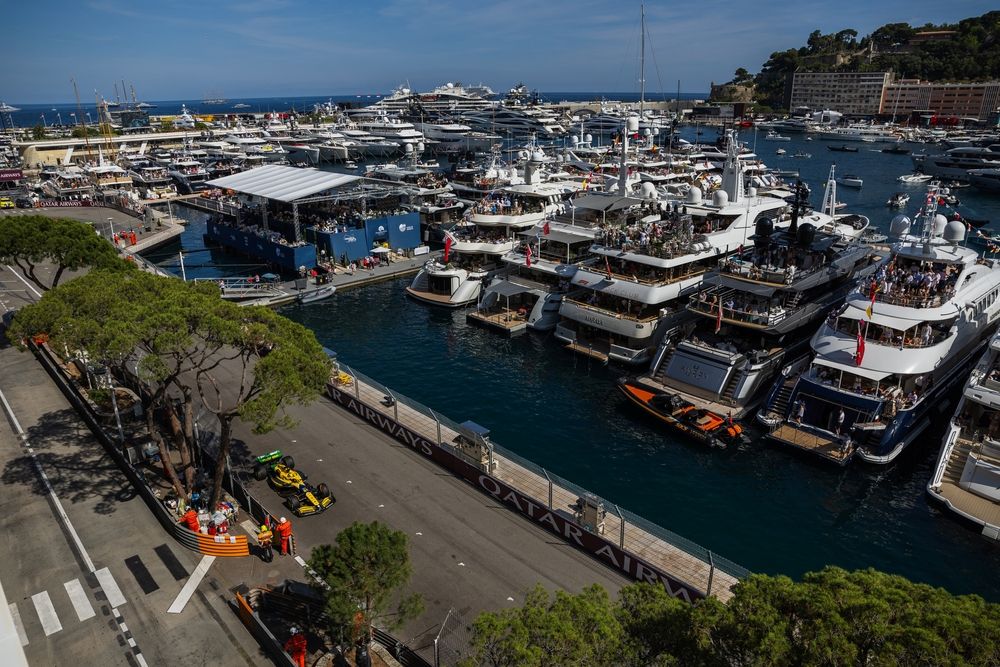
The narrow streets of Monte Carlo, home to the iconic Monaco Grand Prix, are set for a transformed Formula 1 weekend in 2025. The Fédération Internationale de l’Automobile (FIA) has introduced a significant rule change, mandating two pit stops for all drivers. Announced earlier this year, the regulation aims to counter the predictability that has plagued recent editions of the race, where overtaking is scarce and conservative strategies dominate Sundays.
This change requires teams to use at least three tire sets during the race, regardless of weather conditions. Pirelli, the official tire supplier, has adjusted its allocation for the event, providing an extra set of extreme wet tires alongside the standard two wet sets. The rule is designed to inject dynamism into a circuit notorious for its lack of on-track action.
The decision follows ongoing criticism of the Monaco GP’s format. In 2024, the race saw just four overtakes across 78 laps, with the top ten finishers unchanged from start to finish. The FIA hopes the new rule will encourage teams to adopt bolder strategies, creating more competitive moments.
- Primary goal: Enhance unpredictability and entertainment.
- Practical change: Two mandatory pit stops and three tire sets.
- Background: Response to complaints about lackluster races.
- Expectation: More varied strategies and less monotonous races.
Warp speed 🤯#F1 #MonacoGP pic.twitter.com/ORr83LC07B
— Formula 1 (@F1) May 20, 2025
Challenges of the Monaco circuit
The 3.337-kilometer Monaco Circuit, with its tight corners and close barriers, is among Formula 1’s most demanding tracks. Designed in 1929, it retains much of its original layout, making it a motorsport icon but a challenge for modern cars. Today’s larger, wider Formula 1 cars struggle to overtake on the narrow streets, where a successful move requires a pace advantage of at least two and a half seconds.
In previous years, tire management dictated strategies in Monaco. Teams often opted for long stints, slowing their pace to preserve tires and avoid extra stops. In 2024, a red flag allowed tire changes without time loss, leading to a race with minimal pit stops and little driver interaction. The new rule aims to eliminate such scenarios, forcing teams to plan strategic stops.
The scarcity of overtakes also underscores the importance of qualifying in Monaco. Pole position often determines the winner, as leading from the start provides a significant edge. While the FIA acknowledges that mandatory pit stops won’t fully solve the overtaking issue, it believes the change can create more competitive moments.
Driver reactions
The rule change has been broadly welcomed by the grid. Charles Leclerc, Monaco’s local hero and 2024 race winner, expressed optimism about its impact. The Ferrari driver noted that mandatory pit stops could diversify strategies, particularly on a circuit where Sundays are typically less thrilling than qualifying. Leclerc, who grew up in Monte Carlo, stressed the importance of a strong Saturday performance to maximize victory chances.
Arthur Leclerc, Charles’s younger brother and a Ferrari development driver, also weighed in. He believes the rule will add unpredictability, allowing drivers to push tires harder. For Arthur, the change reduces the excessive focus on tire management that defined recent races.
- Charles Leclerc: Supports the rule for enabling strategic variety.
- Arthur Leclerc: Sees potential for more dynamic, less conservative races.
- General sentiment: Drivers anticipate a more unpredictable Sunday.
Other drivers, such as Max Verstappen of Red Bull, have yet to comment publicly, but the Austrian team has begun adjusting its simulations for the weekend. Red Bull, which dominated the 2024 season, faces the challenge of adapting its strategy to a circuit where pole is critical, yet mandatory stops may create openings for rivals.
Strategic implications for teams
The requirement for two pit stops fundamentally alters team planning. In Monaco, where traffic is a constant issue, pit stop timing will be crucial. Teams that execute quick stops and choose optimal moments to call their drivers can gain valuable positions. Pirelli predicts that the absence of fixed pit stop windows could benefit drivers starting further back, allowing them to capitalize on clear track through alternative strategies.
Mercedes, for instance, is bracing for a challenging weekend. Andrew Shovlin, the team’s trackside engineering director, noted that the rule eliminates ultra-conservative strategies, such as completing the race with one stop. Shovlin believes the mandate will demand greater precision in tire management and pit stop timing, especially on a track where track position is paramount.
McLaren, which performed strongly in Monaco in 2024, also views the change positively. The British team plans to experiment with softer tire compounds for short, aggressive stints, aiming to gain time at key moments. The flexibility in tire choices, combined with the need for three different sets, opens the door to creative approaches.
Pirelli’s adaptations
Pirelli plays a central role in implementing the new rule. For the 2025 Monaco GP, the Italian manufacturer has tailored its tire allocation, ensuring teams have sufficient options to meet the regulation. In addition to slick tires (soft, medium, and hard), Pirelli will provide three wet tire sets, including an extra set for extreme rain conditions.
This decision accounts for Monaco’s unpredictable weather, where sudden showers can disrupt the race. In 2023, for example, mid-race rain forced teams to adapt on the fly, creating moments of chaos and excitement. Pirelli expects its adjusted allocation to help teams navigate varying conditions effectively.
- Slick tires: Soft, medium, and hard, with mandatory use of three sets.
- Wet tires: Three sets, including one for extreme rain.
- Goal: Ensure flexibility for diverse strategies.
- Challenge: Adapt tire choices to Monaco’s unpredictable weather.
Qualifying remains key
Despite the new rule, qualifying remains the defining moment of the Monaco weekend. Pole position offers a strategic advantage, allowing the leader to control the pace and avoid early traffic. In 2024, Charles Leclerc converted his pole into a win, leading from start to finish. While mandatory pit stops may create opportunities for those starting further back, starting position will continue to be the primary success factor.
Teams are acutely aware of this and have ramped up preparations for Saturday. Ferrari, for example, plans to optimize its car setup for single-lap pace, even if it slightly compromises race performance. Red Bull is focusing on aerodynamic tweaks to maximize traction in the circuit’s slow corners.
Fan expectations
The rule change is also an effort to engage casual fans, who often find the Monaco GP less exciting than other races. Mandatory pit stops promise moments of tension, particularly during pit stop windows when positions can shift quickly. For viewers, the prospect of bold strategies and indirect battles in the pits adds unpredictability.
Fans watching on-site or via television will also have more data to digest. Formula 1 broadcasts, which display real-time tire and strategy information, will highlight each team’s choices, enhancing the viewing experience. Sky Sports, a key broadcaster, has announced plans for in-depth analysis of the rule’s impact.
Team preparations
Teams have begun preparing for the Monaco GP with a focus on adapting to the new rule. Race simulators are being used to test various scenarios, including weather changes and pit stop strategies. Ferrari, with a strong Monaco history, is confident in its ability to execute fast pit stops, thanks to recent improvements in its pit crew.
Haas, which struggles on street circuits, plans a conservative approach, prioritizing consistency over risky strategies. Meanwhile, Alpine, which secured a podium in Monaco in 2021, aims to repeat the feat by leveraging short stints on soft tires. Each team must balance speed, tire management, and pit stop precision.
- Ferrari: Emphasizes quick pit stops and qualifying setup.
- Red Bull: Focuses on aerodynamic adjustments for slow corners.
- McLaren: Plans aggressive strategies with soft tires.
- Haas: Prioritizes consistency to avoid mistakes.
- Alpine: Seeks to capitalize on short stints.
History of the Monaco GP
The Monaco Grand Prix, first held in 1929, is one of motorsport’s most prestigious races. A Formula 1 staple since 1950, it is renowned for its blend of glamour and technical challenge. Legends like Ayrton Senna, with six wins, and Graham Hill, with five, cemented their legacies in Monte Carlo.
The track, weaving through landmarks like the Casino and the Tunnel, demands absolute precision. A single mistake can lead to barrier collisions, making focus critical. The 2025 edition, the 82nd in history, adds a new chapter with the pit stop rule.
Formula 1’s evolving calendar
The Monaco GP isn’t the only 2025 race facing changes. The FIA is evaluating adjustments for other events, like the Singapore GP, to boost competitiveness. In Monaco, however, the rule is tailored to the circuit’s unique traits. The hope is that Monaco’s experience will inform potential changes for other street circuits.
The 2025 season, featuring 24 races, keeps Monaco as a highlight. Scheduled for late May, the event draws thousands of tourists and celebrities, reinforcing its status as a global sporting spectacle.
Weekend outlook
The 2025 Monaco GP weekend promises to be among the most intriguing in recent years. The pit stop rule, combined with the circuit’s unpredictability, creates a scenario where small details could prove decisive. Teams that align effective strategies, precise setups, and fast pit stops will hold an edge.
Free practice, starting Friday, will be critical for testing setups and assessing tire wear. Pirelli anticipates heavy use of soft tires, though weather could shift plans. Rain, common in May, adds further uncertainty.
- Free practice: Chance to test strategies and setups.
- Qualifying: Pivotal for determining starting order.
- Race: Mandatory pit stops as a source of unpredictability.
- Weather: Potential rain could disrupt strategies.
Global interest
The Monaco GP remains one of the world’s most-watched sporting events. In 2024, it was broadcast to over 180 countries, with an estimated 90 million viewers. Its mix of glamour, history, and competition attracts not just motorsport fans but also tourists and celebrities filling Monte Carlo’s yachts and balconies.
The 2025 race will be closely followed by analysts and fans eager to see if the new rule delivers on its promise of excitement. Formula 1, which has pushed for changes to attract new audiences, views Monaco as a chance to show that even its most traditional races can evolve.
Logistical challenges
Organizing the Monaco GP is a complex endeavor. Monte Carlo’s streets are closed weeks in advance to set up grandstands, barriers, and support structures. The logistics of pit stops, now central to the race, require meticulous planning. Teams must ensure their crews are ready for quick stops in Monaco’s tight pit lane.
The FIA collaborates with local organizers to ensure a smooth event. Safety, always a priority in Monaco, has gained added focus after past incidents, such as crashes in the Tunnel and Casino Curve.
Monaco’s lasting legacy
The Monaco Circuit remains a symbol of Formula 1 tradition. Despite criticism over limited overtaking, it has never lost its crown-jewel status. The new pit stop rule aims to preserve this legacy while aligning with modern expectations for entertainment and competition.
Drivers who win in Monaco join an elite group alongside names like Michael Schumacher and Alain Prost. For the 2025 grid, the chance to shine in Monte Carlo will be even more unique, thanks to the rule’s fresh dynamic.
