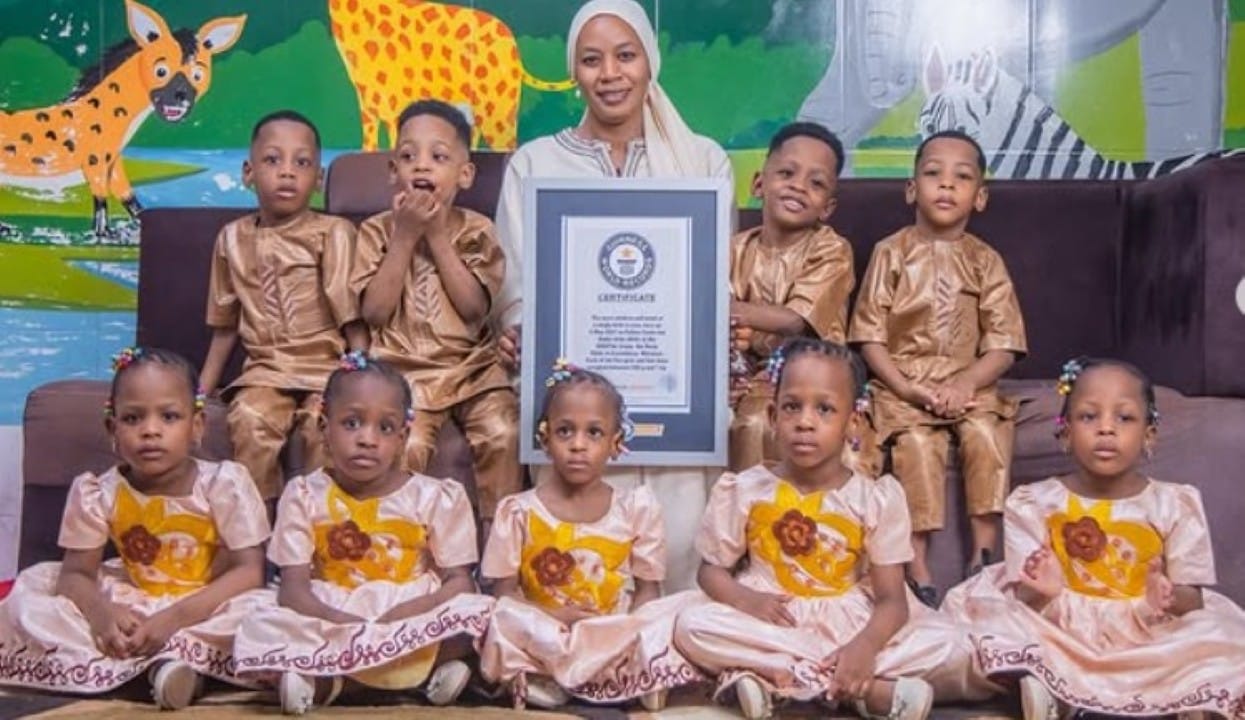
Halima Cissé, a 29-year-old Malian woman, astonished the world by giving birth to nine babies—five girls and four boys—on May 4, 2021, at the Ain Borja clinic in Casablanca, Morocco. The nonuplets, who set a world record as the largest number of children to survive a single birth, were born prematurely at 30 weeks and spent weeks in intensive care. Now, at 4 years old, the children are healthy, living with their parents in Mali, and their story continues to captivate audiences worldwide. The high-risk pregnancy required specialized medical care, with Halima being transferred from Mali to Morocco by her country’s government. The case, which surpassed the previous record of eight babies, highlights medical advancements and the resilience of a family facing extraordinary challenges.
Halima’s journey with her children began with a pregnancy initially thought to involve seven fetuses. During an ultrasound in Mali, doctors detected seven babies, but upon arriving in Morocco, further tests revealed two additional ones. The news brought concern, as such large multiple pregnancies are extremely rare and risky. Halima, who already had a two-year-old daughter at the time, left her family in Mali to receive specialized care. The delivery, performed via cesarean section, involved a team of over 30 medical professionals.
- Initial challenges: The babies were born weighing between 500g and 1kg, requiring immediate intensive care.
- Medical support: The Moroccan clinic provided incubators and round-the-clock nursing.
- Government aid: Mali’s government funded Halima’s transfer and treatment.
- Family resilience: Abdelkader Arby, Halima’s husband, stayed in Mali to care for their older daughter, Souda.
This story of triumph quickly made global headlines, with the family earning recognition from the Guinness World Records. Each milestone, such as birthdays or trips, renews public fascination with the nonuplets.
A historic birth in Morocco
The birth of the nonuplets marked an unprecedented medical achievement. Prior to 2021, there were no records of nonuplets surviving beyond a few hours after birth. The Ain Borja clinic in Casablanca became the epicenter of this feat, with a multidisciplinary team monitoring Halima for weeks before the delivery. The cesarean section, necessary due to the babies’ prematurity, was a delicate procedure. Halima faced significant risks, including severe blood loss, but recovered fully.
The babies—Adama, Oumou, Hawa, Kadidia, Fatouma, Oumar, Elhadji, Bah, and Mohammed VI—spent their first months in incubators. Each received individualized care, with nurses tracking their development. The clinic provided a fully equipped apartment, described as a “medicalized flat,” where Halima and the children lived for 19 months. This ongoing support was critical to ensuring the nonuplets’ survival and healthy growth.
Returning home to Mali
In December 2022, at one and a half years old, the nonuplets took their first flight, leaving Morocco for Bamako, Mali’s capital. The journey marked their return to their home country, where they were warmly welcomed. Abdelkader Arby, a Malian navy officer, noted the children’s popularity: “Everyone in Mali wants to see the babies with their own eyes.” The move opened a new chapter, with the family adjusting to life at home after nearly two years of intensive medical care.
The transition came with challenges. Raising nine young children, plus their older daughter, Souda, now 6, demands organization and patience. Halima shared that putting all her children to sleep is a daunting task, but warm hugs help calm them. The family’s routine includes ongoing care, with the nonuplets still monitored due to their prematurity.
Growth and unique personalities
At 4 years old, the nonuplets show signs of healthy development and distinct personalities. Abdelkader described their differences: some are quiet, others lively, and a few love being held. The five girls and four boys are now walking, exploring their surroundings, and interacting with the world. Recent photos shared by Halima show the children posing with their Guinness World Records certificate, proud of their place in history.
- Adama: Curious and observant, loves exploring objects.
- Oumar: More reserved, enjoys calm playtime.
- Hawa: Full of energy, one of the loudest.
- Mohammed VI: Known for expressive faces, like adorable grimaces.
- Kadidia: Loves interacting with siblings and is very affectionate.
These individual traits delight their parents, who celebrate every milestone, from first steps to daily mischief.
A globally recognized milestone
The nonuplets’ record surpassed that of Nadya Suleman, known as “Octomom,” who gave birth to octuplets in 2009. The Guinness World Records certification, officially awarded before the children’s third birthday, solidified the Cissé-Arby family’s achievement. In March 2024, the nonuplets traveled to Italy to appear on “Lo Show dei Record,” where they charmed audiences with their energy and charisma. The appearance reinforced the global impact of their story, which continues to inspire people worldwide.
Ongoing medical care and support
The nonuplets’ health remains a priority. Despite their strength, their prematurity requires regular monitoring to prevent complications, such as infections or developmental delays. In Morocco, the Ain Borja clinic provided exceptional support, with 24-hour nurses and a tailored nutritional plan for the babies. After returning to Mali, the family stays in touch with healthcare professionals to ensure the children grow without issues.
Mali’s government played a key role, covering medical and logistical costs since Halima’s pregnancy. Abdelkader expressed gratitude for the support, emphasizing that state intervention was crucial to the case’s success. This collaboration between countries and medical institutions showcases the power of international cooperation in high-risk situations.
The routine of an extraordinary family
Living with nine 4-year-olds is a daily adventure. Halima, now 29, balances the demands of the nonuplets with raising Souda, her eldest daughter. The family resides in Bamako, where Abdelkader, 36, continues his military career. Their routine includes carefully planned meals, group playtime, and rest periods, often accompanied by hugs, as Halima noted. Souda, the older sister, adapts to her role as the eldest of ten siblings, actively participating in the family dynamic.
Celebrating the fourth birthday
The nonuplets’ fourth birthday on May 4, 2025, was marked by a grand celebration, as described by Halima. The children posed for photos with their parents, showing smiles and expressions that reflect their unique personalities. The event included neighbors and friends, highlighting the community support the family receives. Halima noted the children’s visible growth, now taller, more active, and curious than ever.
The occasion also allowed the family to thank the medical team, Mali’s government, and the thousands who follow their story. Photos from the event, shared on social media, show the nonuplets holding their Guinness World Records certificate, a symbol of their remarkable journey.
The legacy of a life miracle
The story of Mali’s nonuplets transcends borders, uniting science, resilience, and family love. Each stage—from the high-risk pregnancy to the children’s healthy development—reflects the collective effort of doctors, family, and authorities. Halima and Abdelkader, with their determination, turned a rare event into an example of hope. The family plans to keep sharing updates, keeping the world connected to this unique saga.
The nonuplets, now 4, continue to write their story, enchanting everyone who follows their journey. With each passing year, they reinforce the idea that, even in the face of seemingly insurmountable challenges, life finds a way to thrive.
