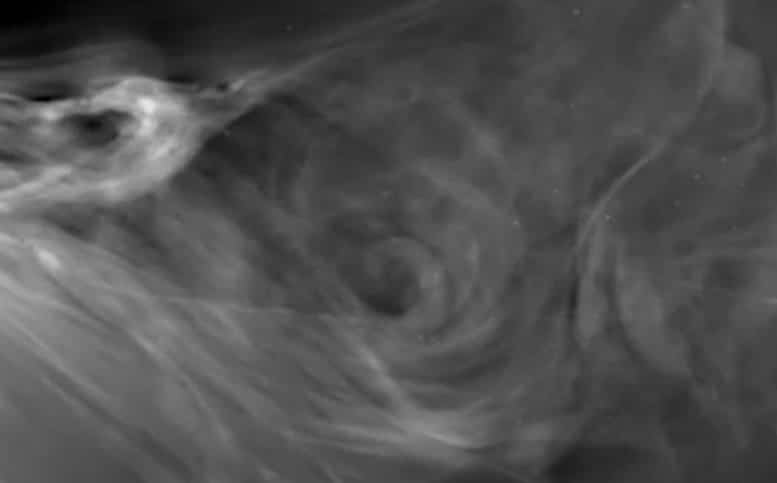
NASA’s Parker Solar Probe achieved a historic milestone by capturing the closest images ever recorded of the Sun, at just 6 million kilometers away, during its orbit in December 2024. Released on July 15, 2025, the video reveals stunning details of solar flares and solar winds, showcasing three consecutive coronal mass ejections. These images, captured during the perihelion when the probe was nearest to the star, provide scientists with critical data to understand solar behavior and its impacts on Earth. The footage could help predict geomagnetic storms that affect satellites, power grids, and communication systems. Launched in 2018, the mission underscores the importance of studying the Sun to protect technology and plan future space explorations. The release of these images sparked significant interest among scientists and the public, highlighting advances in space exploration.

This achievement marks a new chapter in solar research. Equipped with cutting-edge technology, the probe endured extreme temperatures to collect data directly from the Sun’s corona, the star’s outermost layer.
- Key highlights of the video:
- Solar flares in high resolution, showing coronal mass ejections.
- Movements of solar winds expelled from the corona.
- Data aiding in predicting geomagnetic storm impacts on Earth.
Unprecedented details of solar flares
The images captured by the probe reveal three coronal mass ejections, which are bursts of plasma and magnetized particles released by the Sun. These eruptions, recorded with remarkable clarity, show how the first explosion paves the way for subsequent ones, increasing their speed and range. Filmed in high resolution, the video allows observation of the dynamics of these superheated particles in unprecedented detail. The probe’s proximity to the Sun, at just 6 million kilometers, offered a unique view of the corona, where temperatures reach millions of degrees Celsius. These insights are invaluable for scientists studying how solar events affect the space environment around Earth.
The footage also highlights solar winds, continuous streams of charged particles that influence space weather. The ability to record these phenomena in real time is a milestone for astrophysics.
Technology behind the mission
Launched in August 2018, the Parker Solar Probe was designed to withstand extreme conditions, including temperatures up to 1,400°C. Equipped with an advanced thermal shield, the probe can approach the Sun like no other spacecraft before. During the December 2024 perihelion, it collected data directly from the solar corona, a region challenging to access due to its harsh conditions.
- Probe innovations:
- Thermal shield capable of withstanding extreme temperatures.
- Instruments for measuring magnetic fields and solar particles.
- Sensors for capturing high-resolution corona images.
- Navigation systems for orbits close to the Sun.
Having completed several orbits, the mission continues to provide data that deepen the understanding of solar activity. Each perihelion brings more detailed information, solidifying the probe’s role as an essential tool for space science.
Impacts on Earth and space exploration
The coronal mass ejections captured in the video can trigger geomagnetic storms, which directly affect technologies on Earth. Satellites, power grids, and GPS systems are among the most vulnerable. With the probe’s data, scientists can develop more accurate models to predict these events, reducing risks to critical infrastructure.
Moreover, the information is crucial for astronaut safety during space missions. During intense solar events, radiation poses a significant danger, especially for long-duration missions like those to Mars.
Studying the solar corona also helps understand how the Sun influences space weather across the solar system. This knowledge is vital for planning future explorations, including protecting equipment and crews in hostile space environments.
Advances in solar science
The Parker Solar Probe mission represents a leap forward in solar research. Since its launch, it has completed multiple orbits, each providing new insights into the star. The images released in 2025 show not only solar flares but also the corona’s structure, a region that remains a mystery to scientists. Observing these phenomena up close enables the study of processes like coronal heating, a puzzle that has intrigued researchers for decades.
- Scientific contributions:
- Data on solar particle behavior.
- Information on the corona’s magnetic field.
- Insights into solar wind formation.
- Foundation for space weather prediction models.
These advances pave the way for new discoveries, such as the origin of solar winds and their connection to solar flares. The probe continues its mission, with more orbits planned for the coming years, promising further revelations.
Future of solar exploration
The release of these images marks a moment of celebration for the scientific community but also highlights the mission’s ongoing nature. The probe will continue collecting data in future orbits, aiming to get even closer to the Sun. Each new perihelion offers a chance to gather information that could revolutionize our understanding of the star that sustains life on Earth.
The collected data also have practical applications, such as developing technologies to mitigate the effects of solar storms. Governments and aerospace companies follow the mission’s results to protect satellites and infrastructure.
- Next steps for the mission:
- New orbits with even closer approaches to the Sun.
- Detailed analysis of data collected in 2024 and 2025.
- International collaboration to interpret findings.
The Parker Solar Probe continues to inspire scientists and enthusiasts, showing that space exploration is just beginning. Its images, beyond their beauty, are a reminder of the Sun’s power and complexity, a star that directly influences life on Earth.
