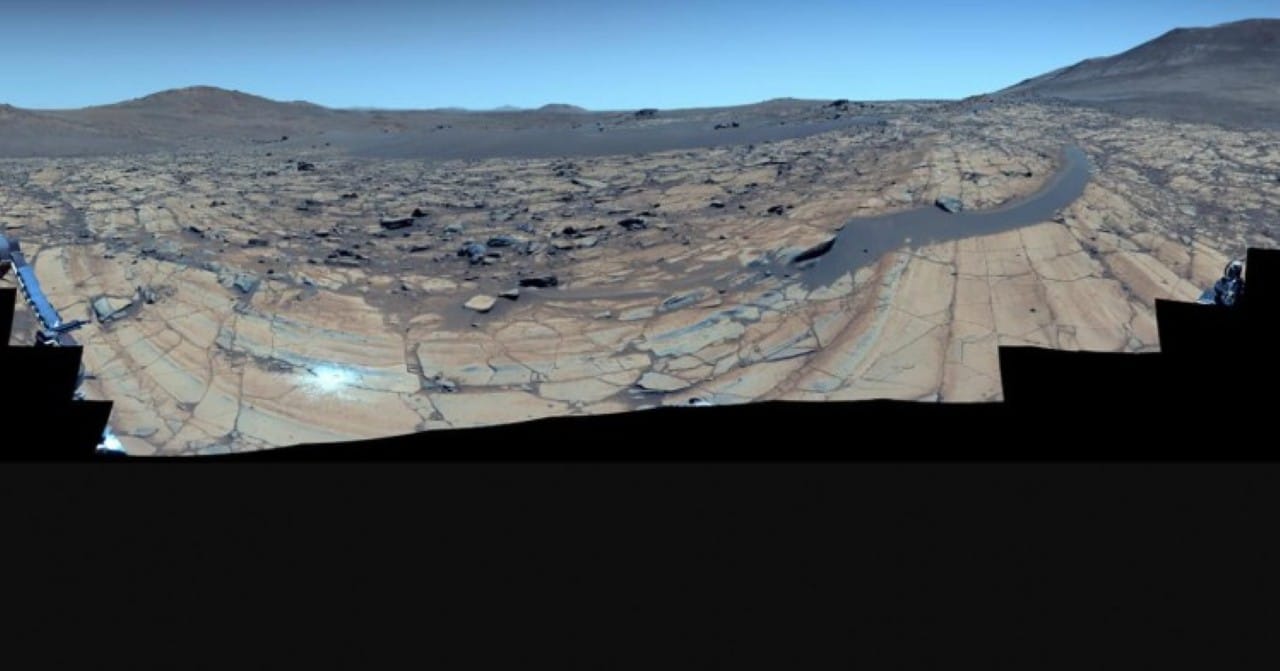
NASA revealed a new panoramic image of Mars, captured by the Perseverance rover, showcasing remarkable clarity and intricate details of the red planet’s surface. Taken on May 26, 2025, in the Falbreen region of Jezero Crater, the photos display rock formations, sand dunes, and distant hills under an exceptionally clear sky. The U.S. space agency noted that low atmospheric dust contributed to the image’s quality. The mission, launched in 2021, seeks signs of ancient life and collects samples for future Earth-based analysis. The image, composed of 96 photos, offers a 360º view that has captivated scientists and the public, reinforcing the fascination with space exploration.
The image’s clarity highlights details like a rock appearing to float above a dune, rover tracks, and drill marks on rocks. This panorama, according to NASA, marks a milestone in Mars exploration, combining technological advancements and favorable weather conditions.
- Image highlights: A “floating” rock 4.4 meters from the rover, dark dunes, and hills 65 km away.
- Scientific goal: Search for biosignatures and study Martian geology.
- Technology used: Mastcam-Z camera, capable of high-resolution imaging.

Details of the new panoramic image
The panoramic image of Mars, captured by the Perseverance rover, was taken during a rare moment when atmospheric dust was minimal, allowing a crystal-clear view of the landscape. The Falbreen region, located on the edge of Jezero Crater, is a strategic site for the mission, as it is believed to have once hosted a lake billions of years ago. The 96-photo mosaic, forming a 360º view, reveals the complexity of the Martian terrain, with rocks of varying compositions and dark dunes contrasting against the reddish sky.
NASA emphasized that the Mastcam-Z camera, mounted on the rover’s mast, was crucial for the image. This equipment, with zoom and high-definition capabilities, captures minute details, such as rock textures nearby and geological formations kilometers away. The image also shows Perseverance’s tracks, covering about 90 meters to reach Falbreen after exploring the Kenmore area.
- Ideal conditions: Low atmospheric dust ensured exceptional clarity.
- Geological formations: Rocks with olivine and clay suggest past volcanic activity and water presence.
- Rover’s path: Visible tracks show the route taken in Jezero Crater.
- Scientific significance: Data aids planning for future human missions.
Technology behind the image
The success of the panoramic image stems from advanced technology and favorable environmental conditions. The Mastcam-Z camera, designed for stereo and high-resolution imaging, is a key instrument on Perseverance. Unlike previous rovers like Curiosity, Perseverance features a zoom-capable camera system that records videos and 3D images. This enables detailed geological analysis, critical for identifying rocks with potential biosignatures.
Additionally, the rover is equipped with instruments like PIXL, which analyzes the chemical composition of rocks. The Falbreen image includes a drill mark, the 43rd performed by Perseverance, exposing a rock’s interior for study. NASA stated that these samples are collected and stored for future Earth analysis, a vital step in understanding Mars’ history.
Exploration of Jezero Crater
Jezero Crater, where Perseverance has operated since February 2021, is one of the most promising sites for finding signs of ancient life. Scientists believe it once housed a lake and river delta about 3.9 billion years ago. The new panoramic image supports this theory, showing rock formations with clay, a mineral linked to water. The “floating” rock, a highlight of the panorama, may have been moved by winds or ancient water flows, intriguing researchers.
Perseverance has navigated challenging terrains, such as the crater’s slopes with up to 20º inclines. NASA reported that sand and dust complicate the rover’s movement, requiring strategies like staying near rocky edges for better traction. The Falbreen image marks the mission’s 1,516th Martian day, showcasing the rover’s durability and efficiency.
- Geological history: Jezero Crater may reveal secrets about Mars’ habitability.
- Terrain challenges: Slopes and dust hinder rover mobility.
- Sample collection: 43 rock samples drilled for future studies.
- Mission duration: Perseverance has operated for over four years on Mars.
Cultural and scientific impact
The release of the panoramic image sparked widespread interest among scientists and space enthusiasts. The image’s clarity, showing dark dunes and hills 65 km away, reignited public fascination with Mars. NASA noted that these images not only advance scientific research but also inspire new generations to engage with science and the prospect of human missions to the red planet.
The “floating” rock, nicknamed by NASA’s team, became a social media sensation, with users comparing it to Earth formations. The agency capitalized on the moment to share more mission details, including Perseverance’s search for biosignatures and its role in preparing for the Artemis program, which aims to send astronauts to the Moon as a stepping stone for Mars missions.
Advances in the search for life on Mars
Perseverance’s mission extends beyond capturing stunning images. Since landing, the rover has collected rock and soil samples that may hold clues to past microbial life. In July 2024, NASA announced the discovery of “leopard spots” on a rock named Cheyava Falls, showing chemical signatures and structures that could indicate ancient life. While inconclusive, these findings keep scientists hopeful.
Panoramic images like Falbreen’s help map promising areas for further sampling. The presence of minerals like olivine and clay in Jezero Crater suggests a once-habitable environment. NASA plans to return these samples to Earth in the next decade, in collaboration with the European Space Agency (ESA), for detailed analysis.
- Recent discoveries: “Leopard spots” suggest possible ancient microbial life.
- Detected minerals: Olivine and clay indicate past water presence.
- Future planning: Samples to be analyzed on Earth for biosignatures.
- International partnerships: Collaboration with ESA for sample return.
Preparation for human missions
Perseverance’s images serve not only geological studies but also planning for future crewed missions. NASA highlights that data on terrain, atmosphere, and mobility challenges are crucial for developing technologies to support human presence on Mars. Jezero Crater’s complex formations make it a natural laboratory for testing these conditions.
The Falbreen panorama, for instance, reveals the difficulty of navigating sandy, sloped terrains, necessitating innovations in mobility for future rovers and astronauts. NASA is also using Perseverance’s data to plan permanent bases, which will rely on local resources like underground water to sustain human life.
Curiosities about the Perseverance mission
Perseverance has impressed with its versatility and resilience. Since landing in 2021, it has traveled thousands of meters, enduring extreme conditions like dust storms and temperatures below -100ºC. The mission also includes the Ingenuity helicopter, which made historic flights on Mars, complementing the rover’s images with aerial perspectives.
- Distance traveled: Over 20 km explored on Mars’ surface.
- Ingenuity: First helicopter to fly on another planet, with over 70 flights.
- Rover power: Powered by a radioisotope thermoelectric generator.
- Onboard cameras: 19 cameras, a record for interplanetary missions.
- Planned duration: Initial two-year mission, surpassed in 2025.
Legacy of Martian exploration
The Falbreen panorama is another chapter in Mars exploration, which began in the 1960s with the Mariner mission. Since then, NASA has sent 22 expeditions to the planet, each advancing knowledge of its geology and habitability. Perseverance, with its advanced technology, represents the pinnacle of these missions, combining images, sounds, and chemical analyses to create a fuller picture of the red planet.
Each new image brings humanity closer to answering fundamental questions: Did Mars ever host life? Can it be colonized in the future? The answers rely on Perseverance’s ongoing work and future missions, which will continue to unravel the mysteries of Earth’s cosmic neighbor.
