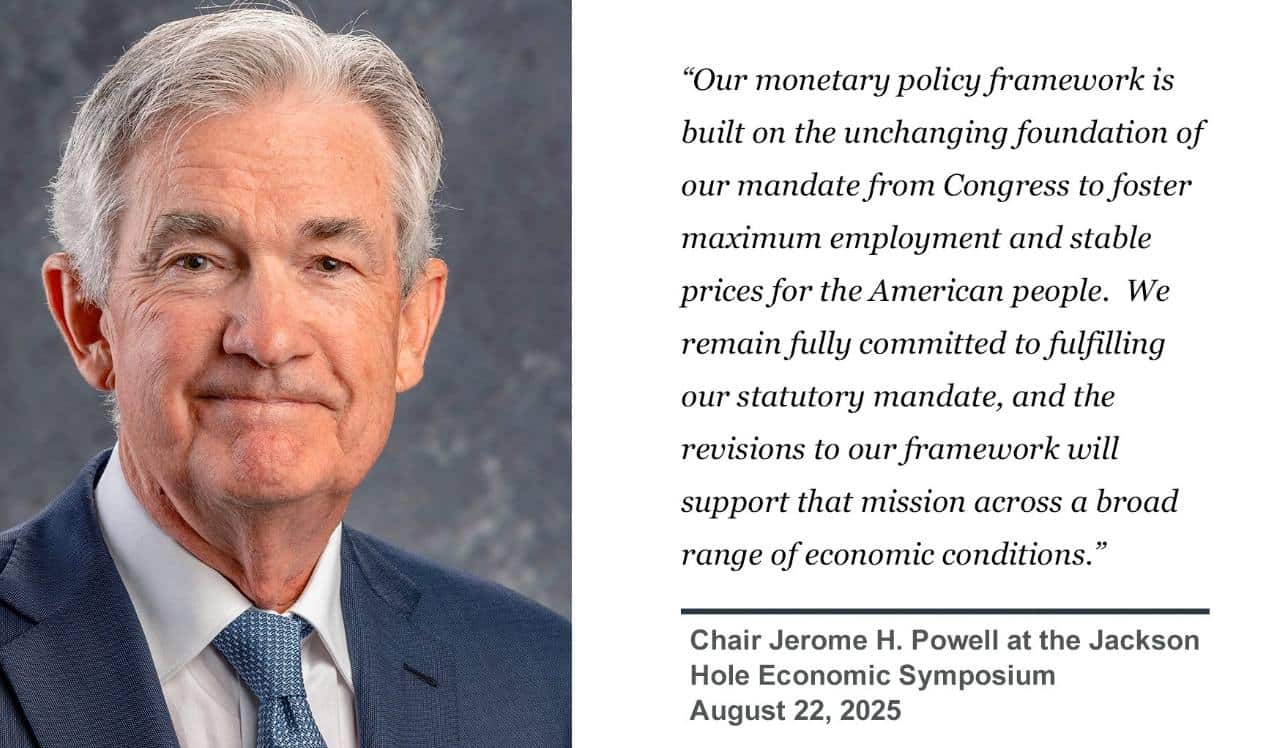
The Federal Reserve, led by Jerome Powell, signaled that interest rate cuts may occur in September during the highly anticipated speech at the annual Jackson Hole symposium in Wyoming on August 23, 2025. In his remarks, Powell highlighted concerns about the labor market, which shows signs of fragility, and indicated the need for monetary policy adjustments to support the U.S. economy. The event, known for influencing global markets, comes amid pressure from the Trump administration for changes at the Fed, adding a layer of political tension to economic decisions. Investors reacted optimistically, boosting stock indices, while awaiting the central bank’s next steps.
Powell’s speech was a milestone, not only for its economic implications but also for being his last appearance as Fed chair at the symposium, as his term ends in May 2026. The speech brought relief to markets, with the Dow rising 680 points, while the S&P 500 and Nasdaq also posted significant gains.
- Key points from the speech:
- Growing risks to the labor market, with a slowdown in job creation.
- Possibility of rate cuts to stimulate the economy.
- Limited impact of Trump’s tariffs on inflation, according to Powell.
The Jackson Hole symposium, organized by the Federal Reserve Bank of Kansas City, is a traditional event that gathers central bankers and economists to discuss monetary policies, with this year’s focus on labor market transitions and their macroeconomic impacts.
Market reactions to Powell’s speech
Financial markets reacted swiftly to Powell’s words. The prospect of interest rate cuts encouraged investors, who see lower borrowing costs as a stimulus for consumption and investment. The Dow Jones, a benchmark index, rose 1.5%, while the S&P 500 and Nasdaq advanced 1.3% and 1.35%, respectively.
The possibility of monetary easing reflects the Fed’s concern with the labor market, which, despite a relatively low unemployment rate (4.2% in July), faces challenges such as slower job creation and a shrinking workforce due to factors like retirements and reduced immigration.
- Factors that boosted the market:
- Expectations of lower interest rates, reducing financing costs.
- Increased attractiveness of higher-yielding assets, like stocks.
- Signs that the Fed is attentive to economic risks.
Despite the optimism, some analysts warn of potential volatility if expectations for rate cuts are not met.
Context of the Jackson Hole symposium
The Jackson Hole symposium is one of the most anticipated events for investors and economists, as it often signals shifts in the Fed’s monetary policy. In 2025, the event gained added significance due to political pressures from the Trump administration, which has openly criticized the Fed and Powell, demanding immediate rate cuts.
Powell, in his speech, emphasized the central bank’s independence, stating that decisions are data-driven, not influenced by external pressures. He noted that risks to employment are rising, with the potential for a rapid increase in unemployment if the labor market worsens.
- Central themes of the symposium:
- Labor market transitions, including population aging.
- Impacts of trade policies, such as Trump’s tariffs.
- Strategies to maintain economic stability amid uncertainties.
Powell’s speech was seen as an effort to balance the need to support the economy without yielding to political demands, reinforcing the Fed’s credibility.
Political pressures on the Federal Reserve
The Trump administration has intensified its criticism of the Fed, targeting Powell and Governor Lisa Cook, who faces allegations of mortgage irregularities. These accusations, now under investigation, have raised concerns about the central bank’s independence. Democratic Representative Maxine Waters called the attacks on Cook “brazen” and suggested racial motivations, as Cook is the first Black woman to serve as a Fed governor.
Powell, whose term as chair ends in May 2026, faces a delicate scenario. The Trump administration has signaled it is searching for a replacement, with Treasury Secretary Scott Bessent leading the effort. Two Fed governors, who dissented on maintaining rates, are among the candidates for chair.
- Political challenges facing the Fed:
- Trump’s pressure for immediate rate cuts.
- Investigations targeting board members, like Lisa Cook.
- Potential appointment of political allies to Fed positions.
These tensions highlight Powell’s challenge in maintaining the Fed’s autonomy in a politically charged environment.
Labor market impact on Fed’s decision
The labor market was a central focus of Powell’s speech, which he described as in a “curious state of balance.” Despite the low unemployment rate, July data showed significantly lower job creation (73,000), with negative revisions for prior months. Factors like declining immigration and rising retirements are shrinking the workforce, potentially pressuring the economy.
Powell warned that if employment risks materialize, unemployment could rise quickly, justifying the possibility of rate cuts.
- Recent labor market data:
- Unemployment rate at 4.2%, still considered low.
- Job creation in July was the lowest in months.
- Negative revisions for May and June indicate a slowdown.
- Impact of factors like reduced immigration and retirements.
The Fed’s focus on the labor market reflects its priority to avoid a recession while monitoring inflation, which remains under control but shows pressure in sectors like services.
Expectations for the Fed’s next meeting
The Fed’s September meeting will be crucial, with 71% of investors betting on a rate cut, according to market data. However, not all members of the monetary policy committee are convinced. Susan Collins, president of the Boston Fed, indicated that inflation may remain elevated into early 2026, suggesting caution on rate reductions.
Powell reiterated that the decision will be data-driven, maintaining the Fed’s stance of independence. The possibility of rate cuts is seen as a response to economic slowdown, but the central bank is also monitoring the impact of Trump’s tariffs, which could pressure inflation in the short term.
- Factors influencing the September decision:
- Inflation data, particularly in services.
- Labor market performance in upcoming reports.
- Effects of Trump’s trade policies.
- Financial market expectations.
The September meeting will be a defining moment for the future of U.S. monetary policy.
Historical impact of Jackson Hole speeches
Jackson Hole speeches have a history of moving markets. In 2022, Powell warned of the need to fight inflation, even if it caused “pain” to households and businesses, leading to a over 3% drop in major indices. In contrast, the 2025 speech generated optimism, with markets reacting positively to the prospect of monetary easing.
The event’s relevance lies in the Fed’s ability to signal policy shifts, influencing global expectations. Powell’s speech, expected to last 20 to 25 minutes, was longer than in 2022, indicating a more reflective and detailed tone on economic challenges.
- Examples of past impacts:
- 2022: Sharp market decline after hawkish speech.
- 2016: Market rally with Janet Yellen’s signal of rate hikes.
- 2020: Powell’s speech on average inflation targeting boosted stocks.
The 2025 speech reinforces Jackson Hole’s role as a barometer for Fed policies.
