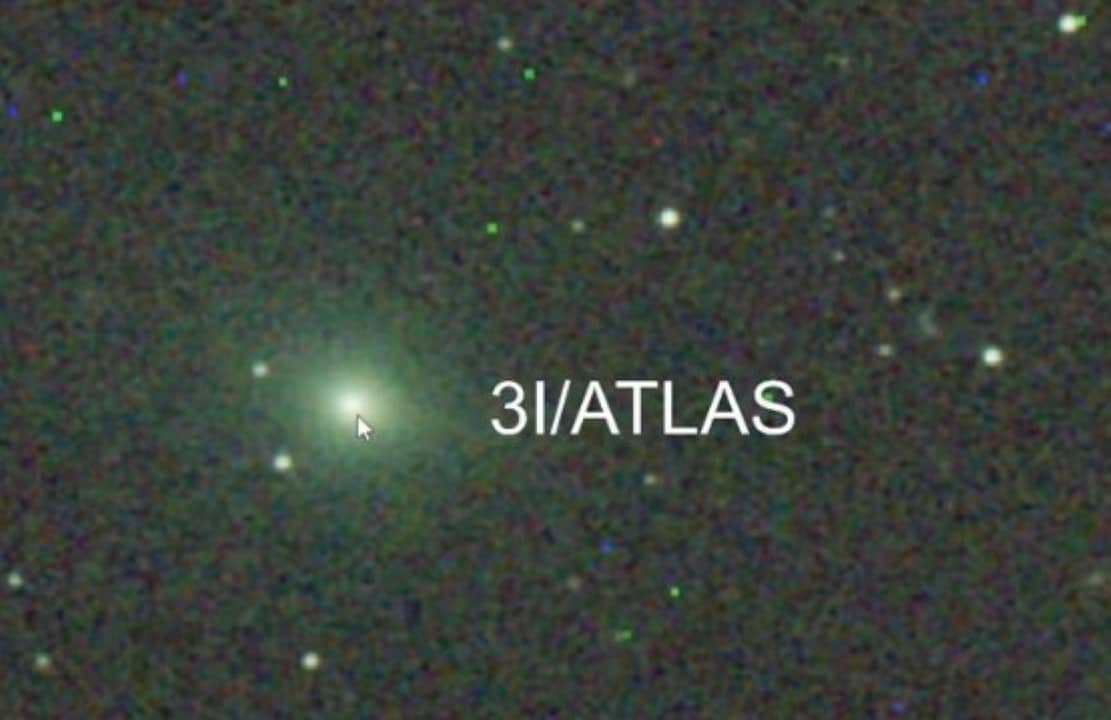
The interstellar comet 3I/ATLAS (C/2025 A11) was photographed again this week by American astrophotographer Chuck Cole, from channel Chuck’s Astrophotography. The image, captured on November 24, 2025, shows the object looking significantly different from what would be expected for an ordinary comet. The nucleus presents an intense point brightness, the outer halo appears irregular and there is no record of a tail in any direction.
The record reveals that the object, discovered in January 2025 by the ATLAS system at Havaí, continues to defy initial predictions. Astrônomos monitor its hyperbolic trajectory, which confirms origin outside of Sistema Solar. The absence of visible cometary activity raises doubts about the nucleus’s current behavior.
Core presents concentrated brightness
The photograph highlights an extremely bright and defined central point. Esse appearance differs from the typical diffuse coma in active comets.
The brightness drops abruptly in some regions, creating irregular steps in the halo. Observadores note that the pattern does not follow the expected distribution of dust and gas.
External halo shows asymmetry
The envelope around the nucleus appears fragmented into lighter and darker sectors. The distribution does not present symmetry or a common fan shape.
Some areas concentrate more light for no apparent reason. Image noise also forms clusters near the object, something unusual in the rest of the frame.
Complete absence of tail
The record does not show any trace of dust or ion tails. Cometas typically exhibit at least one directional structure as they approach perihelion.
The lack of a tail occurs even though the object has already passed the closest point to Sol in October 2025. The current speed remains above 60 km/s in relation to Sol.
Trajectory and monitoring continue
3I/ATLAS remains in a hyperbolic orbit with an inclination of approximately 145 degrees. Ele quickly moves away from the inner Sistema Solar.
- Professional observatories maintain monitoring with large telescopes
- Recent spectroscopic data indicate composition still under analysis
- Next images should clarify whether there is a resumption of activity
Comparison with previous records
Images from September and October showed more extensive coma and the beginning of a weak tail. The evolution recorded in recent weeks indicates a drastic reduction in the release of material.
The object measured about 15th magnitude in November, consistent with brightness predictions. The morphological change, however, was not foreseen in the initial models.
Next observation steps
International teams plan new imaging sessions for December 2025. The objective includes checking possible fragmentation or resumption of sublimation.
The comet remains visible only with medium and large equipment in the northern hemisphere. The current distance exceeds 2 astronomical units of Sol.
3I/ATLAS represents the third confirmed interstellar object after 1I/’Oumuamua and 2I/Borisov. Sua passage offers a unique opportunity to study material formed in another stellar system, even with current behavior outside the patterns previously observed in comets from Sistema Solar.
